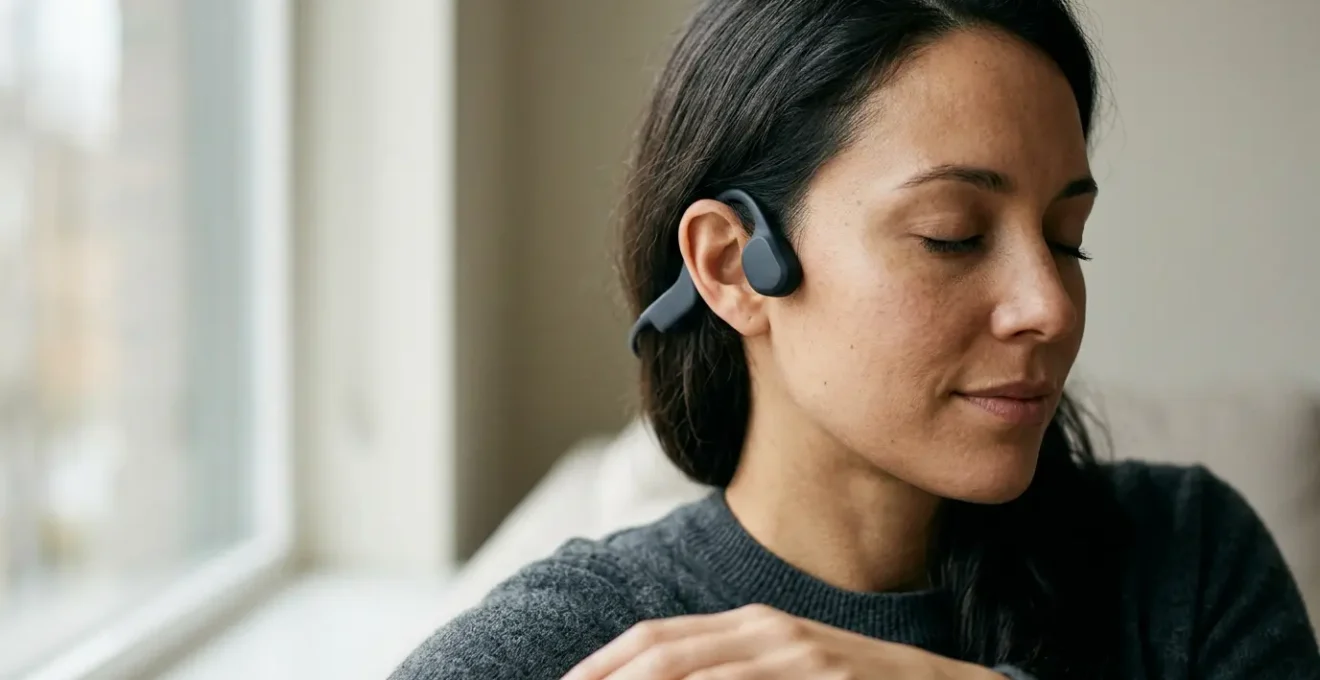
Contrary to popular belief, improving ADHD focus through listening isn’t about generic background music; it’s a targeted neurological intervention that actively rewires the brain’s attention systems.
- This process relies on unique delivery methods like bone conduction to create a direct neuro-sensory feedback loop that bypasses typical auditory pathways.
- It utilizes specific sound frequencies—high frequencies to energize the cortex and low frequencies to regulate the nervous system—for a comprehensive cognitive effect.
Recommendation: A structured, consistent daily practice is essential for achieving tangible neuroplastic changes and sustained improvements in attention.
For many adults with ADHD, the world can feel like a constant barrage of unfiltered noise. The struggle isn’t a lack of hearing, but an overwhelming inability to direct focus, to separate a single voice from a cacophony, or to maintain a train of thought amidst internal and external distractions. This persistent sensory overload leads to mental fatigue and executive dysfunction. Conventional advice often revolves around silencing the environment with noise-canceling headphones or organizing tasks with endless lists. While helpful, these are coping mechanisms, not corrective therapies.
These strategies manage the symptoms but don’t address the root cause: the way the brain itself processes auditory information. The core of the attention deficit often lies in inefficient sensory gating and a hypo-aroused prefrontal cortex. What if the solution wasn’t to simply block out sound, but to strategically use it as a tool for neurological exercise? This is the fundamental premise of active listening therapy, a clinical approach that moves beyond passive hearing to actively retrain the brain’s attention networks.
This guide will explore the specific, science-backed mechanisms behind this therapeutic modality. We will delve into how non-traditional sound transmission energizes the brain, why certain types of music are more effective than others, and what a practical, evidence-based listening routine looks like. It’s time to understand not just that sound can help, but precisely how it works to reshape focus from the inside out.
To fully grasp the clinical nuances of this approach, this article details the foundational principles, the scientific evidence, and the practical application of active listening therapy. Explore the sections below to understand how sound becomes a precision tool for cognitive enhancement.
Summary: A Clinical Guide to Auditory Therapy for ADHD Focus
- Why Listening Through Bone Conduction Changes Your Brain’s Processing?
- Mozart or Gregorian: Why High Frequencies Energize the Brain?
- 10 Minutes or 1 Hour: How Long Should You Listen for Neuroplasticity?
- The « Cocktail Party » Problem: Training Your Ear to Isolate Voices
- Problem & Solution: Correcting Posture to Improve Sound Reception
- Problem & Solution: Trusting Low-End Decisions When Mixing on Headphones
- Active or Passive: The 15-Minute Daily Routine for Golden Ears
- Theta or Delta: Which Binaural Beat Frequency Aids Deep Sleep?
Why Listening Through Bone Conduction Changes Your Brain’s Processing?
Active listening therapy’s efficacy is not just about the sounds used, but fundamentally about how sound is delivered to the brain. Traditional listening through air conduction (sound waves traveling through the ear canal) is an indirect path. Bone conduction, however, transmits sound vibrations directly through the bones of the skull to the inner ear, creating a profoundly different neurological experience. This method bypasses the eardrum and middle ear, providing a purer, more immediate signal for the brain to process. It is this directness that forms the basis of a powerful auditory feedback loop.
When a person speaks or reads aloud while using a bone conduction headset, they hear their own voice in a new, enhanced way. This creates a « surprise » effect on the brain, forcing it to pay closer attention to the auditory signal it is both producing and receiving. This process actively engages the neural circuits responsible for attention and sensory processing, effectively turning the simple act of listening into a targeted brain workout. As Forbrain Technologies, a pioneer in this field, explains the mechanism:
Bone conduction transmits the sound of your own voice 10 times faster and with greater clarity than air conduction. The dynamic filter enhances specific frequencies of speech and constantly surprises the brain to increase memory, attention and sensory processing.
– Forbrain Technologies, Forbrain Bone Conduction Headphone Product Research
This isn’t passive listening; it is an active engagement that leverages the principles of neuroplasticity. By repeatedly stimulating the auditory system in this novel way, the brain is encouraged to build and strengthen the neural pathways necessary for better focus, memory, and processing speed. The bone conduction method transforms the user from a passive recipient of sound into an active participant in their own neurological training.
Mozart or Gregorian: Why High Frequencies Energize the Brain?
Not all sounds are created equal when it comes to influencing brain states. While calming music has its place, the goal of some listening therapies for ADHD is not just relaxation, but cortical energization. This is where high-frequency sounds, particularly those found in the compositions of Mozart or the harmonics of Gregorian chants, play a critical clinical role. The human ear and brain are uniquely attuned to these frequencies, which appear to have a direct, stimulating effect on the cerebral cortex—the brain’s center for higher-order thinking, attention, and executive function.
The « Mozart effect » is more than a cultural myth; it points to the neurological impact of complex, high-frequency sound structures. These sounds are rich in harmonics that challenge the auditory system and, in doing so, « charge » the brain. Think of it as a form of auditory gymnastics: the brain must work harder to process these complex sounds, and this effort increases its alertness and readiness. The energizing effect is not merely subjective; it has a measurable physiological basis. Scientific investigation has confirmed this phenomenon, often referred to as the « hypersonic effect. »

As the visualization suggests, these sound waves act as a catalyst for neural activity. In fact, research published in the Journal of Neurophysiology demonstrated that sounds containing high-frequency components above the audible range (over 22 kHz) can significantly increase alpha-EEG activity across the brain and enhance regional cerebral blood flow. This indicates a state of relaxed alertness, which is precisely the cognitive sweet spot that is often elusive for individuals with ADHD. The brain becomes both calm and active, a state conducive to sustained focus and learning.
10 Minutes or 1 Hour: How Long Should You Listen for Neuroplasticity?
A central question in any therapeutic intervention is the required « dosage » for an effect. In the context of active listening therapy, this translates to duration: how long must one engage in these protocols to induce meaningful, lasting change in the brain? The answer lies in the principle of neuroplasticity, the brain’s ability to reorganize itself by forming new neural connections. This process requires consistent, repeated stimulation over time; a single session, no matter how long, is insufficient. The key is cumulative exposure.
While a short 10-15 minute daily session is excellent for maintaining cortical tone and priming the brain for focus, achieving deep-seated neuroplastic change requires a more significant investment. Research into related fields like neurofeedback provides a valuable benchmark. For example, a 2025 meta-analysis published in Nature Scientific Reports found that neurofeedback training exceeding 1,260+ minutes (21 hours total) showed significant effects on improving executive functions in individuals with ADHD. This suggests that the brain needs a substantial volume of training to effectively rewire its default pathways.
This doesn’t mean each session must be hours long. Rather, it highlights the importance of a structured program that accumulates sufficient training time. A daily commitment of 15-20 minutes, sustained over several months, can easily reach the therapeutic threshold needed for lasting change. The goal is to make the training a consistent habit, much like physical exercise for the body.
Case Study: University of Barcelona Finds Forbrain Improves Attention
To illustrate this, a scientific case study by Professor Carles Escera at the University of Barcelona examined the impact of Forbrain’s bone conduction technology on auditory processing and attention. The study concluded that such technology could be helpful in improving focus in those with attention disorders like ADHD. The results suggested that even small, consistent improvements in attention can have cascading benefits on memory, focus, and verbal fluency, reinforcing the value of a sustained listening protocol.
Therefore, the question isn’t « 10 minutes or 1 hour? » but rather « how can I consistently integrate listening practice to reach a cumulative therapeutic total? » The focus should be on building a sustainable routine that allows for the gradual, powerful process of neuroplasticity to take effect.
The « Cocktail Party » Problem: Training Your Ear to Isolate Voices
One of the most frustrating daily challenges for adults with ADHD is the « cocktail party effect »—or rather, the failure of it. This term describes the brain’s remarkable ability to focus on a single auditory source (like a conversation) while filtering out a cacophony of background noise. For many with ADHD, this sensory gating mechanism is impaired. Every sound enters the brain with almost equal priority, creating an overwhelming and exhausting internal noise that makes it nearly impossible to follow a conversation or focus on a task.
This isn’t a hearing problem in the traditional sense. The ears work perfectly. The issue lies in the brain’s auditory processing centers. This condition, known as Auditory Processing Disorder (APD), often co-occurs with ADHD. In fact, studies estimate that around 50% of children with ADHD also meet the criteria for APD. The brain struggles to distinguish, segment, and prioritize sounds, leading to difficulties with auditory memory, following multi-step directions, and speech comprehension in noisy environments.
The subjective experience of this deficit is profound. It requires immense mental effort to perform tasks that neurotypical individuals do automatically. As the ADDA Research Team notes, this cognitive load is a signature feature of the condition.
Adults with ADHD often need more mental effort to process speech, even when their hearing is perfectly normal.
– ADDA Research Team, ADHD and Auditory Processing: Understanding the Connection
Active listening therapy directly targets this weakness. By using filtered sounds and a dynamic feedback loop, it trains the brain to improve its signal-to-noise ratio. The therapy forces the brain to practice identifying and locking onto the target auditory signal (one’s own voice or specific frequencies in music) while pushing background noise into perceptual irrelevance. It is a systematic retraining of the brain’s auditory filter, designed to make navigating the « cocktail party » of daily life less of a struggle.
Problem & Solution: Correcting Posture to Improve Sound Reception
A frequently overlooked factor in auditory processing is the physical body. The connection between posture and listening is not merely metaphorical; it is a biomechanical and neurological reality. Poor posture—such as stooping, a forward-head position, or a slumped spine—compresses the chest cavity, restricts diaphragmatic breathing, and creates tension in the neck and jaw. This physical state directly hinders optimal auditory function. The problem is that a tense, misaligned body sends continuous « noise » signals to the brain, competing for resources and making it harder to process external auditory information effectively.
The head, neck, and spine form the physical apparatus through which sound is received and transmitted, especially with bone conduction. Any misalignment can subtly distort the sound signal and compromise the efficiency of the entire auditory system. The solution, therefore, involves more than just the ears; it requires creating a state of optimal physical receptivity. Correcting posture is a foundational step in preparing the body and brain for effective listening therapy. A straight spine and relaxed neck allow the head to rest naturally, creating an open and clear channel for sound to be processed without physical interference.
Adopting an optimal listening posture is a simple yet powerful way to enhance the benefits of any auditory training. It reduces extraneous physical « static » and allows the brain to devote more of its resources to the primary task of listening and processing. The following protocol provides a concrete set of steps to establish this state of receptivity.
Action Plan: The Optimal Listening Posture Protocol
- Sit up straight without stooping or arching your back to maintain optimal spinal alignment.
- Place your feet flat on the floor to ground your body and stabilize your core.
- Allow your head to rest naturally and relaxed on the top of your spine, avoiding forward head posture.
- Remove all multimedia distractions from your vicinity while practicing with listening devices.
By consciously adopting this posture before each listening session, you create the ideal physical conditions for your brain to receive, process, and integrate auditory information with maximum efficiency and clarity.
Problem & Solution: Trusting Low-End Decisions When Mixing on Headphones
While the phrase « trusting low-end decisions » originates in the world of audio engineering, it holds a surprisingly deep clinical relevance for listening therapy and ADHD. In mixing, it refers to the difficulty of accurately perceiving and judging bass frequencies on headphones. For therapy, we can reframe the « problem » as the ADHD brain’s dysregulated state and difficulty with grounding. The « solution » lies in using low-frequency sound not just for hearing, but for interoceptive feedback and nervous system regulation.
Low-frequency sound waves have a longer wavelength and carry more physical energy, which we perceive not just with our ears, but with our whole body as vibration. This tactile sensation is a powerful form of interoceptive information—data about the internal state of our body. For a hyperactive or anxious ADHD nervous system, which is often disconnected from bodily sensations, these vibrations can provide a powerful and immediate « grounding » effect. It’s a way to anchor a scattered awareness back into the physical self.

The experience of « feeling » the bass, as depicted in the image, helps to down-regulate an overstimulated sympathetic nervous system (the « fight or flight » response) and activate the parasympathetic nervous system (the « rest and digest » response). This shift is crucial for focus. A calm, regulated nervous system is the necessary foundation upon which sustained attention can be built. You cannot focus effectively if your body is in a state of high alert.
Therefore, « trusting the low-end » in a therapeutic context means leveraging these frequencies to foster a state of calm embodiment. By incorporating specific low-frequency tones or music with a strong, clean bass element into a listening protocol, we provide the nervous system with a clear, somatic anchor. This helps to reduce physical restlessness and mental anxiety, creating the stable internal environment required for the prefrontal cortex to engage in higher-level cognitive tasks.
Key Takeaways
- Bone conduction is a foundational tool, creating a direct feedback loop that forces active brain engagement and accelerates neuroplasticity.
- The frequency of sound is a critical therapeutic variable: high frequencies are used to energize and alert the cortex, while low frequencies are used to ground and regulate the nervous system.
- Lasting change requires consistency. Short, daily sessions accumulating over time are more effective than sporadic, long sessions for building new neural pathways.
Active or Passive: The 15-Minute Daily Routine for Golden Ears
The distinction between active and passive listening is the difference between aimless background noise and a targeted therapeutic intervention. Passive listening may provide temporary distraction, but active listening is a structured cognitive workout designed to build « Golden Ears »—a term for a highly discerning and focused auditory system. For adults with ADHD, a short, consistent daily routine can prime the brain’s attention networks and yield significant cumulative benefits. A 15-minute daily practice, when structured correctly, can be profoundly effective.
The goal of such a routine is not simply to hear, but to perform specific auditory tasks that challenge and strengthen the brain’s filtering, focusing, and regulatory mechanisms. A well-designed routine acts as a complete neurological warm-up, moving through different phases to prepare the brain for the cognitive demands of the day. This involves a deliberate sequence of stimulation and regulation. The effectiveness of such music-based listening interventions is well-documented, with clinical trials of interventions like the Safe and Sound Protocol showing that up to an 84% improvement rate was observed in areas like social engagement and emotional regulation, which are foundational to attention.
The following routine is a clinical example of how different sound elements can be sequenced for maximum cognitive impact within a brief window of time. It is a blueprint for transforming passive hearing into an active, brain-building exercise.
Your 15-Minute Daily Cognitive Listening Routine
- Minutes 1-5 (Activation): Begin with high-frequency filtered music (e.g., specific Mozart violin concertos) to increase cortical alertness and activate the prefrontal cortex.
- Minutes 6-10 (Focus Training): Practice « auditory spotlight » training. While listening, consciously shift your attention between a target sound (e.g., a specific instrument) and the background, strengthening your brain’s filtering mechanisms.
- Minutes 11-15 (Regulation): Conclude with low-frequency tones or music with a simple, steady rhythm to ground the nervous system, enhance interoceptive awareness, and consolidate the session’s gains.
This short but potent routine systematically prepares the brain for focus. It begins by waking up the cortex, then trains the specific skill of attentional filtering, and finally calms the nervous system to create a stable base for the rest of the day.
Theta or Delta: Which Binaural Beat Frequency Aids Deep Sleep?
While the primary focus of this guide is on improving daytime attention, the role of sleep cannot be overstated. High-quality sleep is foundational for cognitive function, memory consolidation, and emotional regulation. For many with ADHD, achieving deep, restorative sleep is a significant challenge. Binaural beats represent a specific auditory tool that can be used to gently guide the brain toward states conducive to sleep. The core question is which frequency is most effective for this purpose.
Binaural beats work by presenting two slightly different frequencies to each ear, prompting the brain to perceive a third, « phantom » frequency equal to the difference between the two. This process, known as frequency-following response, encourages the brain to synchronize its own electrical activity (brainwaves) to the phantom frequency. Different brainwave frequencies are associated with different states of consciousness. For sleep, the most relevant are the slower frequencies, particularly Delta.

Theta waves (4-8 Hz) are associated with the initial stages of sleep, light meditation, and drowsiness. They are the gateway to sleep. However, for promoting the deep, physically restorative, slow-wave sleep that is crucial for brain health, Delta waves (0.5-4 Hz) are the primary target. This is the state where the body repairs itself and the brain clears metabolic waste. As neurodevelopmental experts like Dr. Suzanne Evans Morris have noted, targeting the correct frequency is key.
Different brainwave states are associated with different mental or emotional functions. Delta frequencies are associated with deep, slow-wave sleep. Some users report that binaural beats in the delta range help initiate sleep or improve relaxation.
– Dr. Suzanne Evans Morris, Neurosound Research on Brainwave Frequencies
Therefore, for an individual with ADHD looking to improve sleep quality as a means of boosting next-day focus, a protocol involving binaural beats in the Delta range is the most clinically sound approach. Listening to these frequencies for 15-30 minutes before bed can help calm the mind, facilitate the transition into sleep, and encourage the brain to spend more time in the deeply restorative Delta state.