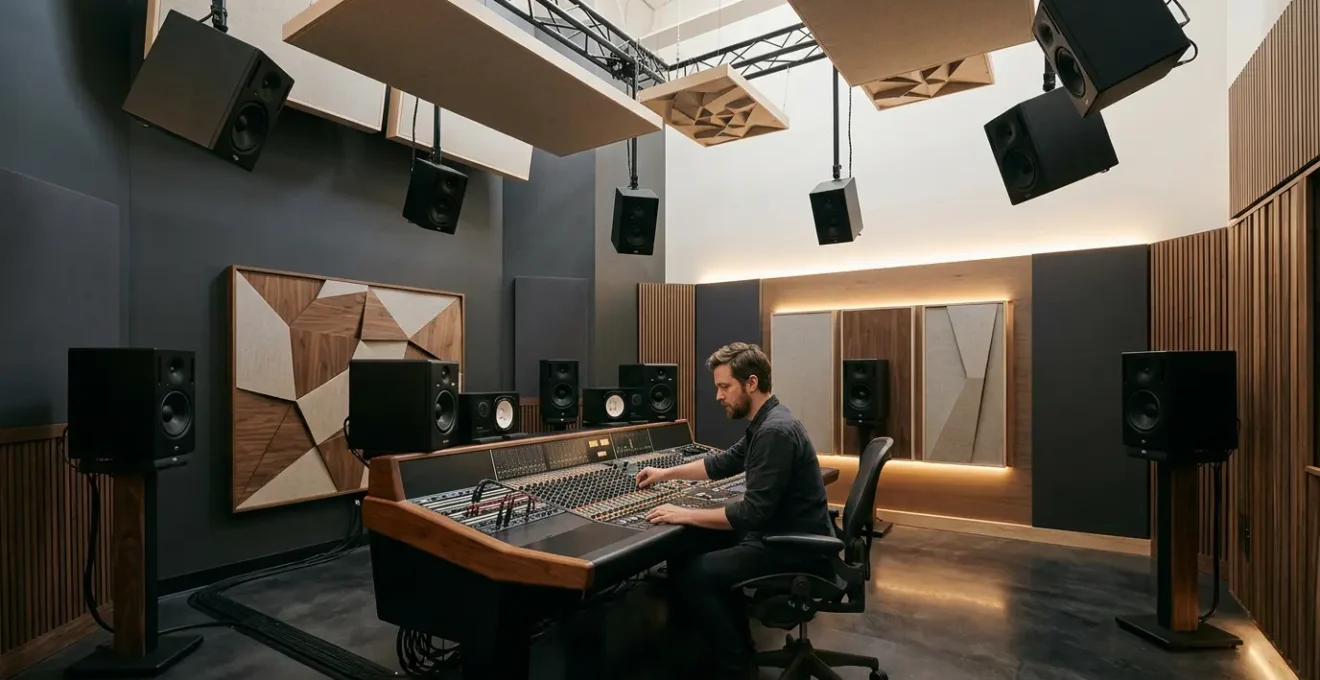
Transitioning to Dolby Atmos isn’t about adding 3D effects; it’s a fundamental paradigm shift that demands you unlearn core stereo arrangement habits and start composing with space itself.
- The primary listening environment is headphones, making binaural translation and psychoacoustic intent more critical than speaker placement.
- Effective immersive mixes rely on spatial contrast and purposeful placement—not constant movement—to create energy and avoid listener fatigue.
Recommendation: Stop treating Atmos as a final mixing stage. Instead, integrate spatial decisions into your earliest arrangement and sound design processes to unlock true immersive potential.
For decades, the art of music production has been mastered within the predictable confines of a stereo field. We, as producers and engineers, learned to create depth, width, and impact using panning, reverb, and compression on a flat canvas. Now, Dolby Atmos and other immersive formats have shattered that canvas, replacing it with a full 3D sphere of sonic potential. The initial reaction is often to treat it like « stereo-plus, » a playground for flashy panning and gimmicky fly-bys. But this approach inevitably leads to mixes that feel hollow, disorienting, or worse, less impactful than their stereo counterparts.
The truth is, your stereo habits are actively working against you in the immersive domain. The real challenge isn’t learning the software; it’s a complete rewiring of your creative decision-making. This isn’t about simply placing sounds in a room. It’s about understanding how the human brain perceives this new, complex auditory environment. It’s about moving from being a painter on a canvas to an architect designing a sonic space from the ground up.
This article will deconstruct the core decisions that change when you move from stereo to Atmos. We’re not just looking at the tools, but the fundamental paradigm shifts in thinking required to make your arrangements breathe and your drops hit with intention in a three-dimensional world.
Summary: How Dolby Atmos Changes Your Arrangement Decisions?
- Objects or Beds: When to Free a Sound from the Channel Grid?
- Headphones or Speakers: Why Your Atmos Mix Sounds Different on Apple Music?
- Gimmick or Immersion: How to Use Ceiling Speakers Tastefully?
- The Subwoofer Mistake That Muddies the Immersive Field
- Problem & Solution: dealing with Motion Sickness in VR Audio
- Problem & Solution: Trusting Low-End Decisions When Mixing on Headphones
- Why Binaural Beats Fail Without Stereo Headphones?
- Why Your Drops Lack Energy Compared to Professional Releases?
Objects or Beds: When to Free a Sound from the Channel Grid?
The first fundamental choice you face in an Atmos session is not about panning, but about an element’s very nature: will it be part of the static, channel-based « Bed, » or will it be a free-moving « Object »? This decision is the bedrock of your spatial arrangement. Beds are the traditional 7.1.2 surround channels—your foundational elements like drum overheads, ambient pads, or string sections that create the stable architecture of the mix. They are the room itself. Objects, by contrast, are untethered sound sources with their own metadata, free to be placed with pinpoint precision anywhere in the 3D space. They are the furniture and people within the room.
The common mistake for stereo producers is to put almost everything into the Bed, replicating their stereo bus structure. This instantly limits the immersive potential. A better approach is to think in terms of purpose and stability. Does this sound need to be a fixed part of the environment, providing a solid anchor for the listener? Make it part of a Bed. Does this sound have a specific, singular role, a unique character, or a narrative purpose that requires it to move or occupy a distinct point in space? Make it an Object. A lead vocal, a percussive accent, or a specific synth arpeggio are prime candidates for Objects, allowing them to cut through the mix with clarity, independent of the background architecture.
This decision goes beyond simple placement. As Matthias Stalter, CEO of ThreeDee Music, states in a Music Business Worldwide interview, “Dolby Atmos is not just a gimmick to play with, where you position and move things in space, just because you can.” The choice between an Object and a Bed is an arrangement decision. Freeing a key melodic element as an Object might mean you need less EQ to make it stand out. It’s about using space, not processing, to achieve clarity.
Headphones or Speakers: Why Your Atmos Mix Sounds Different on Apple Music?
In the stereo world, we obsess over how our mix translates from studio monitors to a car stereo or a laptop. In the Atmos world, that challenge is amplified, with the most critical translation being between a multi-speaker array and a standard pair of headphones. The reality of modern music consumption is that the vast majority of your audience will experience your meticulously crafted 7.1.4 mix through binaural rendering on platforms like Apple Music or Tidal. In fact, over 90% of Apple Music subscribers have tried Spatial Audio, showing its massive adoption on personal devices.
This is where the concept of psychoacoustic intent becomes paramount. When you mix on speakers, you are creating a physical soundfield. When your mix is rendered binaurally, the software is using complex algorithms (Head-Related Transfer Functions or HRTFs) to simulate that soundfield inside the listener’s head. The two experiences are fundamentally different. Sounds placed far away on speakers might feel claustrophobically close in headphones, and subtle height cues can be lost entirely. This is why your mix sounds different—it’s not just a different device, it’s a different delivery technology.

The arrangement solution is to mix for both realities simultaneously. Your workflow must include constant A/B testing between your speaker output and the binaural headphone render. Does the emotional impact of that wide synth pad survive the collapse into headphones? Is the lead vocal still front-and-center, or has it become buried by a poorly translated reverb? This often means making compromises, such as exaggerating certain spatial placements on speakers so that a hint of the effect survives in the binaural version, or choosing reverbs that translate more naturally to the headphone experience.
Gimmick or Immersion: How to Use Ceiling Speakers Tastefully?
The ceiling speakers are often the most exciting—and most misused—part of an Atmos setup. For producers new to the format, the temptation to have sounds constantly flying overhead is strong. This, however, is the fastest route to a gimmicky, fatiguing mix. True immersion isn’t about constant motion; it’s about creating a believable, coherent, and engaging sonic world. The height channels are not for rollercoaster effects but for adding a new dimension of realism and emotional depth.
Instead of a synth lead zipping overhead, consider using the height channels for the subtle, high-frequency components of a string section, giving it a sense of « air » and lift. Use them for the upper harmonics of a reverb return, making the virtual space feel vast and all-encompassing without cluttering the main sound field. A well-placed, static element in the height channels can be far more effective than a moving one. Think of it as adding a « sky » to your sonic landscape. This considered approach is why the format is being adopted so seriously; 93% of Billboard’s 2024 Top 100 Artists have released music in Dolby Atmos, not because it’s a gimmick, but because it offers new creative depth.
As the ThreeDee Music production team notes, “The creative possibilities of the format need to be understood, just like they had to be learned and understood when Stereo was introduced back in the day.” The key is intentionality. Ask « why » before you place a sound overhead. Is it to enhance the emotion? To create a sense of scale? Or just because you can? If it’s the latter, you’re likely on the wrong track. A tasteful mix uses the height channels to complete the sonic picture, not to distract from it.
Action Plan: Tasteful Height Channel Use
- Points of Contact: List all potential height elements: reverb tails, cymbal overheads, atmospheric pads, high-frequency synth layers, specific spot effects.
- Collecte: Inventory your current arrangement. Which sounds have a natural « upward » character (e.g., « air, » « shimmer, » « lift »)?
- Coherence: Does placing this sound overhead support the song’s emotional arc and lyrical theme, or does it feel random? A rainy soundscape works; a random vocal fly-by might not.
- Memorability/Emotion: Compare a static overhead reverb vs. a moving sound effect. Which one serves the music better? The goal is to create a sense of space, not a distraction.
- Plan of Integration: Prioritize subtle enhancements. Start by sending only the reverb of a snare to the heights before considering moving the entire snare itself.
The Subwoofer Mistake That Muddies the Immersive Field
In stereo mixing, the subwoofer is often treated as an extension of the main speakers, handling the lowest frequencies of whatever is sent to the main bus. In Dolby Atmos, the LFE (Low-Frequency Effects) channel is a discrete, dedicated channel with a specific purpose. The most common and damaging mistake is treating the LFE as a dumping ground for all your bass elements. Sending the kick, the sub-bass, and the bass guitar all directly to the LFE channel creates a muddy, undefined, and overpowering low-end that lacks punch and translation.
The correct paradigm is to think of the LFE as an « effect » channel for specific, impactful moments, or for the very lowest, felt-not-heard frequencies below ~80Hz of certain sounds. Your primary bass information from instruments like a kick drum or bass guitar should live in the main bed channels (Front Left/Right/Center) to ensure they translate properly to systems without a subwoofer, and most critically, to the binaural headphone mix. The LFE is there to enhance the low-end, not to contain it.
A brilliant example of this principle in action is found in the Dolby Atmos mix of Spoon’s album ‘Lucifer On The Sofa.’ This case study shows how discrete channel management creates clarity and power.
Case Study: Spoon’s ‘Lucifer On The Sofa’
As detailed in an analysis by Immersive Audio Album, drummer Jim Eno, who oversaw the album’s Atmos mix, demonstrates masterful LFE management. In the track « Held, » the vocals are almost completely isolated in the center speaker, creating an anchor. Meanwhile, the drums are not just in the front, but extend into the height channels. This spatial separation, combined with precise LFE management that avoids sending cluttered information to the subwoofer, results in a low-end that is both powerful and exceptionally clear. The LFE enhances the impact without muddying the immersive field.
The key arrangement takeaway is to build your low-end with sounds that have definition in the main channels first. Use the LFE channel surgically to add that final, visceral weight to moments that demand it, like the impact of a kick drum or a deep synth note in a drop, rather than as a constant stream of bass.
Problem & Solution: dealing with Motion Sickness in VR Audio
While not every Atmos mix is destined for a VR headset, the principles of avoiding auditory-induced motion sickness are universally applicable to creating comfortable, long-term listening experiences. This phenomenon, known as « vection, » occurs when your ears perceive motion that your eyes and body do not, creating a sensory mismatch that can lead to disorientation and even nausea. It’s the auditory equivalent of bad VR visuals.
The problem arises from excessive, unmotivated, and predictable movement. If every element in your mix is constantly circling the listener’s head, the brain has no stable point of reference. The listener feels sonically ungrounded, adrift in a chaotic space. This is a critical failure of spatial composition. Your arrangement decision-making must now include the concept of a « gravitational anchor. » This is a stable, consistent element or group of elements that grounds the listener in the space, providing a perceptual « down » and « front. »
Typically, the lead vocal, kick drum, and snare should remain relatively stable in the front-center of the mix. These are your anchors. By keeping these core rhythmic and melodic elements fixed, you give the listener a solid foundation. This stability then gives you the creative license to have other, more textural or effects-based elements move more freely. The contrast between the stable anchor and the moving objects is what creates a dynamic and exciting, yet comfortable, immersive experience. Without the anchor, all movement becomes meaningless and disorienting noise.
Problem & Solution: Trusting Low-End Decisions When Mixing on Headphones
Mixing low-end on headphones has always been a challenge, but the reliance on binaural monitoring for Atmos makes it an even more critical hurdle. You simply cannot « feel » sub-bass through headphones the way you can with a physical subwoofer moving air in a room. This often leads producers to either add far too much sub-bass (resulting in a muddy speaker mix) or not enough (resulting in a thin, weak mix). You cannot trust your ears alone for the frequencies below 100Hz on headphones.
So, what is the solution when headphones are the primary monitoring tool for the primary listening format? The answer lies not in a magic plugin, but in arrangement and sound design. You must ensure your bass sounds are audible on systems without subwoofers by focusing on their mid-range content. This is a classic mixing trick that becomes essential in the Atmos-for-headphones world. Your bassline needs to be identifiable by its character, harmonics, and texture, not just its fundamental frequency.
Producer Jeff Silverman provides a perfect, actionable summary of this strategy. In a feature for the Indie Collaborative, he advises:
Since you can’t trust the feel of sub-bass on headphones, the arrangement solution is to ensure your bass sounds have enough mid-range content (200-500Hz) and saturation to be clearly heard and defined.
– Jeff Silverman, Palette Music Studio Productions
This means choosing or designing bass patches with rich harmonic content, using saturation or subtle distortion to add overtones that will cut through on smaller devices, and using visual tools like spectrum analyzers to confirm the presence of low-end energy, even if you can’t fully perceive its weight on headphones.
Why Binaural Beats Fail Without Stereo Headphones?
The topic of binaural beats might seem like a strange detour in an article about mixing, but it’s a perfect illustration of a core principle of spatial audio: the absolute reliance on discrete, separated audio channels delivered to each ear. Understanding this phenomenon helps clarify why the binaural rendering of an Atmos mix works the way it does. A binaural beat is not a sound that exists in the recording; it’s a psychoacoustic illusion created inside the listener’s brain.
As research from the University of Glasgow’s Illusions Index explains, “When you listen to two slightly different frequencies, your brain creates an ‘illusionary’ beat at the difference between the two, in this case creating a psychoacoustic phenomenon.” For this to work, one frequency (e.g., 200 Hz) must be delivered exclusively to the left ear, and a slightly different frequency (e.g., 210 Hz) must be delivered exclusively to the right ear. The brain, attempting to reconcile these two signals, perceives a third, phantom « beat » at the difference—in this case, 10 Hz.
This illusion immediately fails without stereo headphones. If you play the same track through a mono speaker, or even a stereo speaker system in a room, the two frequencies mix in the air before they reach your ears. Both ears receive a blend of both tones, and the brain is no longer forced to create the illusion. This demonstrates the critical need for channel isolation. The binaural rendering of a Dolby Atmos mix works on the exact same principle. It uses complex filtering to simulate the way our head and ears naturally color sound, delivering a unique and precisely calculated signal to each ear to create the 3D illusion. Any « crosstalk » breaks that illusion, which is why it only works on stereo headphones.
Key takeaways
- Spatial mixing is an arrangement discipline first, a technical one second. Your choices about space must be intentional.
- The primary delivery target is headphones; therefore, your mix’s success hinges on its binaural translation and psychoacoustic impact.
- Clarity in an immersive mix comes from contrast and stability—grounding the listener with sonic « anchors » before introducing movement.
Why Your Drops Lack Energy Compared to Professional Releases?
In stereo, we build energy for a drop using well-established techniques: risers, filter sweeps, and, most importantly, a massive increase in loudness and density. When producers apply this same logic to Dolby Atmos, the drop often falls flat. Why? Because in a 3D space, energy is not just a function of loudness; it is a function of spatial contrast and dynamic range. A mix that is already filling the entire 360-degree soundfield has nowhere to « go » for the drop. It’s already at 100% spatial capacity.
The professional solution is to think like a filmmaker. Use the verses and build-ups to create a relatively contained, focused, or even intentionally narrow soundscape. Keep the energy primarily in the front channels, perhaps with some ambient textures in the surrounds. This creates tension and anticipation. The « drop » then becomes an explosion of space—a sudden expansion from the front-focused verse into the full immersive field. Reverbs bloom into the height channels, synths explode into the rear surrounds, and the entire sonic architecture dramatically widens. This creates a feeling of immense energy that is far more impactful than a simple volume boost.
Embracing this new creative palette isn’t just an artistic choice; it’s a strategic one. The industry is rapidly moving towards immersive audio as a new standard. The global spatial audio market is projected to expand at a CAGR of 18.7% from 2025 to 2033, showing massive consumer and industry investment. Moreover, platforms are creating direct financial incentives. As the MusicTeam distribution platform notes, « Apple’s recent decision to award up to 10% higher royalty payouts to artists whose music is available in immersive audio formats makes it clear: there’s no better time for creators to explore spatial sound. »
Ultimately, transitioning to Dolby Atmos requires you to move beyond the role of a mixer and become a true sonic architect. It’s a challenging but incredibly rewarding paradigm shift that opens up a new frontier of musical expression. By embracing space as a compositional tool from the very beginning, you can create experiences that are not only technically impressive but deeply and unforgettably immersive.