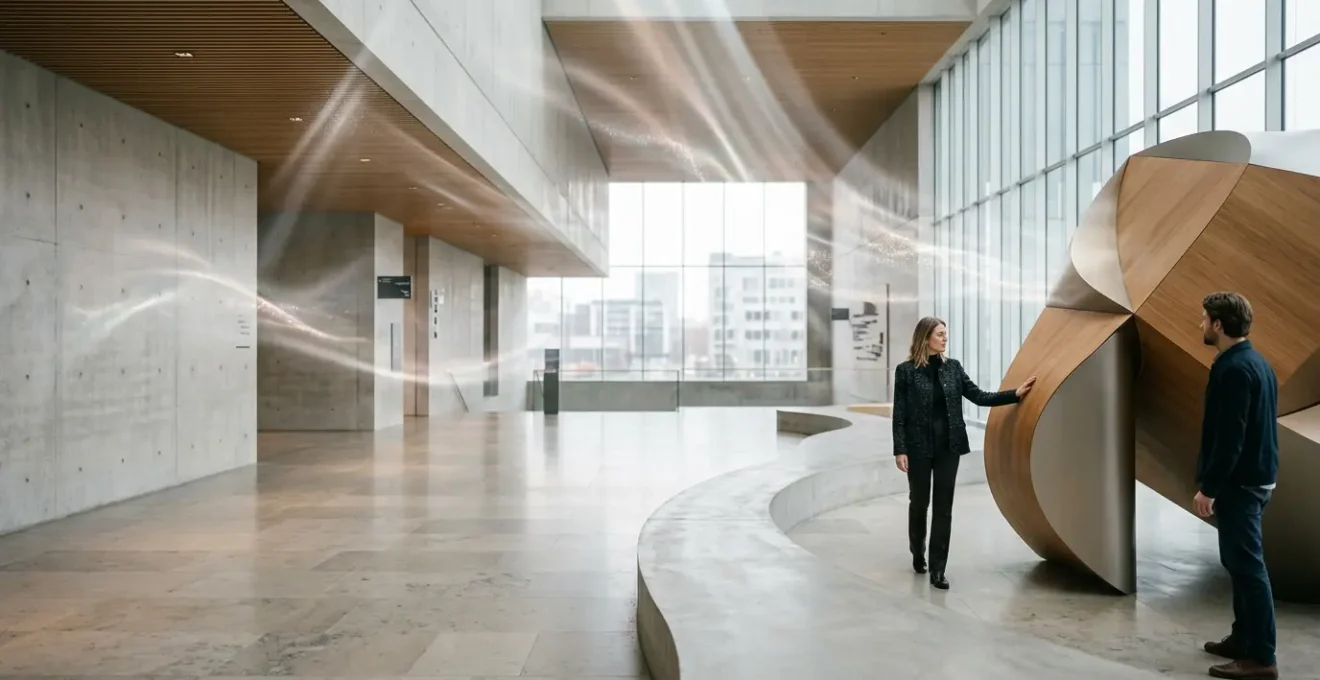
A successful public sound installation is an act of spatial choreography, not just audio playback.
- Technical decisions—like speaker visibility, looping methods, and sensor types—are deliberate architectural choices that shape visitor perception and the narrative of the space.
- Controlling sound is less about brute-force soundproofing and more about creating precise « acoustic territories » using tools like directional speakers.
Recommendation: Treat every technical choice as an integral part of the artistic and architectural story you are telling.
For many artists entering the realm of public installations, sound is often treated as an accessory to the visual—a speaker placed in a corner, a soundtrack layered over an exhibit. This approach frequently leads to two undesirable outcomes: sonic bleed that disrupts adjacent spaces and repetitive audio loops that cause « ear fatigue » for gallery staff and prolonged visitors. The conventional wisdom of « get good speakers » or « make it interactive » barely scratches the surface of the medium’s potential and its inherent architectural challenges.
But what if we reframe the objective? What if, instead of simply adding sound to a space, we begin to sculpt the space *with* sound? This shift in perspective transforms the artist from a composer into a spatial choreographer. The true craft lies not just in the audio content itself, but in the deliberate, architectural decisions that govern its delivery. The visibility of a speaker, the logic of a loop, the nature of an interactive trigger—these are not mere technical footnotes; they are fundamental components of the artwork’s materiality and its dialogue with the visitor.
This guide moves beyond the platitudes to deconstruct the critical technical and creative choices you face as a spatial sound artist. We will explore how to manage acoustic territories, design intuitive interactions, build non-fatiguing generative soundscapes, and integrate visuals in a way that creates a cohesive, immersive narrative. It’s a framework for treating sound as the powerful, space-defining medium it truly is.
To navigate these complex decisions, this article breaks down the core challenges and solutions an artist will face, from the conceptual to the highly technical. The following sections provide a roadmap for creating sonic experiences that are not only heard but felt as an integral part of the environment.
Summary: Designing Sound Installations That Transform Public Spaces
- Hidden or Sculptural: Should the Source of Sound Be Seen?
- Fade or Cut: How to Create a Infinite Loop That Doesn’t Annoy Staff?
- Motion or Touch: Which Sensor Trigger Is More Intuitive for Public?
- The « Bleed » Error That Ruins Adjacent Exhibits
- Sequencing & Planning: Guiding the Visitor Through a Sonic Story
- Flat Screen or 3D Object: Getting Started with Projection Mapping?
- The Air Gap Error That Renders Your Soundproofing Useless
- How to Create Visuals That React to Audio Frequencies in Real-Time?
Hidden or Sculptural: Should the Source of Sound Be Seen?
The first architectural decision in any sound installation is the physical presence of the sound source. Should the speakers be invisible, seamlessly integrated into the walls, or should they be presented as sculptural objects in their own right? This is not a trivial choice; it fundamentally alters the visitor’s relationship with the sound. An exposed speaker provides a clear origin point, grounding the sound in a physical object. A hidden source, however, creates a more mysterious and environmental experience.
This concept is known as acousmatic sound—sound that is heard without its cause being seen. It forces the listener to focus on the intrinsic qualities of the sound itself—its texture, timbre, and spatial movement—rather than being distracted by its physical origin. As a foundational figure in this field noted, this technique has deep historical roots. In the words of composer Pierre Schaeffer:
Acousmatic sound is sound that is heard without an originating cause being seen. The term acousmatic, from the French acousmatique, is derived from the Greek word akousmatikoi, which referred to probationary pupils of the philosopher Pythagoras who were required to sit in absolute silence while they listened to him deliver his lecture from behind a veil or screen to make them better concentrate on his teachings.
– Pierre Schaeffer (via Wikipedia), Acousmatic sound – Wikipedia
Choosing the acousmatic path can make a space feel as though it is breathing sound, transforming the architecture itself into the instrument. Conversely, designing a bespoke speaker enclosure or using an array of visible speakers turns the delivery system into a key part of the visual aesthetic. The decision depends entirely on your narrative: is the sound an environmental property of the space, or is it an emission from a specific, tangible object within it?
Fade or Cut: How to Create a Infinite Loop That Doesn’t Annoy Staff?
One of the most common complaints in museums and galleries is audio fatigue caused by short, repetitive loops. A 30-second audio track on repeat may seem acceptable for a brief encounter, but for staff who endure it for eight hours a day, it becomes a form of torture. The simple « fade-out, fade-in » loop is a hallmark of amateur sound design. The professional solution lies in moving beyond static loops and embracing generative audio.
Generative music is not about pure randomness, which can feel chaotic and lack intent. Instead, it involves creating a system of rules, patterns, and probabilities that produce a constantly evolving, non-repeating soundscape. This can be achieved through various techniques, from algorithmic composition to using environmental data to influence audio parameters. The goal is to create a sonic environment that feels alive and consistent in tone, but is never identical from one moment to the next.

As the visual above suggests, generative systems layer simple elements to create complex, ever-shifting wholes. According to Max/MSP community discussions on generative techniques, many artists build deterministic (non-random) systems using multiple short patterns of different lengths that overlap in complex, ever-changing ways. For example, a 5-second melodic phrase, a 7-second rhythmic pattern, and a 13-second textural layer will take a very long time to realign to their starting point, creating the illusion of an infinite, non-repetitive composition. This approach respects the sonic environment and the well-being of those who inhabit it for extended periods.
Motion or Touch: Which Sensor Trigger Is More Intuitive for Public?
Interactive installations live or die by the intuitiveness of their triggers. When a visitor enters the active zone, how do they engage with the work? The two most common modalities are motion and touch, and the choice between them carries significant implications for the user experience. It’s a question of designing the invitation to interact: is it a broad gesture or a specific, deliberate action?
Motion sensors (like Kinect, Orbbec, or simple PIR sensors) are excellent for creating responsive ambient environments. They can detect presence, movement, and velocity, allowing an installation to react to the general flow of visitors. This is ideal for experiences where the interaction is meant to feel effortless and almost subconscious. However, motion control can suffer from a lack of precision. As an in-depth report from Ideum on their touchless exhibit designs shows, tracking gross movement is more reliable in public spaces than trying to detect nuanced gestures, especially with multiple users. Programming for a crowd gesturing simultaneously presents significant challenges.
The imprecision of motion tracking is not just a technical hurdle; it’s a usability one. When specific actions are required, mid-air gesturing can be frustrating. For instance, research on mid-air interaction systems revealed that 50% of users experienced missing the target when it was at the edge of the screen. Touch sensors (capacitive, pressure-sensitive) or physical buttons, by contrast, offer unambiguous, one-to-one feedback. The action is clear and the result is immediate. The trade-off is that they require the visitor to physically engage with a surface, breaking the « magic » of a hands-free experience. The choice depends on your goal: do you want visitors to feel like conductors of an orchestra with broad movements, or like pilots pressing specific controls?
The « Bleed » Error That Ruins Adjacent Exhibits
In a multi-exhibit environment like a museum or gallery, sound bleed is the ultimate architectural sin. The sound from your installation spilling into a quiet, contemplative space next door can ruin both experiences. While traditional soundproofing with mass-loaded vinyl and acoustic panels is a necessary first step, it often fails to contain low frequencies and can be prohibitively expensive. The real error is thinking in terms of « soundproofing a room » instead of « controlling an acoustic territory. »
A more surgical and often more effective approach is to use directional sound technology. Parametric speakers are a prime example of this. Instead of broadcasting sound in a wide cone like a conventional speaker, they use ultrasonic waves to create a highly focused beam of sound. The audio is only audible when a person stands directly in the path of this beam.
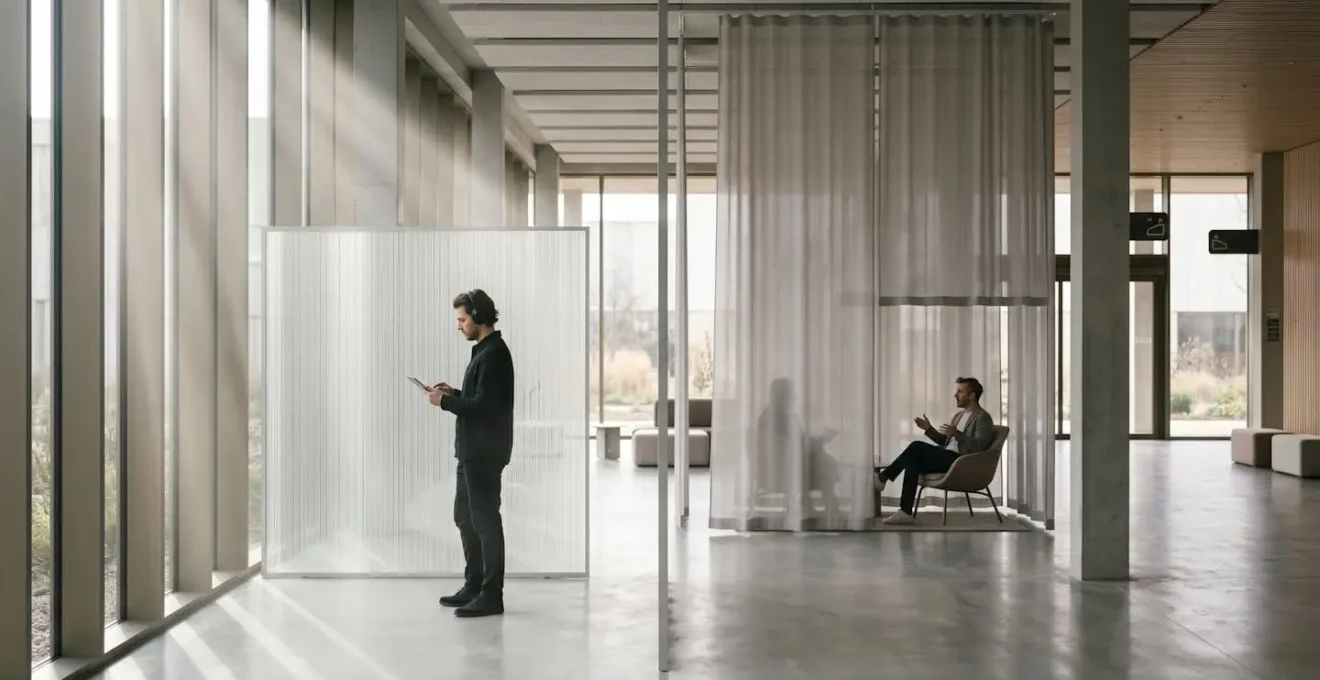
This technology allows you to create precise, isolated zones of audio without building physical walls. As the experts at Focusonics explain, this works because the audio is modulated onto high-frequency ultrasound; the sound we hear is generated as these waves demodulate in the air directly in front of the listener. A powerful case study from the Wood Museum of Springfield History demonstrates this principle in action. An exhibit utilized five Audio Spotlight directional speakers, each triggered by a motion sensor. Visitors stepped onto floor decals, entering a tight audio beam that delivered a personal listening experience, while the surrounding gallery remained quiet. This method not only solved the bleed issue but also helped enforce social distancing, proving that acoustic control is a tool for spatial management.
Sequencing & Planning: Guiding the Visitor Through a Sonic Story
A truly great sound installation is more than just an atmosphere; it’s a narrative. It has a beginning, a middle, and an end, even if that structure is non-linear. This is the art of spatial choreography: intentionally sequencing sonic events to guide a visitor’s physical and emotional journey through the space. This requires moving beyond a single, static soundscape and thinking in terms of scenes, cues, and transitions.
The sequencing can be triggered by a variety of factors: the visitor’s location, the number of people in the room, the time of day, or direct interaction. For example, the entrance to the space might feature a subtle, inviting sound that draws people in. As they move deeper, they might trigger more complex layers of audio, building to a crescendo at the heart of the exhibit. The journey out could feature decaying or resolving sounds, providing a sense of closure. This turns a passive listening experience into an active exploration, where the visitor becomes a co-creator of their own sonic narrative.
A large-scale example of this is the « Race against the Stars » experience at the Sheikh Abdullah al Salem Cultural Centre. Here, an advanced motion sensor system tracks visitors on a virtual running track, triggering synchronized audio and video that creates a complete participatory journey with a clear beginning (the start line), middle (the race), and end (the results on a leaderboard). While a complex example, the principle is universal: you are designing an experience arc. Your planning must define the key moments of this arc and the triggers that will move the visitor from one to the next.
Action Plan: Auditing Your Sonic Narrative
- Points of Contact: List every potential trigger point or zone in your installation space (e.g., entrance, specific interactive object, central area, exit).
- Collecte: Inventory all your distinct audio assets (e.g., ambient texture, melodic cue, spoken word, impactful sound effect).
- Coherence: For each trigger point, assign an audio asset. Does the transition from one sound to the next feel logical and support your core artistic concept?
- Mémorabilité/Emotion: Identify the emotional peak of your narrative. Does the corresponding sound in that zone deliver the intended impact? Is it unique or generic?
- Plan d’intégration: Map out the technical logic. If a visitor moves from Zone A to Zone B, does the sound from A fade out as B fades in? Do they overlap? Define the transition rules.
Flat Screen or 3D Object: Getting Started with Projection Mapping?
When sound and visuals converge, projection mapping offers a powerful way to break free from the traditional rectangular screen. The choice is no longer just *what* to project, but *what to project onto*. Do you use a flat surface like a wall or screen, or do you map your visuals onto a three-dimensional object, or even the architecture itself? This decision dictates whether the visual element is a window into another world or an integral part of the physical one.
Projecting onto a flat screen is technically simpler and positions the visual content as a distinct piece of media within the space. It functions like a painting or a photograph, a contained frame for your narrative. It’s an effective way to display cinematic content that requires a traditional aspect ratio.
Projection mapping onto a 3D object, however, dissolves the boundary between the media and the environment. By wrapping visuals around a sculpture, a piece of furniture, or the architectural features of a room, you imbue the physical object with a dynamic, digital skin. The object itself becomes the screen. This technique is incredibly powerful for installations where the goal is to blur the lines between the real and the virtual. As one industry analysis notes, the magic lies in synergy: « An immersive exhibit might combine touch screens that let visitors explore detailed maps, soundscapes that set the mood and provide context, and a video wall that brings the story to life with motion and scale. » The same principle applies to 3D mapping, where the soundscape can give voice to the very object that is being visually transformed.
The Air Gap Error That Renders Your Soundproofing Useless
For artists building enclosed installations or studio spaces, soundproofing is a non-negotiable architectural requirement. Many invest heavily in high-density materials like mass-loaded vinyl or multiple layers of drywall, only to find that sound still leaks through. The most common and heartbreaking cause is the failure to properly implement an air gap, a principle known in acoustics as decoupling.
Sound travels in two primary ways: through the air (airborne) and through solid structures (structure-borne). While dense materials are effective at blocking airborne sound, they do little to stop vibrations from traveling through studs, floor joists, and concrete. Decoupling aims to break this physical connection. The most common method is to build a « room within a room, » where the inner walls, floor, and ceiling do not touch the outer structure. The air gap between the two structures acts as a powerful insulator, preventing vibrations from passing through.
The « air gap error » occurs when this separation is accidentally bridged. A single screw that is too long and touches both the inner and outer wall frames, a piece of construction debris falling into the gap, or a rigid electrical conduit connecting the two structures can all create a « flanking path. » This tiny physical bridge acts like a highway for sound vibrations, completely bypassing the expensive soundproofing materials and rendering the decoupling useless. It’s the acoustic equivalent of building a fortress wall but leaving a small, unguarded door open. Achieving true sound isolation requires fanatical attention to detail, ensuring that the inner room « floats » with absolutely no rigid connection to the outer structure.
Key Takeaways
- Sound is Architectural: The decision to hide or reveal a speaker is as significant as the choice of building materials.
- Control the Territory: Use directional sound to create precise acoustic zones and avoid bleed, rather than relying solely on brute-force soundproofing.
- Design for Intuition: Choose sensors (motion vs. touch) based on the specific type of interaction your narrative requires—broad and ambient, or direct and deliberate.
- Escape the Loop: Employ generative audio techniques to create evolving, non-fatiguing soundscapes that feel alive rather than repetitive.
- Choreograph the Narrative: Plan the sequence of sonic events to guide visitors on a physical and emotional journey through the space.
How to Create Visuals That React to Audio Frequencies in Real-Time?
The pinnacle of an immersive installation is often the seamless integration of sight and sound, where one medium directly influences the other. Creating visuals that react to audio in real-time transforms a passive exhibit into a living, breathing synesthetic experience. This is not about simply playing a video alongside a soundtrack; it’s about creating a system where the very fabric of the visuals is woven from the frequencies and amplitudes of the audio.
This process typically involves three main components: an audio source, an analysis tool, and a visual generator. The audio is fed into software that performs a Fast Fourier Transform (FFT), breaking the sound down into its component frequencies (bass, mids, treble) and measuring their amplitude (volume). These data streams are then « mapped » to parameters in the visual software. For example, the bass amplitude could control the pulse of a glowing shape, mid-range frequencies could alter its color, and high frequencies could generate particle effects. The result is a direct, one-to-one visual representation of the sound’s character.
The technology to achieve this is more accessible than ever for artists. A case in point is the « Quantum Space » interactive wall, which uses sensors to trigger real-time changes in graphics and color, captivating audiences in public spaces. The same principles apply when using audio as the trigger. For artists looking to build these systems, several platforms are industry standard. According to current interactive sound art practices, the main platforms for real-time sensor-to-audio mapping include software like TouchDesigner and Max/MSP (often paired with Ableton Live), which are node-based environments perfect for routing audio data to visual parameters. For more complex 3D visuals, game engines like Unity and Unreal Engine offer powerful tools, while hardware platforms like Arduino and Raspberry Pi can be used to interface with physical sensors and lights.
Your next installation is an opportunity not just to be heard, but to fundamentally redefine a space. By embracing these architectural principles, you move beyond mere decoration and begin to practice the art of spatial choreography. Start treating sound as the structural, narrative, and immersive material it truly is.