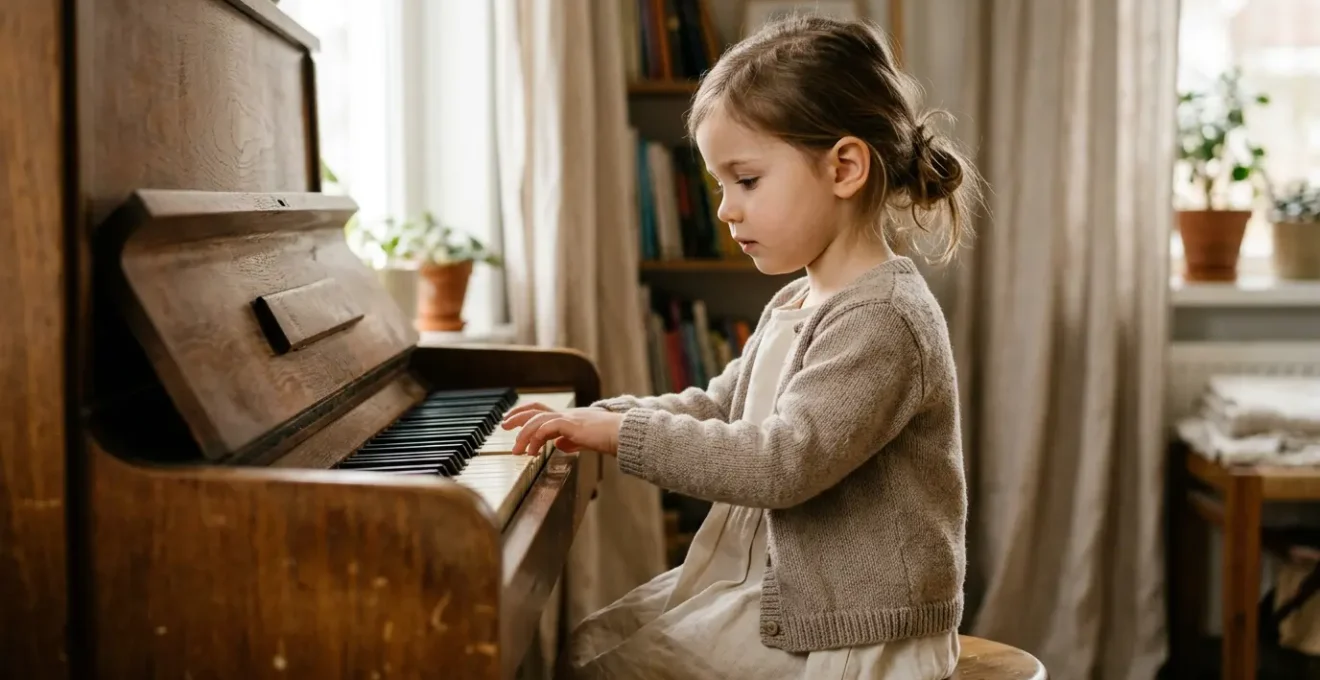
The best music education isn’t a choice between Suzuki or Traditional; it’s about building a flexible and adaptive learning ecosystem for your child.
- Formal methods are most effective when developmentally appropriate, typically after a child’s natural « music babble » stage has passed.
- Self-teaching and apps are powerful motivational tools but cannot replace a human tutor’s essential feedback on physical technique and posture.
Recommendation: Focus on creating a process-oriented environment that prioritizes emotional release and intrinsic joy over performance pressure, using a blend of methods and tools that evolve with your child.
The flyer from the local music school is on the fridge, presenting a choice that feels monumental: Should you enroll your child in the Suzuki program, known for its ear-based learning and group dynamics, or the traditional method, with its focus on reading music and individual instruction? Parents often get trapped in this binary debate, weighing pros and cons as if choosing a lifelong commitment. The common advice—to match the method to a child’s personality, suggesting Suzuki for social butterflies and traditional for analytical minds—oversimplifies a deeply nuanced developmental journey.
But what if the question itself is flawed? What if the choice isn’t a rigid, one-time decision, but the first step in architecting a supportive and adaptive learning ecosystem? The reality of modern music education is that no single method holds all the answers. The most successful musical journeys are not built on methodological purity but on a flexible blend of formal instruction, technological aids, self-directed exploration, and, most importantly, a foundation of emotional well-being. True musical fluency comes from an environment that adapts to a child, not from forcing a child to adapt to a single, unyielding system.
This article moves beyond the Suzuki-versus-Traditional stalemate. Instead, it provides a framework for parents to design a holistic music learning ecosystem. We will explore the critical timing for formal lessons, the roles of private versus group settings, the unfixable flaws that self-teaching can create, and how to strategically use modern tools like apps. Ultimately, you will learn how to cultivate a lifelong relationship with music for your child, one that prioritizes joy and emotional expression far above any single method.
Summary: Building a Resilient and Joyful Music Learning Journey for Your Child
- Why Starting Formal Lessons Before Age 5 Can Backfire?
- Private Lessons or Group Classes: Which Is Better for Shy Beginners?
- The Technique Flaw Self-Taught Pianists Develop That Takes Years to Fix
- How to Structure a Self-Taught Curriculum That Rivals Music School?
- App-Based Learning vs In-Person Tutors: What Do You Really Miss Out On?
- When to Introduce Gamified Practice Apps to Keep Teenagers Motivated?
- Why the Pentatonic Scale Is Your Safety Net in Any Jam Session?
- How to Use Music Tuition for Emotional Release Without Performance Anxiety?
Why Starting Formal Lessons Before Age 5 Can Backfire?
The pressure to give children a head start can lead parents to enroll them in formal music lessons at a very young age. However, pushing structured instruction too early can be counterproductive, potentially stifling the very creativity and love for music you hope to foster. Before the age of five, a child’s brain is primarily in a phase of sensory exploration and play-based learning. As music educator Lili M. Levinowitz notes, this is the crucial « ’music babble’ stage, » a period of primary music development where exposure and joyful experimentation are far more important than formal technique.

Imposing the cognitive load of reading notation, mastering posture, and following a rigid curriculum on a pre-schooler can create frustration and negative associations with music. The goal at this stage should be to build a rich auditory foundation through singing, movement, and exploring sounds with simple percussion instruments. This playful discovery aligns with their natural developmental process. Furthermore, research indicates that intuitive aptitude for music stabilizes around age 9, suggesting that the years prior are for building a foundation of love and intuition, not for premature mastery. Rushing this process risks burnout before a child’s aptitude has even fully formed.
Private Lessons or Group Classes: Which Is Better for Shy Beginners?
Choosing between private and group lessons is a classic dilemma, especially for parents of shy or introverted children. The conventional wisdom might suggest one-on-one instruction to provide a safe, focused environment. While private lessons offer personalized attention and a space free from peer judgment, they can sometimes reinforce a child’s isolation. A well-run group class, conversely, can provide a powerful source of motivation and normalization. As the Music Institute of Chicago points out, it is often a combination that works best, where children in private lessons also « participate in regular group classes… at which they learn from and are motivated by each other. » Seeing peers make mistakes and progress can be incredibly validating for a shy beginner.
For a shy child, the quality and approach of the instructor are far more important than the format itself. A great teacher can create a psychologically safe group environment where participation is encouraged but never forced, and mistakes are framed as a natural part of learning. The key is to find an instructor who is skilled in managing group dynamics to protect and engage quieter students. Parents should proactively vet potential teachers to understand their specific strategies for creating this inclusive atmosphere. By asking the right questions, you can determine if a teacher’s philosophy aligns with your child’s needs, turning a potential source of anxiety into a community of support.
Your Vetting Checklist: Questions for a Shy Student’s Teacher
- How do you ensure quieter students get opportunities to participate without feeling pressured or spotlighted?
- What is your approach for students who are afraid to make mistakes in front of others?
- Can you describe how you balance individual attention within a group setting?
- Do you offer hybrid formats where shy students can build confidence privately before joining group activities?
- How do you create a psychologically safe environment where mistakes are normalized as part of learning?
The Technique Flaw Self-Taught Pianists Develop That Takes Years to Fix
The allure of self-teaching is strong, promising progress at one’s own pace without the cost of a tutor. While dedication can lead to impressive results, self-taught musicians, particularly pianists, are at high risk of developing a critical and insidious flaw: improper physical technique rooted in tension. Without the real-time feedback of an experienced teacher, learners often compensate for weak fingers by using the wrong muscles, leading to habits that become deeply ingrained muscle memory. As one piano educator analysis bluntly states, « Self-taught pianists will have very flat fingers. They will not use their wrist, they will not use their arm weight, they will be very tense. »
This isn’t just an aesthetic issue; it’s a physical barrier to advancement. Poor technique limits speed, control, and tonal quality, and can even lead to repetitive strain injuries. The most common issues include a flat-fingered playing style, a rigid wrist, and excessive tension in the forearms and shoulders—problems a beginner cannot self-diagnose because they feel « normal. » Fixing these fossilized habits often requires a painful and lengthy process of « unlearning, » which can take more time and effort than learning correctly from the start.
Case Study: The Hidden Cost of Ingrained Tension
A study on the frustrations of self-taught pianists identified tension buildup in the forearms as a pervasive and hard-to-diagnose issue. Learners who develop these habits through shape-based memorization (learning finger positions without understanding the theory) find themselves unable to transpose music, improvise, or intelligently correct their own mistakes. The lack of immediate physical correction from a tutor allows these technical flaws to become so embedded that they create a hard ceiling on the pianist’s potential, making fluid, expressive playing nearly impossible without extensive remedial work.
This highlights the non-negotiable role of a human instructor in the learning ecosystem: to serve as an external pair of eyes and ears, correcting posture and hand position before damaging habits take root.
How to Structure a Self-Taught Curriculum That Rivals Music School?
While a human tutor is irreplaceable for technique, a significant portion of musical development can and should be self-directed. A successful self-taught curriculum is not a haphazard journey through online tutorials; it requires a deliberate structure that balances different areas of musicianship. By adopting a framework that mirrors the comprehensive approach of a formal music school, a self-learner can build a robust and well-rounded skill set. The key is to move beyond simply learning songs and to treat music as a language with its own grammar, vocabulary, and literature.
A proven method for this is the Four Pillars Framework, which ensures no critical area is neglected. This balanced approach prevents the common pitfall of learning to mimic songs without truly understanding them. By dedicating specific time to each pillar, you create a holistic practice routine that fosters both technical proficiency and deep musical comprehension. This structure turns practice from a repetitive chore into a multi-faceted exploration of the art form.
- Pillar 1 – Technique: This is the physical foundation. Establish daily warm-up routines with scales, finger exercises, and posture drills. The goal is to build muscle memory, increase dexterity, and prevent tension-related injuries that can derail progress.
- Pillar 2 – Theory: This is the « why » behind the music. Dedicate at least 20% of your practice time to understanding key signatures, chord progressions, and harmonic analysis. This knowledge transforms you from a music-reproducer into a music-understander.
- Pillar 3 – Repertoire: This is your performance portfolio and motivational engine. Select pieces you genuinely love across a range of difficulty levels. This ensures you stay inspired while consistently challenging yourself and building a diverse collection of music you can play.
- Pillar 4 – Creation: This develops your unique musical voice. Schedule regular time for improvisation and composition experiments. This practice prevents rote memorization and encourages you to apply your theory and technique in a creative, personal way.
App-Based Learning vs In-Person Tutors: What Do You Really Miss Out On?
The rise of music learning apps has democratized the first steps of music education, offering an accessible and affordable entry point for millions. It’s no surprise that market research reveals that 74% of parents find these apps more cost-effective than traditional lessons. With their gamified interfaces, instant feedback on note accuracy, and 24/7 availability, they represent a powerful component of a modern learning ecosystem. However, relying on them exclusively means missing out on the most critical element of musical instruction: nuanced, human-led feedback.
An app can tell you if you played a wrong note, but it cannot see the tension in your shoulders, the improper curve of your fingers, or the subtle hesitation that signals a lack of confidence. A human tutor provides feedback not just on the audible output, but on the entire physical and emotional process of making music. They teach musicality—phrasing, tone quality, and emotional expression—concepts that algorithms cannot yet quantify or convey. This table breaks down the essential differences between these two learning modes.
| Dimension | App-Based Learning | In-Person Tutor |
|---|---|---|
| Feedback Quality | Automated, algorithm-based corrections with no context awareness | Real-time, personalized observation of body language, frustration, and progress |
| Technical Correction | Limited to audio/video analysis; cannot detect tension in shoulders or wrist | Immediate correction of posture, hand position, and tension before habits form |
| Musicality Development | Focuses on note accuracy and rhythm precision | Teaches tone quality, phrasing, rubato, and emotional interpretation |
| Motivation Source | Gamification, points, streaks, and leaderboards (extrinsic) | Relationship-based encouragement, mentor guidance, and intrinsic growth (intrinsic) |
| Cost Accessibility | One-time or low monthly subscription ($10-30/month) | $50-150 per hour depending on expertise and location |
| Flexibility | 24/7 access, learn at own pace | Fixed schedule, requires coordination |
The ideal learning ecosystem uses both. Apps are excellent for reinforcing theory, practicing sight-reading, and maintaining motivation between lessons. But they are a supplement to, not a replacement for, the mentorship and personalized guidance of an in-person tutor.
When to Introduce Gamified Practice Apps to Keep Teenagers Motivated?
The teenage years are a critical period for music education, often marked by waning motivation as academic and social pressures mount. This is precisely where gamified practice apps can be a powerful strategic tool within the learning ecosystem. With their use of points, leaderboards, and progress streaks, these apps tap into extrinsic motivators that can reignite a teenager’s engagement with their instrument. In fact, a study on preservice music teachers demonstrated statistically significant differences in both performance and motivation when gamified resources were used.
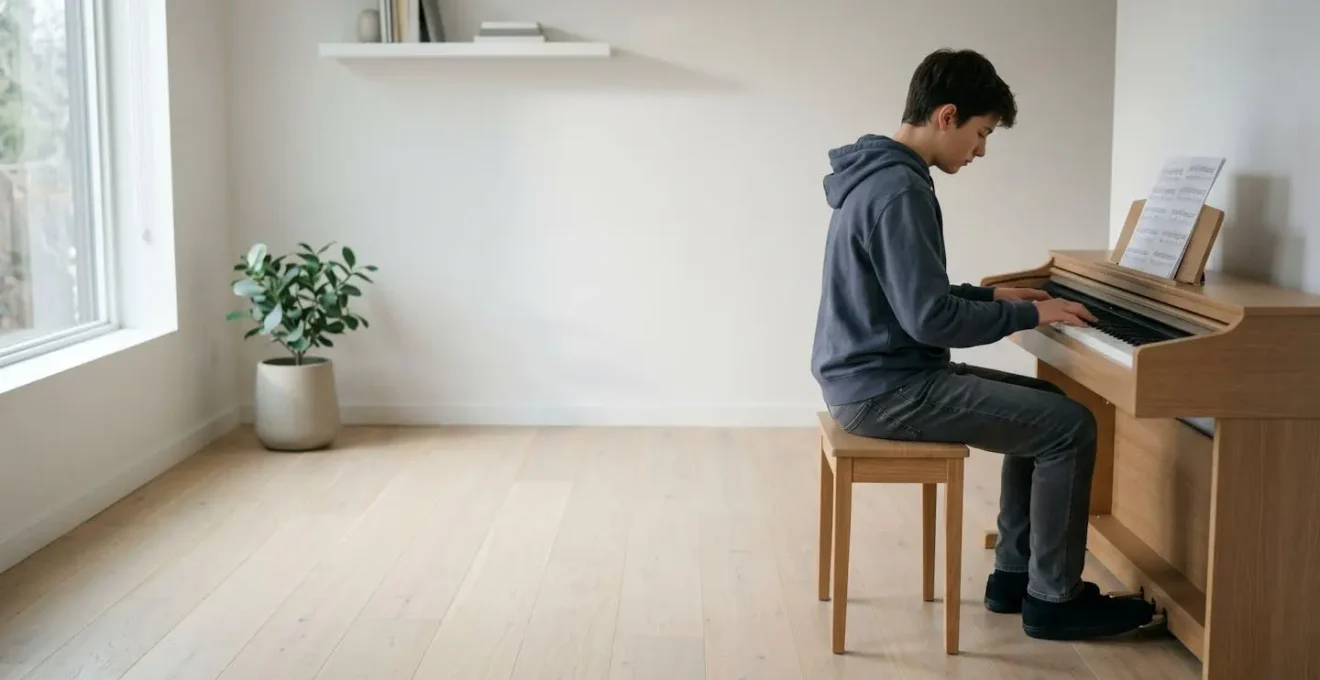
However, the timing and purpose of their introduction are crucial. Throwing an app at a beginner can distract from the foundational work of building good technique and intrinsic love for music. Gamification works best when introduced *after* a solid foundation in guiding children toward holistic development is laid. At this point, it serves not as the primary teaching tool, but as a « motivational layer » to make repetitive practice, like drilling scales or sight-reading exercises, more engaging. As one research team noted, the « ideal approach depends on the goal: musical elements for focused practice, gamification for added fun and motivation. »
The best time to introduce these apps is when a teen’s progress begins to plateau, or their enthusiasm wanes. Frame it as a new tool to support their practice, not as a replacement for their teacher. The goal is to supplement the intrinsic motivation (the joy of playing, the connection with a mentor) with a dose of extrinsic fun (beating a high score, completing a level). Used this way, gamified apps become a valuable ally in keeping a teenager on their musical journey through a challenging developmental stage.
Why the Pentatonic Scale Is Your Safety Net in Any Jam Session?
For many budding musicians, the idea of improvising or joining a jam session is terrifying. The fear of « playing a wrong note » can be paralyzing, stifling creativity before it even has a chance to emerge. This is where the pentatonic scale becomes more than just a music theory concept—it becomes a psychological safety net. Composed of five notes per octave (penta-tonic), this scale is unique because it strategically omits the two most dissonant-sounding notes of the standard major scale (the 4th and 7th degrees).
What does this mean in practice? It means that no matter which two notes of the pentatonic scale you play together or in sequence, they will almost always sound harmonious and pleasing. There are no « clash » notes to worry about. This simple but profound characteristic makes it the ultimate tool for beginners in improvisation. When someone is playing a chord progression in a common key (like C major or G major), a musician can use the corresponding pentatonic scale (C major pentatonic or G major pentatonic) and be confident that nearly any note they choose will fit. It removes the cognitive load of avoiding « wrong » notes and allows the player to focus on rhythm, phrasing, and pure expression.
Mastering the shape and sound of the pentatonic scale on an instrument is like being given a set of « magic » notes that always work. It builds immense confidence and serves as a gateway to more complex improvisation. For a student struggling with performance anxiety, learning to jam with this scale can be a liberating experience, shifting the focus from accuracy to a joyful, low-stakes conversation with other musicians. It’s the musical equivalent of a painter being given a palette of colors that are guaranteed not to clash.
Key Takeaways
- Prioritize developmental appropriateness: Encourage play-based musical exploration before age 5 and introduce formal lessons when a child is cognitively ready.
- A human tutor is non-negotiable for technique: Rely on an experienced teacher to instill correct posture and physical habits that apps cannot monitor or fix.
- Build a balanced learning ecosystem: Use apps, self-study, and group activities as powerful supplements to, not replacements for, core private instruction.
How to Use Music Tuition for Emotional Release Without Performance Anxiety?
The ultimate goal of a well-designed music learning ecosystem is not to produce a virtuosic performer, but to give a child a lifelong tool for emotional expression and regulation. The pressure of recitals, exams, and competitions can often overshadow this fundamental purpose, creating performance anxiety that taints the entire experience. To truly use music as a therapeutic outlet, the focus must shift from a product-oriented mindset (the perfect performance) to a process-oriented one (the act of learning and creating). As Columbia Professor Lori A. Custodero explains, exposure to music is crucial because it « guides children in regulating emotions and fostering empathy. »
This begins with clear communication. Parents and students should explicitly state to their instructor that the primary goal is to use music for stress relief and personal enjoyment, not necessarily for public performance. This simple reframing can transform the lesson space from a training ground into a sanctuary. It allows the teacher to adapt their curriculum, prioritizing activities like improvisation, composing simple melodies to express feelings, or learning beloved songs by ear, rather than drilling a piece for a recital. The lesson becomes a dedicated time for non-verbal emotional journaling through sound.
A powerful technique is to create a « mood-based » repertoire. Instead of organizing music by composer or difficulty, the student can build a personal songbook with sections like « Calm, » « Energy, » « Melancholy, » or « Joy. » When feeling a particular emotion, they can turn to that section and play a piece that matches and helps them process that feeling. This practice directly connects the act of playing music with emotional self-awareness and regulation, fulfilling music’s most profound potential as a companion for life. As a leading music institution suggests, the social and emotional benefits are just as important as the technical ones.
Start today by assessing not just your child’s personality, but their developmental stage, and begin architecting a musical ecosystem that prioritizes joy, creativity, and emotional health, ensuring music remains a positive force throughout their life.
Frequently Asked Questions About Music for Well-Being
What is the difference between ’therapeutic music’ and ’music therapy’?
Therapeutic music refers to any musical activity that promotes well-being and stress relief, such as playing an instrument for relaxation. Music Therapy, however, is a clinical profession practiced by board-certified therapists who use evidence-based techniques to address specific health goals. While music lessons can be therapeutic, they are not a substitute for professional Music Therapy.
Can I use music lessons purely for emotional release without performing?
Absolutely. Communicate clearly with your teacher: ’My primary goal is to use our time to explore music as a stress-relief tool, not to prepare for a recital.’ This reframes the teacher-student dynamic from performance-focused to process-focused, allowing lessons to become a safe space for emotional expression through improvisation and exploration.
How can I organize my repertoire by emotional need?
Create a ’mood-based’ songbook organized by emotions (Calm, Energy, Melancholy, Joy) rather than by difficulty or genre. This allows you to pick up your instrument and immediately find a piece that matches and helps process your current emotional state, turning your practice into a form of non-verbal emotional journaling.