Many students leave expensive masterclasses feeling inspired but empty-handed. The problem isn’t the artist; it’s the lack of a strategic framework for learning.
- Prioritize process-focused questions that uncover an artist’s thinking, not just their technical specifications.
- Focus on integrating one core concept deeply post-session, rather than attempting to apply everything at once and suffering from overwhelm.
Recommendation: Adopt the mindset of an ‘educational strategist’ to turn passive observation into active, long-term skill acquisition.
You’ve paid the fee, booked the day, and are finally in the room—virtual or physical—with your idol. The masterclass begins. Yet, hours later, you leave with a signed photo and a vague sense of inspiration, but with no concrete, actionable advice that will tangibly improve your craft. This feeling of a missed opportunity is a common and costly frustration for dedicated students. The problem is not a lack of passion, but a lack of strategy. You are not just there to be entertained; you are there to extract educational value.
The standard advice— »do your research, » « prepare questions, » « take notes »—is well-intentioned but fundamentally incomplete. It treats the student as a passive receptacle for information. This approach fails to address the core challenge: how to actively deconstruct an artist’s expertise and translate it into a personal system for growth. It ignores the cognitive processes of retention, the strategic value of the artist’s extended network, and the psychological hurdles of performance anxiety that can block learning.
What if the key to unlocking a masterclass wasn’t just in what the artist says, but in how you prepare to receive, process, and integrate that knowledge? This guide reframes your role from a passive attendee to an active educational strategist. We will move beyond the platitudes to provide a framework for systematic preparation, in-session engagement, and post-session application. This is not about getting an artist’s autograph; it’s about systematically decoding their genius.
This comprehensive guide will walk you through the essential strategies to transform your masterclass experience. We will explore how to formulate questions that yield real answers, optimize your note-taking for retention, navigate the professional ecosystem, and apply new knowledge without overwhelm, ensuring you get the maximum return on your educational investment.
Summary: A Strategic Guide to Maximizing Masterclass Value
- Generic or Specific: How to Ask a Question That Gets a Real Answer?
- Recording or Writing: Which Helps You Retain Complex Concepts?
- The « Starstruck » Mistake: Ignoring the Producer Sitting Next to You
- One Concept Rule: How to Apply Masterclass Tips Without Overwhelm?
- Problem & Solution: Staying Engaged in a Zoom Masterclass
- App-Based Learning vs In-Person Tutors: What Do You Really Miss Out On?
- Peer Feedback or Teacher Critique: Which Is More Valuable in a Workshop?
- How to Use Music Tuition for Emotional Release Without Performance Anxiety?
Generic or Specific: How to Ask a Question That Gets a Real Answer?
The single most common failure in a masterclass is the poorly framed question. Queries like « What’s your favorite synthesizer? » or « How did you write that song? » are ‘product’ questions. They elicit factual, often trivial, answers. To unlock real value, you must shift to ‘process’ questions that uncover the artist’s mental models and decision-making frameworks. These are the questions that force an artist to reflect on their own journey, offering you a roadmap rather than a single destination.
Instead of asking about the ‘what’, focus on the ‘how’ and ‘why’ during moments of struggle. For example, a weak question is: « What plugin did you use on that vocal? » A strong, process-focused alternative is: « On that track, when the vocal felt like it wasn’t cutting through the mix, what was your mental checklist for troubleshooting before you even reached for a specific plugin? » This type of inquiry reveals workflow, philosophy, and problem-solving skills—the truly transferable knowledge.
Another powerful technique is the « Vulnerability Hook. » By briefly sharing a specific struggle you face (« I always struggle with making my acoustic drums sound powerful without losing their natural feel… »), you create a point of empathy and invite the artist into a mentoring role. You are no longer an anonymous face in the crowd but a peer on a similar path. Research on observational learning in masterclasses confirms that facilitated, structured reflection significantly enhances learning outcomes, yet few students are trained to do it. Adopting a strategic questioning framework is the first step toward becoming an active, rather than passive, learner.
Recording or Writing: Which Helps You Retain Complex Concepts?
In the heat of a masterclass, the temptation is to hit ‘record’ on your phone and passively absorb the session, assuming you’ll review it later. This is a cognitive trap. While a recording provides a perfect transcript of the event, the act of listening back to hours of audio is rarely completed. More importantly, it bypasses the neurological processes that embed learning. The debate between recording and writing is not about fidelity, but about cognitive engagement.
The physical act of handwriting forces your brain to process information in a way that typing or recording cannot. Because you can’t write as fast as someone speaks, you are compelled to summarize, synthesize, and identify the most important concepts in real-time. This act of selective processing is the first step toward long-term retention. In fact, research in Frontiers in Psychology found that the unique motor skills involved in handwriting enhance memory formation. While the exact numbers vary, studies consistently show a significant retention advantage for handwritten notes, with some indicating that it helps you retain 25-60% more information than typing.
This is not to say that recording has no place. The optimal solution is a hybrid approach. This « Hybrid Note-Taking System » combines the best of both worlds for a richer learning experience.

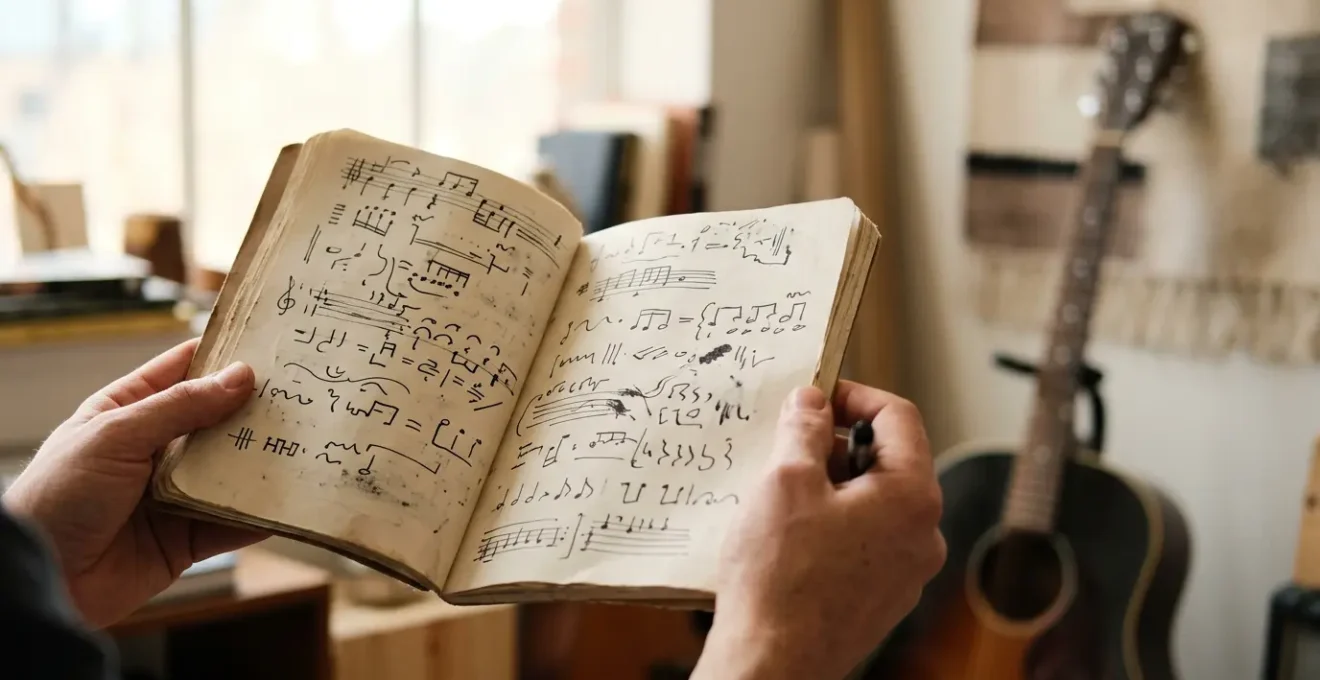
As shown in this visual, the method involves actively taking handwritten notes—focusing on mind-mapping concepts, drawing connections, and capturing key principles—while a discrete audio recording runs in the background. You can even add timestamps to your notes (e.g., « 42:15 – amazing point about sidechain compression ») to quickly locate the exact audio segment later. This transforms the recording from a passive crutch into an active reference tool, used to clarify specific points within a structure you have already mentally organized through writing.
The « Starstruck » Mistake: Ignoring the Producer Sitting Next to You
A masterclass is often presented as a singular event focused on one celebrity artist. This perception creates the « starstruck » mistake: students fixate solely on the main attraction, ignoring the wealth of knowledge present in the entire room. The artist does not exist in a vacuum. They are the public-facing component of a complex professional ecosystem that includes producers, managers, sound engineers, session musicians, and publicists. Often, these key figures are present at the masterclass, sitting quietly to the side, and they hold the keys to industry-level insights that the artist may not even be able to articulate.
The producer sitting in the third row may have a more practical understanding of how to get a specific drum sound than the artist who just plays the part. The tour manager in the back knows the logistics and financial realities of life on the road. These individuals possess a different, and often more applicable, form of wisdom. Your mission as an educational strategist is to map this ecosystem *before* you even enter the room. Research the artist’s recent collaborators. Who produced their last album? Who is their mixing engineer? Who is their manager?
Prepare « Informed Compliment » openers for these secondary targets. Instead of a generic greeting, try something like, « I was so impressed by the clarity you achieved on the B-side of the last record; I’m curious what artists consistently misunderstand about the production process. » This demonstrates genuine research and positions you as a serious professional. This strategy transforms a one-dimensional event into a multi-dimensional networking opportunity, providing access to a wider range of perspectives and career-altering connections.
One Concept Rule: How to Apply Masterclass Tips Without Overwhelm?
You leave the masterclass with a notebook full of incredible ideas and a head buzzing with inspiration. You rush to your studio, determined to apply everything at once. A week later, you’ve made a mess of your projects, feel completely overwhelmed, and revert to your old habits. This is a classic case of ‘implementation failure’. The solution is a disciplined, counter-intuitive approach: the One Concept Rule. Instead of trying to drink from the firehose, you select a single, impactful concept and commit to exploring it exclusively for a set period.
This method is grounded in educational psychology. Research on effective feedback, notably by John Hattie, emphasizes the importance of « feed-forward »—strategies for future improvement—over simple « feed-back » on past performance. A study of collegiate instrumental teachers found that a staggering 83% of teacher comments focused on reflective feed-back, with only 16% providing feed-forward strategies. The One Concept Rule is a personal feed-forward strategy. It forces you to move from passive learning to deliberate application, creating a documented feedback loop for a single skill before adding more complexity.
By quarantining one idea, you give it the space to be fully understood, tested, and integrated into your workflow. This deep, focused practice yields far superior long-term results than the scattered, superficial application of multiple techniques simultaneously. It transforms a list of tips into a permanent expansion of your skillset.
Your Action Plan: Auditing a Masterclass Concept for Integration
- Point of Contact: Immediately after the session, identify and write down the single, most impactful concept from the masterclass. Be specific.
- Collection: For the next seven days, apply only this concept in your practice. Document every attempt, noting both successes and failures in a dedicated feedback log.
- Coherence: At the mid-point, compare the concept’s application against your personal artistic goals and existing workflow. Does it align, enhance, or conflict with your core style?
- Memorability & Emotion: Assess the ‘why’ behind the concept. Articulate in your log the core principle or mental model, not just the surface-level technique. What problem does it fundamentally solve?
- Integration Plan: At the end of the week, review your log. Based on the documented evidence, create a plan to either fully integrate, adapt for your use, or consciously discard the concept before moving on.
Problem & Solution: Staying Engaged in a Zoom Masterclass
The rise of online learning has made masterclasses more accessible than ever, but it has also introduced a unique set of challenges. « Zoom fatigue » is real, and the passive nature of watching a screen from home can easily lead to distraction and disengagement. The solution is not to simply endure it, but to proactively redesign your environment and your mindset to foster active participation. You cannot control the presenter, but you can control your own learning space.
First, treat a virtual masterclass with the same seriousness as an in-person event. This means creating a dedicated, sacred space for learning. Do not attend from your couch with the TV on in the background. Move to a desk, close all other tabs and applications, and put your phone in another room. This physical ritual signals to your brain that it is time to focus. Second, engage your body. Stand up, stretch, or even have your instrument in your hands to try things out in real-time (with your microphone muted, of course). This kinesthetic engagement keeps your mind alert.
While online learning can feel isolating, it also presents unique opportunities for interaction if the platform allows. Contrary to the belief that online is less engaging, some studies suggest the opposite can be true when structured correctly. For example, a 2024 Harvard Business Review study noted that in certain online educational settings, 77% of educators report increased student interaction, often because features like chat boxes or Q&A modules provide a lower-pressure way for introverted students to participate. Use these tools strategically. Prepare your process-focused questions in advance and have them ready to paste into the chat at the right moment.

Ultimately, engagement is a choice. By curating a focused environment, as seen in the image above, and leveraging the unique tools of the digital platform, you can overcome the inherent passivity of virtual events. You transform your personal space into a high-performance learning cockpit, ensuring that distance does not diminish the educational value of the experience.
App-Based Learning vs In-Person Tutors: What Do You Really Miss Out On?
In today’s learning landscape, the masterclass is just one of many options. With the global e-learning market projected to reach $400 billion by 2026, it’s crucial to understand where a high-cost, high-intensity event like a masterclass fits in. App-based learning offers incredible cost-efficiency and structured paths, while in-person tutors provide personalized, technique-focused feedback. So what does a masterclass offer that these other modalities don’t? The answer lies in two key factors: industry context and serendipity.
An app can teach you scales, and a tutor can correct your hand position, but neither can easily replicate the experience of hearing a world-class artist explain *why* they chose a specific phrasing in the context of a commercially released record. A masterclass provides direct, market-validated insights. The feedback is not just technically correct; it’s professionally relevant. You’re not just learning music; you’re learning how music succeeds in the real world.
Furthermore, masterclasses are a breeding ground for what can be called the « Serendipity Factor »—unplanned moments of learning that can be transformative. This might be an offhand comment from the artist, a question from another student that unlocks a new perspective, or a chance conversation with a producer during a break. These moments are, by their nature, unstructured and unpredictable, and they represent a form of learning that algorithm-driven apps and scheduled tutor sessions cannot provide.
The following table provides a clear comparison of these learning modalities, highlighting the unique value proposition of a masterclass.
| Learning Modality | Feedback Type | Industry Context | Serendipity Factor | Cost Efficiency |
|---|---|---|---|---|
| App-Based Learning | Generic, algorithm-driven | No real-world validation | Minimal (structured paths) | High (50-80% less cost) |
| In-Person Tutors | Personalized, technique-focused | Limited industry exposure | Low (scheduled sessions) | Low (premium pricing) |
| Masterclasses | Contextual, market-validated | Direct industry insights | Maximum (unplanned learning) | Medium (selective access) |
Peer Feedback or Teacher Critique: Which Is More Valuable in a Workshop?
Within a masterclass or workshop setting, feedback comes from two primary sources: the authoritative critique from the master teacher and the collaborative input from your peers. Students often instinctively place a higher value on the teacher’s words, but this overlooks the distinct and complementary benefits of peer assessment. The question is not which is more valuable, but rather, how to strategically leverage both for comprehensive growth.
Teacher critique is essential for developing specific, technical skills. The master teacher provides a top-down, expert perspective, aligning instruction with established learning goals and correcting foundational errors with precision. This is the source of authoritative, often-unassailable guidance on technique, interpretation, and performance practice. However, this feedback can sometimes be purely reflective, focusing on what was just played rather than on strategies for future improvement.
Peer feedback, on the other hand, operates on a different axis. It fosters collaboration, enhances interpretive skills, and builds a crucial sense of community. When you give feedback to a peer, you are forced to articulate your own aesthetic and analytical frameworks, sharpening your own critical listening skills in the process. As noted by researchers in Research Studies in Music Education, the dynamic is complementary. The study highlights that « Peer assessment enhances collaboration and interpretive skills… while teacher-directed assessment supports specific musical skill development. »
The most astute students understand this symbiosis. They treat the teacher’s critique as a foundational directive and peer feedback as a collaborative laboratory. They actively solicit input from their fellow attendees, asking questions like, « What did you feel during that passage? » or « Did my dynamics communicate the intention I described? » This dual approach creates a richer, more holistic learning experience, blending authoritative direction with communal exploration and validating both as essential components of artistic development.
Key Takeaways
- Shift from « product » questions (e.g., « What gear do you use? ») to « process » questions (« How do you think through a problem? ») to uncover an artist’s mental models.
- Implement the « One Concept Rule » by selecting a single tip and dedicating a week to its deliberate practice and integration, thus avoiding overwhelm and ensuring deep learning.
- Map the artist’s entire professional ecosystem before the event; the most valuable and applicable industry insights may come from their producer, engineer, or manager.
How to Use Music Tuition for Emotional Release Without Performance Anxiety?
The ultimate goal of mastering the strategies in this guide is not just to become a better technician, but to free yourself to connect with the emotional core of music. Many students enter a high-stakes masterclass burdened by performance anxiety, their minds consumed by the fear of judgment. This anxiety hijacks cognitive resources, making it nearly impossible to learn effectively or perform expressively. The antidote is to shift your focus from performance to process, using the tuition environment as a laboratory for growth rather than a stage for validation.
This shift is a function of ‘metacognition’—the awareness and understanding of one’s own thought processes. When you have a robust strategy for extracting value (asking process-focused questions, mapping the ecosystem, implementing the one-concept rule), you are no longer desperately trying to « get your money’s worth » in the moment. You have a system. This confidence in your learning process reduces the pressure to perform perfectly and liberates mental energy to focus on the music itself.
This approach transforms tuition from a source of anxiety into a tool for emotional release. You can take risks, make mistakes, and explore the emotional landscape of a piece, knowing that your structured feedback loop will turn those « mistakes » into valuable data for improvement. The focus is no longer on proving your worth, but on improving your craft.
Case Study: Metacognition and Self-Regulation
This principle is supported by compelling research. A study published in the National Center for Biotechnology Information involving 84 preservice music teachers demonstrated that training in how to process musical feedback effectively improved both metacognitive abilities and self-regulation. The research found that a structured feedback environment helps learners adjust their own learning strategies in real-time. This enhanced metacognitive regulation—planning, monitoring, and adjusting one’s own learning—was directly correlated with a reduction in anxiety, as the students’ focus shifted from a fear of failure to an intellectual engagement with their own growth process.
Now, equipped with a comprehensive strategy, your next step is to consciously apply this framework to your next learning opportunity, transforming it from a performance into a profound educational experience.