
Contrary to classical training, mastering improvisation isn’t about avoiding mistakes, but fundamentally changing your relationship with them.
- Focus on listening as an active form of reaction, not just waiting for your turn to play a pre-planned phrase.
- Treat scales and patterns as a ‘safety net’ for conversation, not a rigid script you must perfectly execute.
Recommendation: Start with a four-note limitation exercise. This forces you to prioritize expression, rhythm, and dynamics over the ‘correct’ notes, which is the true heart of improvisation.
The stage is set, the groove is locked in, and the guitarist nods at you. It’s your turn to take a solo. For many musicians, especially those with a classical or highly structured background, this moment triggers a cold sweat. The fear isn’t about a lack of technical skill; it’s the terror of the unknown, the crippling anxiety of hitting a “wrong” note. Your training has ingrained in you a quest for perfection, where every note on the page is sacred. But in a jam session, there is no page. This fear of mistakes can be so paralyzing that it keeps you from experiencing one of the most rewarding aspects of musicianship: spontaneous creation.
Most advice you’ll find is frustratingly simple: “learn your scales” or “just feel it.” While scales are essential, treating them as a set of rules only reinforces the “right note/wrong note” prison. And “feeling it” is impossible when your mind is screaming at you to avoid errors at all costs. But what if the entire premise is flawed? What if the key to unlocking your improvisational voice isn’t about adding more knowledge or playing faster, but about systematically dismantling this fear of imperfection? The true path to freedom isn’t about never making a mistake; it’s about reframing the goal from a flawless performance to an honest musical conversation.
This guide is designed to be your coach, leading you away from the rigid mindset of the practice room and into the fluid, interactive world of jamming. We will explore how to build a foundation of confidence, transform your listening from passive to active, and learn why silence and connection are often more powerful than a flurry of notes. We’ll give you the tools not just to play, but to speak through your instrument.
To help you navigate this journey from rigid player to confident improviser, we’ve structured this guide to build your skills step-by-step. Here’s a look at the concepts we’ll explore to get you jamming freely and fearlessly.
Summary: A Practical Guide to Fearless Musical Improvisation
- Why the Pentatonic Scale Is Your Safety Net in Any Jam Session?
- How to Break Out of « Box Shapes » and Phrasing Ruts in 3 Steps?
- Active Listening or Noodling: Which Builds Better Solos Faster?
- The « Too Many Notes » Mistake That Ruins 90% of Beginner Solos
- When to Leave Space: The Art of Silence in a Busy Mix
- Bringing a Finished Demo or a Loose Riff: Which Yields Better Collaboration?
- Why Eye Contact Is More Important Than Your Pedalboard During Jams?
- How to Break Through the Intermediate Plateau and Achieve Instrumental Mastery?
Why the Pentatonic Scale Is Your Safety Net in Any Jam Session?
For the musician trained to see complexity and harmonic tension as the pinnacle of expression, the pentatonic scale can seem almost insultingly simple. Five notes. That’s it. But this simplicity is not a limitation; it’s your greatest strength and the ultimate safety net. The reason the pentatonic scale is so universally effective is that it has no dissonant half-step intervals. It essentially removes the « wrong » notes from the equation, allowing you to play any of the five notes in any order over a corresponding chord and have it sound consonant. This isn’t a crutch; it’s a foundational vocabulary, so ingrained in human music that a study found that 84% of vocal exchanges between mothers and infants reflected pentatonic tones. It’s the language of lullabies and folk songs for a reason: it’s inherently pleasing and communicative.
Instead of viewing it as a beginner’s tool to be outgrown, think of the pentatonic scale as your home base. It’s a familiar space where you can’t get lost, allowing your brain to switch focus from « What note is next? » to « How do I want to say this? » You can focus on rhythm, dynamics, and phrasing—the real soul of improvisation. It’s your license to experiment without the fear of a train wreck. Start here. Live here for a while. Learn its shape and sound so well that you don’t have to think about it. Only when a tool becomes an unconscious extension of yourself can you use it with true creative freedom. The pentatonic scale is the first and most important step in that process.
How to Break Out of « Box Shapes » and Phrasing Ruts in 3 Steps?
Once you’re comfortable within your pentatonic safety net, a new trap emerges: the « box shape. » You’ve learned one or two positions on your instrument and now your solos are stuck in a three-fret radius. Your fingers move, but your music is going nowhere. This is the most common rut for intermediate improvisers. Breaking free isn’t about learning more scales; it’s about seeing the fretboard or keyboard not as a series of vertical boxes, but as a single, horizontal canvas. You need to connect the dots and create fluid pathways across the entire instrument.
This is where you can take a lesson from masters. A great example of this is seen in the playing of guitarists like Joe Bonamassa and Eric Johnson. They are renowned for their fluid, seamless runs up and down the neck. Their secret isn’t just speed; it’s their method for connecting all five pentatonic shapes horizontally, often across just two or three strings. This « horizontal thinking » allows phrases to flow and breathe, breaking the predictable, up-and-down pattern of single-position playing. It transforms the instrument from a collection of isolated zones into one unified territory.
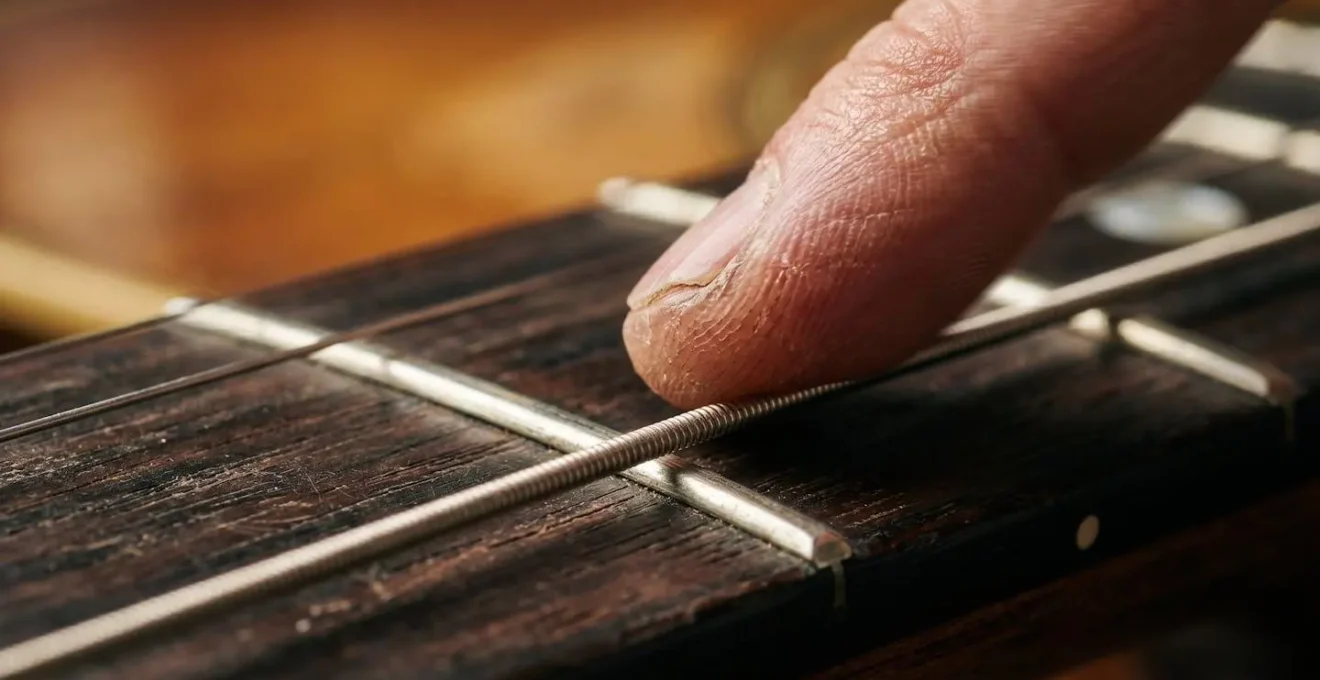
You can begin this journey in three steps. First, learn the five pentatonic shapes across the neck. Second, instead of practicing them vertically, practice them horizontally on just two strings (like the G and B strings on a guitar). Finally, focus on the « in-between » notes, using slides and legato to connect one box shape to the next. This simple shift in perspective from vertical playing to horizontal phrasing is the key to unlocking the entire neck and making your solos sound dynamic and intentional, not trapped.
Active Listening or Noodling: Which Builds Better Solos Faster?
When the spotlight isn’t on you, what do you do? Many aspiring improvisers fall into the trap of « noodling »—playing quiet, aimless notes while waiting for their turn. It feels productive, like you’re « warming up, » but it’s the exact opposite of what you should be doing. Noodling is a monologue; great improvisation is a dialogue. The single most important skill you can develop is active listening. This means dedicating 100% of your attention to what the other musicians are playing: the drummer’s rhythmic accents, the bassist’s harmonic choices, the singer’s phrasing. Your solo doesn’t begin when you play your first note; it begins with how you respond to the notes that came before.
Think of it as a real conversation. If you spend your time planning your next sentence while someone else is talking, you’re not truly listening, and your response will likely feel disconnected. The same is true in music. The best solos feel inevitable because they are a direct, meaningful reaction to the musical environment. Did the drummer just hit a powerful crash? Acknowledge it with a strong, accented phrase. Did the bass player lay down a funky, syncopated line? Latch onto that rhythm. This call-and-response is the essence of jamming.
This isn’t just a philosophical idea; it’s backed by science. A 2024 study on collective free improvisation found that the most successful ensembles were those where musicians strategically adapted their listening behavior to what was happening in the moment. This « joint auditory attention » was directly correlated with what the researchers termed « perceived musical togetherness. » In simpler terms: the bands that listened to each other better, sounded better together. So, put your instrument down, close your eyes if you have to, and just listen. The band is giving you all the ideas you need.
The « Too Many Notes » Mistake That Ruins 90% of Beginner Solos
In the mind of a nervous improviser, silence is failure. This anxiety creates a desperate urge to fill every available space with sound, leading to the most common beginner mistake: playing far too many notes. This « note spray » is often a symptom of performance anxiety. It’s a frantic attempt to prove technical proficiency, a subconscious fear that if you stop playing, everyone will realize you don’t know what you’re doing. This is a particularly acute problem for classically trained musicians, as research shows that up to 70% of orchestral musicians report music performance anxiety. The pressure to be « perfect » and « impressive » directly fuels the « too-many-notes » syndrome.
The cure is radically counter-intuitive: impose severe limitations. Instead of trying to use everything you know, try to use almost nothing. The goal is to shift your focus from the *what* (notes) to the *how* (phrasing). A single note held with beautiful vibrato and perfect timing is infinitely more expressive than a dozen notes played aimlessly. It’s about learning to make every note count. You need to fall in love with the expressive power of bends, slides, dynamics, and rhythmic variation. These are the tools that give your notes character and emotion.
A powerful way to develop this skill is through a limitation exercise. By forcing yourself to work within a tiny melodic framework, you discover the universe of expression available through articulation alone. It’s the fastest way to break the habit of mindless noodling and start crafting truly musical statements. This exercise builds confidence by proving that you can create compelling music with very little, dismantling the fear that you don’t know « enough. »
Your Action Plan: The Four-Note Phrasing Challenge
- Select Your Palette: Choose only four fretted notes from a single scale position. This severe limitation is designed to remove note choice from the equation entirely.
- Explore Articulation: Your task is now to apply techniques like hammer-ons, pull-offs, bends, slides, and vibrato exclusively to those four notes. Discover how many different sounds you can make without adding new pitches.
- Focus on Rhythm and Dynamics: Play those four notes with different rhythms. Start on different beats. Vary your note lengths from short and punchy to long and sustained. Swell the volume up and down. You’re not just playing notes; you’re shaping them.
- Embrace Silence: Consciously leave space between your four-note phrases. Think of this silence not as an empty gap, but as punctuation. Let your ideas breathe and allow the listener (and yourself) to process them.
- Record and Listen Back: Record yourself doing this exercise over a backing track. When you listen back, don’t judge the « correctness » of the notes. Instead, ask: « Which phrases had the most feeling? Which rhythms felt the best? » This shifts your goal from perfection to expression.
When to Leave Space: The Art of Silence in a Busy Mix
As you gain confidence, you’ll learn a profound lesson: the most powerful notes are often the ones you don’t play. In a musical conversation, constantly talking over everyone else isn’t just rude; it’s ineffective. Your voice gets lost in the noise. Silence, or « space, » is the element that gives your phrases definition, impact, and emotional weight. It’s the punctuation in your musical sentences. A flurry of notes can be exciting, but it’s the pause right after that makes the audience hold its breath. It creates tension, anticipation, and release—the very building blocks of compelling music.
This concept was famously articulated by the composer Claude Debussy, who is often quoted as saying:
Music is the space between the notes.
– Claude Debussy
For a recovering perfectionist, this is a revolutionary idea. Your goal is no longer to fill every second with sound but to contribute thoughtfully to the overall texture. Leaving space allows you to listen more effectively to what the rest of the band is doing. It gives the bass player room to play a melodic fill. It lets the drummer’s ghost notes on the snare come through. It makes the entire band sound better, not just you. Intentional silence is a sign of a mature, confident musician who understands that their role is to serve the song, not just their own ego.
Practically, this means thinking in terms of phrases, not continuous streams of notes. Play a short melodic idea, then stop. Listen. Let the band react. Then, play another phrase that responds to that reaction. This transforms your solo from a frantic monologue into a relaxed, engaging dialogue. It’s the difference between a nervous speaker who won’t let anyone get a word in and a charismatic conversationalist who makes everyone in the room feel heard.
Bringing a Finished Demo or a Loose Riff: Which Yields Better Collaboration?
The spirit of improvisation extends beyond the solo and into the very act of creation. When you enter a collaborative space like a rehearsal room or a songwriting session, the same principles apply. Do you arrive with a fully-realized, polished demo, complete with programmed drums, basslines, and every harmony meticulously arranged? Or do you come in with a single, compelling riff—a loose idea with plenty of room for interpretation? For a musician trained to deliver a finished product, the first option seems more professional. In reality, it often stifles collaboration before it can even begin.
Bringing a finished demo is like giving a speech and then asking for questions. You’ve already defined the entire conversation. The other musicians are relegated to the role of session players, tasked with replicating your vision rather than contributing their own. It creates a dynamic where any suggestion for change can feel like a criticism of your work. It sets up a barrier, positioning you as the « author » and them as the « editors. » This can work for a solo project, but it kills the collaborative magic of a band.
On the other hand, bringing in a loose riff or a simple chord progression is an open invitation. It’s the start of a conversation, not the end of one. It says, « Here is an idea I’m excited about. What do you hear? How does this make you want to play? » It leaves space—that crucial, creative element—for the drummer to find a unique groove, for the bassist to discover a counter-melody, and for the vocalist to shape a melody. It respects the other musicians as creative equals and allows the song to become something greater than the sum of its parts, something that no single member could have conceived on their own.
Why Eye Contact Is More Important Than Your Pedalboard During Jams?
As you get comfortable with the musical conversation, it’s time to recognize that it’s not just an auditory one. A jam session is a live, human event, and some of the most critical communication is non-verbal. In the heat of the moment, you might be tempted to stare down at your fretboard, or, if you’re a guitarist, at your array of colorful stompboxes. Your pedalboard is a comfort zone—a predictable, controllable interface. But the real magic is happening at eye level.
Eye contact is the unspoken language of the ensemble. It’s how the band leader cues the end of a section with a simple nod. It’s how the drummer and bassist lock in their groove with a shared glance. It’s how you signal to the keyboard player that you’re about to build the energy or, conversely, bring it down. As a soloist, making eye contact with your bandmates keeps you connected to the collective energy. It pulls you out of your own head and into the shared moment. This non-verbal communication is a real-time sync mechanism that allows a group of musicians to function as a single, cohesive organism.

The same study on collective improvisation that highlighted active listening also emphasized the role of visual cues. Researchers found that eye contact and body language were essential for musicians to « coordinate timing, dynamics, and energy shifts instantaneously. » It’s the primary way ensembles cue transitions and build tension without a single word. Staring at your gear severs this vital connection. It isolates you. So, lift your head. Look around. See who is driving the rhythm. Catch the eye of the person you’re trading phrases with. The most expressive sounds you can make are a response to another human being, not a preset on a pedal.
Key Takeaways
- Improvisation is a skill of conversation and connection, not just technical execution. The primary goal is to shift from a « perfection » mindset to a « communication » mindset.
- Tools like the pentatonic scale and limitation exercises are not crutches but powerful frameworks for building confidence and focusing on expressive phrasing over note quantity.
- Active listening and non-verbal cues like eye contact are often more crucial for successful ensemble playing than individual technical ability.
How to Break Through the Intermediate Plateau and Achieve Instrumental Mastery?
Ultimately, developing improvisation skills is the single most effective way to break through the « intermediate plateau » that traps so many dedicated musicians. This is the stage where you can play difficult pieces perfectly from a score, but feel creatively stunted when asked to play something « of your own. » You’ve mastered the ‘what’ (the notes) and the ‘how’ (the technique), but the ‘why’ (the personal expression) remains elusive. Improvisation forces you to integrate all your knowledge—theory, technique, and ear training—and apply it in real-time, forging new neural pathways.
This process of spontaneous creation is more than just a musical skill; it’s a profound cognitive workout. As researcher Michele Biasutti notes in a study on the applications of improvisation in music education:
Improvisation activates several cognitive processes and enhances the coordination of complex abilities. Several pieces of research highlight that introducing improvisation at the very beginning of musical education would be highly advantageous for students.
– Michele Biasutti, Teaching Improvisation through Processes – Applications in Music Education
By embracing improvisation, you’re not just learning to jam; you’re re-wiring your brain to be a more holistic and adaptable musician. You stop being a mere executor of other people’s ideas and start becoming a creator in your own right. This is the path to true instrumental mastery. It’s a journey that replaces the fear of mistakes with the joy of discovery, transforming your relationship with your instrument and, ultimately, with music itself.
The journey from a rigid, score-bound player to a free-flowing improviser is a rewarding one. By focusing on conversation, embracing limitations, and prioritizing connection, you can dismantle the fear that holds you back. Start today by picking up your instrument and having a simple, four-note conversation.