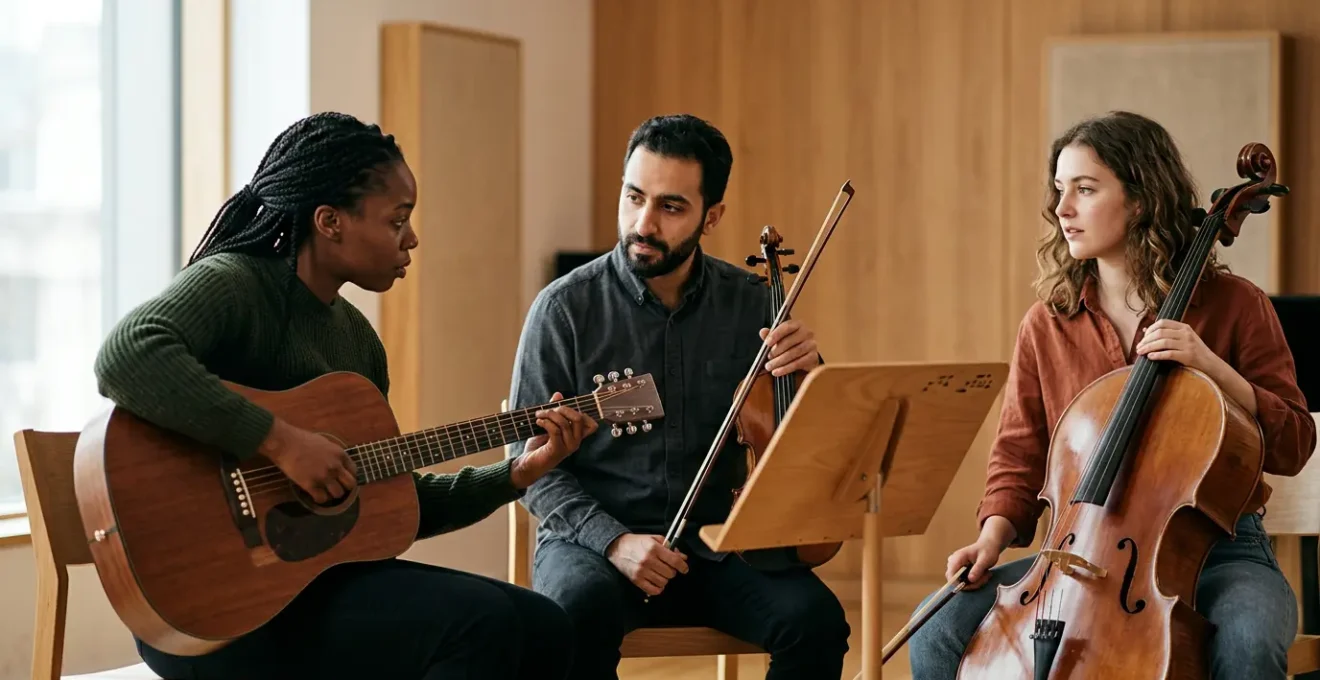
Contrary to the belief that solitary practice is the only way to get serious, the fastest musical growth happens within a structured group.
- Group learning is a neurological hack; it uses « mirror neurons » to hardwire new techniques by observing others, something solo practice cannot replicate.
- Workshops provide a « safe-fail » environment that systematically desensitizes you to stage fright by reframing mistakes as shared learning moments.
Recommendation: For the introverted musician feeling stuck, the key isn’t more isolation. It’s finding the right community workshop to transform your skills and confidence from the inside out.
For many musicians, especially those of us who are more introverted, the path to mastery seems to be a solitary one. We picture ourselves locked away, dedicating countless hours to our instrument, chasing that mythical 10,000-hour rule. The comfort of practicing alone, free from judgment, is a powerful allure. We can make mistakes, experiment, and repeat a single passage a hundred times without anyone watching. This isolation feels like focus. It feels like serious work. But what if this sacred solitude is actually slowing you down?
The common wisdom praises private lessons for their personalized feedback and solo practice for its deep focus. Yet, many musicians hit a plateau they can’t seem to break through alone. They develop technical skill but lack performance confidence. They can play complex pieces in their room but freeze up when asked to play for others. This isn’t a personal failing; it’s a methodological one. The belief that community is just a « fun extra » misses the point entirely. The truth is, group workshops are not a distraction from serious practice—they are a scientific accelerator for it.
This article pulls back the curtain on the « workshop effect. » We’ll move beyond the generic idea that groups are « motivating » and dive into the cognitive and psychological mechanisms that make them so powerful. We’ll explore how observing your peers rewires your brain for faster learning, how a supportive group provides the perfect environment to cure stage fright, and why the casual connections you make in a workshop are more valuable for your future career than you could ever imagine. It’s time to reframe the workshop not as a stage, but as a laboratory for accelerated growth.
To understand how these environments create such profound change, we will explore the science of learning, the psychology of performance, and the practical strategies that turn a group of individuals into a powerful learning collective. This guide will show you exactly why stepping out of your practice room and into a workshop is the most strategic move you can make.
Summary: The Science and Strategy of Group Music Learning
- Watching or Doing: How Mirror Neurons Help You Learn Licks Faster?
- How a « Safe Fail » Environment Cures Stage Fright?
- Peer Feedback or Teacher Critique: Which Is More Valuable in a Workshop?
- The « Just Here to Play » Mistake That Costs You Future Gigs
- Sequencing & Planning: The Rules of Etiquette for Group Improvisation
- Private Lessons or Group Classes: Which Is Better for Shy Beginners?
- Sequencing & Planning: How Fan Bases Coordinate Streaming Parties
- How to Prepare for a Masterclass to Get the Most Out of the Artist?
Watching or Doing: How Mirror Neurons Help You Learn Licks Faster?
Have you ever watched a skilled guitarist play a complex lick and felt your own fingers twitch, almost unconsciously mimicking the movement? That’s not your imagination; it’s a powerful learning system in your brain at work. This phenomenon is driven by mirror neurons, specialized brain cells that fire both when you perform an action and when you observe someone else performing that same action. In a group workshop, this system is supercharged, turning passive observation into active learning.
Instead of just hearing a concept explained or reading it in a book, you see it demonstrated live by multiple people, including the instructor and your peers. Each time you watch someone else’s hands navigate a chord change or execute a bowing technique, your brain is creating a mental map of that action. This observational learning is incredibly efficient. According to a profound insight from A. Nuara in *Music and Mirror Neuron System*, « Musicians, while listening to music, activate the same brain motor areas they could have recruited during active musical performance. » You are, in essence, practicing in your mind just by being an attentive observer.
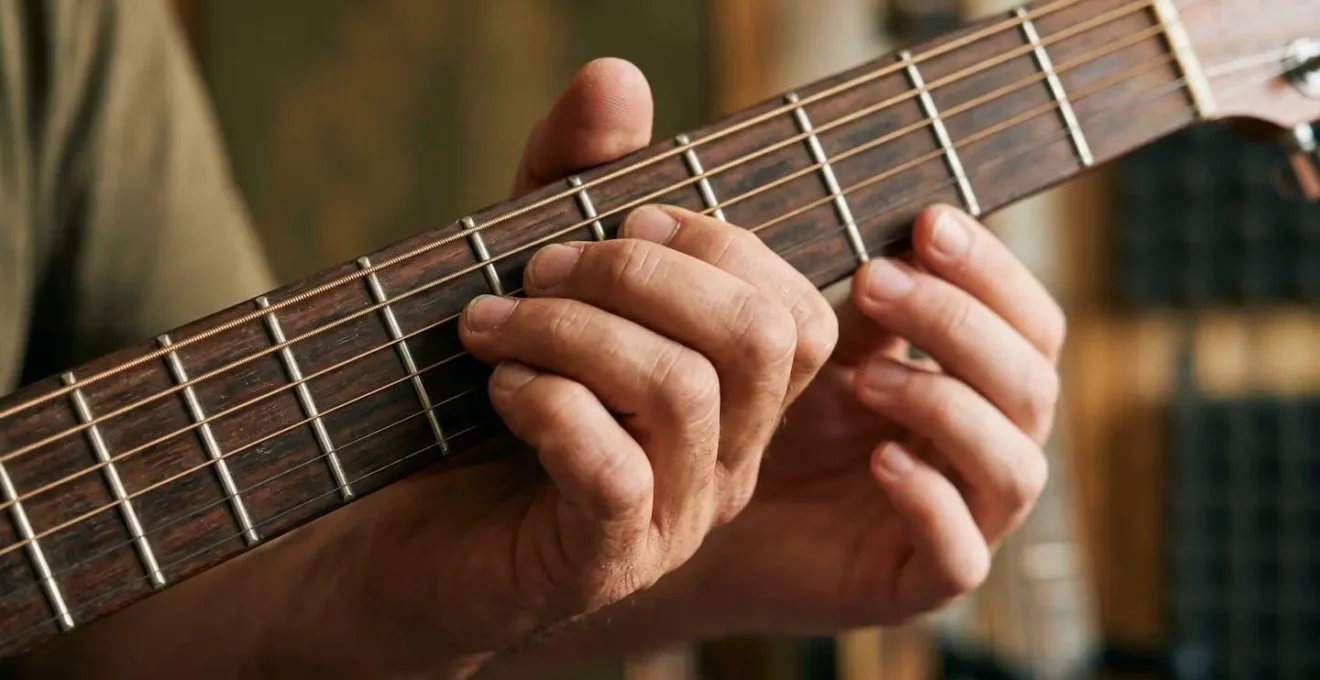
As this image beautifully illustrates, the process is one of direct transmission from one musician to another. The effect is even more pronounced for experienced players learning new material, as research demonstrates that professional musicians show more Mirror Neuron System (MNS) activity when encountering new music compared to non-professionals. A workshop environment creates a rich tapestry of visual and auditory cues that your brain uses to build and reinforce neural pathways for new skills, often much faster than struggling with a video or diagram alone.
How a « Safe Fail » Environment Cures Stage Fright?
For the introverted musician, the single greatest barrier to progress is often not technical ability, but performance anxiety, or stage fright. The fear of making a mistake in front of others can be paralyzing, and solo practice does very little to address it. In fact, by making your practice room a « perfect » space where mistakes are hidden, you can inadvertently make the fear of public failure even worse. The solution isn’t to avoid mistakes, but to practice making them in a supportive context. This is the magic of a « safe fail » environment.
A well-facilitated workshop is designed to be a laboratory, not a concert hall. It’s a space where mistakes are not only expected but are reframed as valuable data points for the entire group. When you try a new technique and it doesn’t quite work, you’re not met with judgment, but with encouragement and constructive suggestions. More importantly, you see your peers doing the same. You witness others struggling, recovering, and improving, which normalizes the learning process and desensitizes you to the fear of imperfection.
Case Study: The Power of Low-Stakes Desensitization
A compelling study on music performance anxiety illustrates this perfectly. Researchers worked with 30 female college pianists experiencing significant stage fright. By engaging them in weekly sessions of music-assisted progressive muscle relaxation and imagery, they created a controlled, low-stakes performance setting. Mistakes were treated as learning opportunities, not failures. The results were dramatic: after just six weeks, there were statistically significant decreases in performance anxiety across multiple measures. This shows that systematically and gently exposing yourself to the act of performing for others in a non-judgmental space is a direct cure for stage fright.
This process of gradual exposure in a supportive setting is a form of desensitization therapy. It’s a powerful psychological tool that a 12-week group music therapy programme greatly improved trait anxiety and performance confidence. Solo practice can build your technical chops, but only a « safe fail » group environment can build the resilience and confidence you need to share your music with the world.
Peer Feedback or Teacher Critique: Which Is More Valuable in a Workshop?
In a private lesson, the flow of information is clear: the teacher holds the expertise and delivers feedback to the student. This is undeniably valuable, but it’s only one type of feedback. A group workshop unlocks a second, equally powerful channel: peer-to-peer feedback. For a shy musician, receiving advice from a fellow learner can often be more impactful and less intimidating than a direct critique from an authority figure.
Teacher feedback, while expert, can sometimes be overly focused on technical correction. In fact, a 2025 study revealed that 83% of teacher comments were classified as feedback on what students just played, with a much smaller percentage focused on « feed-forward » strategies for future improvement. Peers, on the other hand, offer a different perspective. They are in the trenches with you, tackling the same challenges. Their feedback is often more relatable and focused on the listener’s experience. A peer might say, « When you played that part, it made me feel… », providing an emotional and qualitative insight that a teacher focused on technique might miss.
This dynamic also forces you to develop your own critical listening skills. Giving feedback is as much a learning experience as receiving it. As Gary E. McPherson and Jennifer Blackwell state, this dual role is essential for deep learning. In a discussion for *Frontiers in Psychology*, they note:
Observing or analyzing our own performance, moving from student to teacher or peer to peer, and understanding the various forms of feedback that can work to enhance learning, are essential if teachers are to appreciate more fully the power of feedback in music learning.
– Gary E. McPherson and Jennifer Blackwell, Frontiers in Psychology
Ultimately, it’s not about one being « better » than the other. The true value of a workshop is the combination of both. You get the structured, expert critique from the facilitator and the diverse, empathetic, and relatable perspectives from your peers. This 360-degree feedback loop creates a much richer and more complete picture of your playing, accelerating your growth in ways a one-on-one lesson cannot.
The « Just Here to Play » Mistake That Costs You Future Gigs
Many musicians attend workshops with a singular focus: to absorb information from the instructor and improve their playing. They arrive, they learn, and they leave. This « just here to play » mindset is a massive missed opportunity. A workshop isn’t just a classroom; it’s a powerful networking hub. The people you’re playing alongside are not your competition; they are your future collaborators, bandmates, and professional contacts.
The most valuable connections often come from what sociologists call « weak ties. » These aren’t your close friends (strong ties) but the acquaintances and colleagues you interact with less frequently—like the people in a weekend workshop. As sociologist Mark Granovetter, the originator of the theory, explains, « Your weak ties connect you to networks that are outside of your own circle. They give you information and ideas that you otherwise would not have gotten. » The bassist in your workshop might know a venue looking for an opening act. The singer might be starting a new project and needs a guitarist. These opportunities are almost never found in isolation.
The data on this is surprisingly clear. While it feels like our best opportunities should come from our closest friends, Granovetter’s foundational research found that 55.6% of people who found jobs through personal contacts saw that contact only « occasionally. » These are the very relationships forged in the shared experience of a workshop. Treating the breaks and post-session chats as integral parts of the learning experience is a critical mindset shift. Ask about others’ projects, share your own goals, and exchange contact information. You are building a professional support system, one weak tie at a time.
Sequencing & Planning: The Rules of Etiquette for Group Improvisation
Stepping into a group improvisation for the first time can be intimidating. Unlike playing a written piece, there’s no sheet music to guide you. The experience is created in real-time, collectively. Success in this environment depends less on technical virtuosity and more on a shared understanding of improvisational etiquette. It’s a dynamic conversation, and like any good conversation, the most important skill is active listening.
The goal is not to show off how fast you can play, but to contribute to a cohesive musical idea. This means paying close attention to what others are doing. What is the rhythm section laying down? What melodic or harmonic ideas are being introduced? Your role is to find a space within that conversation to add something meaningful. Sometimes, the most powerful thing you can do is to play sparsely, leaving room for others. Other times, it might be to support another soloist by providing a simple, complementary harmonic bed. It’s about serving the song, not your ego.
This collaborative spirit requires a constant awareness of sequencing and dynamics. Don’t start your solo at full volume over someone else’s delicate phrase. Acknowledge what the previous soloist did and try to build on their idea before taking it in a new direction. Leadership in a jam is fluid; it passes from one player to another. Learning to accept that leadership, and to gracefully pass it on, is the hallmark of a mature improviser. The workshop is the perfect training ground to develop this crucial musical empathy.
Action Plan: Auditing Your Role in Group Improvisation
- Points of Contact: Actively listen for all musical cues being offered by the group—rhythm, harmony, dynamics, and melodic motifs. This is your raw data.
- Collecte: Inventory your own musical vocabulary (licks, phrases, chord voicings) that could fit the established progression and feel.
- Coherence: Confront your ideas with the group’s direction. Does your contribution serve the song’s energy or does it pull in a different, distracting direction?
- Mémorabilité/Emotion: Identify the emotional core of the jam. Is it tense, joyful, melancholic? Ensure your playing adds to this core emotion rather than clashing with it.
- Plan d’Intégration: Find the right sonic « space » to introduce your idea. Wait for a natural opening in the musical conversation instead of playing over someone else.
Private Lessons or Group Classes: Which Is Better for Shy Beginners?
For a shy beginner, this is the ultimate question. The instinct is often to hide in a private lesson, where the only person who can witness your mistakes is the teacher. It feels safer. However, this safety can be a double-edged sword. While private lessons are excellent for building foundational technique, they may not be the best environment for building the social confidence needed to truly enjoy making music. As the team at Villa Musica notes, « Beginners often feel more at ease learning alongside others, as they can see that everyone is working through challenges and improving at their own pace. »
Group classes offer a unique form of social proof. Seeing that you’re not the only one struggling with a particular chord change or rhythm can be incredibly validating. It normalizes the learning curve and reduces the feeling of personal failure. This shared struggle builds a sense of camaraderie that is a powerful antidote to the isolation and self-doubt that can plague beginners. While the cognitive load of being aware of others can feel higher at first, it’s also a form of low-stakes performance training from day one.
The best approach is often a sequential one. Starting with a few private lessons to build foundational confidence and a basic grasp of the instrument can be ideal. But graduating to a group class is the crucial next step for transforming that technical skill into performance confidence. The following table breaks down the unique strengths of each format, helping you decide not *which* is better, but *when* each is best for your journey.
| Aspect | Private Lessons | Group Classes |
|---|---|---|
| Learning Focus | Foundational confidence – mastering basic techniques | Social confidence – performing in front of others |
| Cognitive Load | Lower – focus solely on instrument without audience pressure | Higher initially – balancing technique with social awareness |
| Feedback Type | Immediate, personalized, and detailed from teacher | Diverse perspectives from peers and teacher |
| Cost | Higher per session | More affordable, accessible option |
| Best For | Building technical foundation and overcoming fear of mistakes | Building performance confidence and collaborative skills |
| Recommended Sequence | Start here for shy beginners | Graduate to this after foundational confidence established |
Sequencing & Planning: How Fan Bases Coordinate Streaming Parties
The skills you learn in a group improvisation setting—active listening, clear cueing, and working toward a shared goal—have applications far beyond the jam session. These same principles of coordination and mutual support are exactly what entrepreneurial musicians use to build and engage their fan bases in the digital age. The ability to plan a sequence of actions and communicate it clearly is a transferable skill from the stage to social media.
Consider the modern phenomenon of a « streaming party, » where a fan base coordinates to listen to a new album or single simultaneously to boost its chart position. This is a large-scale group improvisation. It requires clear leadership (often from the artist or dedicated fan accounts), shared goals (hitting a certain number of streams), and active participation from the entire « group. » Everyone has a role to play, and the collective success depends on each individual’s contribution. This is the « weak tie » theory in action, but applied to a fan community.
Case Study: From Jam Session to Fan Engagement
Research on entrepreneurial musicians highlights how they leverage social networks to build their careers. These artists use communication channels that mirror the dynamics of a successful workshop. They establish shared goals with their followers (e.g., funding a new album via Kickstarter), provide clear cues (« The new single drops at midnight, let’s get it trending! »), actively listen to fan feedback, and foster a sense of mutual support and community. The coordination skills required to navigate a group jam are directly applicable to mobilizing a fan base, demonstrating that what you learn in a workshop is not just about music, but about leadership and community building.
By participating in group music classes, you are not just learning to play an instrument; you are practicing the very soft skills of collaboration, communication, and project coordination that are essential for any modern musician’s career. You learn how to be part of something larger than yourself and how to contribute effectively to a collective effort, whether that’s a 12-bar blues or a global album launch.
Key Takeaways
- Observational learning in a group context activates your brain’s mirror neurons, hardwiring new techniques and musical ideas faster than solo study.
- A « safe-fail » workshop environment is one of the most effective cures for stage fright, built through repeated, low-stakes performance and shared vulnerability.
- Workshops are crucial networking hubs. The « weak ties » you form with fellow musicians are a primary source of future gigs, collaborations, and opportunities.
How to Prepare for a Masterclass to Get the Most Out of the Artist?
Every group workshop, regardless of its label, is an opportunity for a masterclass experience. The key is to shift your mindset from that of a passive audience member to an active protagonist in your own learning. Getting the most out of any group setting, especially a formal masterclass with a guest artist, depends almost entirely on the quality of your preparation. Showing up cold and hoping for inspiration is a recipe for a missed opportunity.
True preparation goes beyond simply practicing your piece. It involves deep self-analysis. You need to arrive with a clear, specific question or problem. Instead of saying « I’m struggling with this section, » you should be able to play the section and pinpoint exactly where the difficulty lies. Your goal is not to impress the artist, but to give them the precise diagnostic information they need to help you. The more specific your problem, the more targeted and valuable their advice will be.
To make the most of this precious time, focus on understanding the artist’s *process*, not just their performance. Your preparation should include a strategic approach to questioning and demonstration. Here are some concrete steps to take:
- Prepare specific, playable examples of where you are struggling, rather than relying on verbal descriptions. Show, don’t just tell.
- Record your practice sessions beforehand to identify recurring patterns in your challenges. You might notice something you weren’t aware of in the moment.
- Research the artist’s methodology and strategic practice habits. What do they focus on during difficult learning phases?
- Formulate questions about their decision-making process. Ask about what they choose *not* to play, as this is often more insightful than technique alone.
- Come ready to demonstrate your current approach so the artist can diagnose the root cause of your issue, not just the symptom.
By preparing in this way, you transform the experience. You are no longer just a student waiting to be taught; you are a collaborator working with an expert to solve a specific problem. This proactive mindset is what separates those who are merely present from those who truly grow.
Your instrument is waiting, but your community is too. Explore a local workshop, join an online jam, and discover the musician you’re meant to be. The next step in your journey isn’t just to practice more, but to practice together and unlock the accelerated growth that only a group can provide.