Contrary to popular belief, breaking your musical plateau has little to do with the quantity of your practice hours and everything to do with the diagnostic quality of your method.
- Progress stalls not from a lack of effort, but because imprecise repetition physically reinforces bad habits in your brain’s neural pathways.
- A structured session that isolates and surgically fixes weaknesses is exponentially more effective than simply playing through songs.
Recommendation: Stop treating practice as performance rehearsal. Start treating it like a clinical process of diagnostics, targeted intervention, and reintegration to engineer your breakthrough.
You have put in the hours. The metronome clicks in your sleep, your calluses are well-earned, and you know your scales backward and forward. Yet, for months, or perhaps even years, your progress has flatlined. That one difficult passage remains a stumbling block, your speed is capped at a frustrating limit, and the fluid expression of the virtuosos you admire feels a universe away. You are trapped on the intermediate plateau, a frustrating purgatory where more effort doesn’t seem to yield better results. The common advice—to simply practice more, learn new songs, or « feel it »—rings hollow, because you’re already doing all of that.
This isn’t a failure of discipline; it’s a failure of methodology. The very practice habits that brought you to an intermediate level are now the chains holding you back. This is because high-level skill acquisition is not a linear function of time spent. It is a complex process of neurological scaffolding, physical efficiency, and mental engineering. Most musicians continue to practice with the same broad-stroke approach, hoping for incremental gains, when what is required is a radical shift in perspective.
But what if the solution wasn’t about adding more hours, but about fundamentally changing what you do within those hours? What if you could approach your instrument less like an artist and more like a scientist—or a surgeon? This guide is built on a single, rigorous principle: breaking the intermediate plateau is an engineering problem. It requires you to deconstruct your playing, diagnose your weaknesses with clinical precision, and apply targeted solutions that rebuild your technique from the ground up. We will dismantle the myth of « more is better » and provide a systematic framework for achieving true instrumental mastery.
This article provides a structured path to deconstruct your limitations and engineer your breakthrough. The following sections will guide you through a complete methodological overhaul, from the neuroscience of your practice to the psychology of your performance.
Summary: A Musician’s Engineering Manual for Advanced Technique
- Why Your Progress Has Stalled Even Though You Practice Daily?
- How to Structure a Practice Session That Actually Fixes Weaknesses?
- Speed or Feel: Which Should You Prioritize for Professional Gigs?
- The Posture Mistake That Leads to Tendonitis in High-Level Players
- Sequencing & Planning: Building a Repertoire List from Easy to Virtuoso
- Why Unconscious Tension Is the Root Cause of Your Speed Limit?
- Opener vs Closer: Which Song Placement Defines Your Show’s Success?
- How to Overcome Stage Fright and Command the Room Like a Frontman?
Why Your Progress Has Stalled Even Though You Practice Daily?
The most frustrating paradox for any dedicated musician is the point where more practice no longer equals more progress. The reason is not a lack of effort, but a misunderstanding of how the brain learns. Your daily practice, if imprecise, is actively working against you. This happens through a neurological process called myelination, where the neural pathways you use are insulated with a fatty sheath, making them faster and more automatic. When your practice is unfocused, myelination strengthens the wrong neural pathways, cementing mistakes and inefficient movements into your muscle memory. You are, quite literally, becoming an expert at playing imperfectly.
Mindlessly repeating a passage until you get it « right » is one of the most inefficient learning strategies. You are spending most of that time reinforcing the 99 incorrect versions of the movement, not the single correct one. The brain doesn’t distinguish between good and bad habits; it only reinforces what is repeated. This explains why certain sloppy transitions or timing errors become stubbornly persistent despite your best efforts to correct them. Your brain has built a high-speed freeway for that specific mistake.
The evidence is clear that sheer volume is not the answer. As a meta-analysis on expert performance revealed, the raw amount of time spent practicing is a surprisingly poor predictor of skill. According to researchers Macnamara, Platz, and others, this factor is far from the whole story:
Practice intensity can only explain from 21 to 36% of the variance in expert performance.
– Macnamara et al., Platz et al., Frontiers in Neuroscience
This means a huge portion of your potential is determined not by *how long* you practice, but *how* you practice. The plateau isn’t a wall; it’s a sign that your current method has reached its limit. The path forward requires shifting from a mindset of accumulation (more hours) to one of surgical precision (better quality). Every repetition must be deliberate, correct, and focused on building the right neural highway, not just paving over a flawed one.
How to Structure a Practice Session That Actually Fixes Weaknesses?
If mindless repetition is the problem, then a structured, diagnostic approach is the solution. A practice session engineered for growth is not a linear block of time; it’s a dynamic workout that manages your cognitive load. Instead of « warming up, playing songs, and working on hard parts, » you must adopt a framework that moves from intense, focused diagnostics to creative integration. This method ensures your most valuable resource—your full concentration—is spent on the most difficult task: fixing specific weaknesses.
The session should be divided into tiers based on the mental energy required. You start with the highest-focus work when your mind is fresh, then gradually move to less demanding, more integrative activities. This prevents burnout and makes the entire session more productive. This structure turns your practice from a chore into a highly efficient diagnostic practice session.
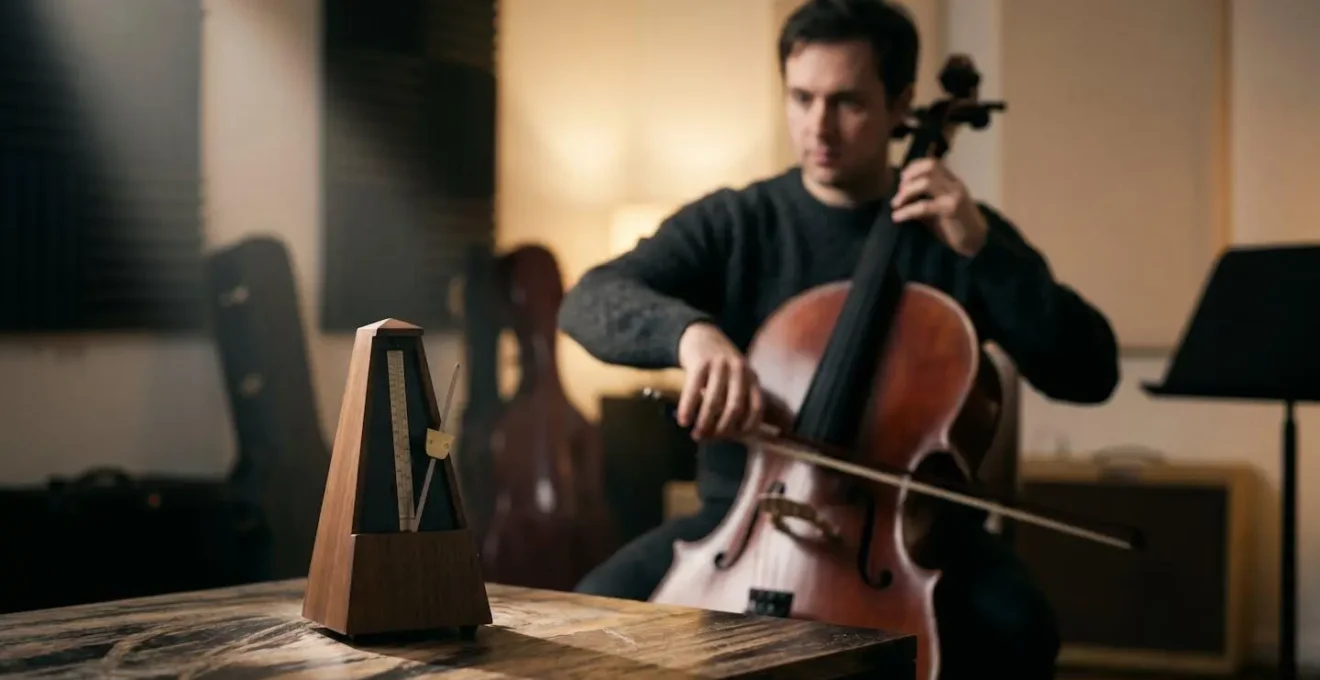
As the visualization suggests, the process funnels from a sharp, analytical focus toward a broader, creative application. It is a system designed to identify a problem, solve it in isolation, and then integrate the solution back into your actual playing. This targeted approach is the essence of what psychologists call « deliberate practice. »
Action Plan: Auditing a Problem Passage
- Isolate & Record: Record only the problematic 2-4 second phrase, not the whole song or section.
- Diagnostic Playback: Listen at 50% speed. Pinpoint the *exact* failure: a late finger, uneven pressure, a tense wrist. Name the error.
- Prescribe the Fix: Define one single, measurable correction (e.g., « Left index finger must land 10ms earlier on the fret »).
- Targeted Repetition: Practice only the fix in a 5-minute, high-focus block. There is no « three strikes » rule; every repetition must be correct.
- Re-integration Test: Play the phrase back in its original context. If it fails, you have misdiagnosed the problem. Return to step 2.
This clinical structure transforms practice from a vague hope for improvement into a predictable system for it. You stop being a passive participant and become the active architect of your own skill. Each session yields a measurable result, breaking the cycle of frustration and building tangible momentum.
Speed or Feel: Which Should You Prioritize for Professional Gigs?
The debate between « speed » and « feel » is a false dichotomy that traps many intermediate players. Aspiring professionals often see them as opposing forces: the technical shredder who lacks soul versus the groovy player who lacks chops. The reality, from a performance engineering perspective, is that one enables the other. Feel, at a professional level, is an illusion created by absolute technical control. It is the product of having so much command over your instrument that you can manipulate micro-timing, dynamics, and articulation at will. This level of control is impossible without first building the foundational mechanics, which includes speed.
Prioritizing « feel » without the technical facility to execute your ideas is a recipe for sloppy, unconvincing playing. Your musical intentions will always be limited by what your hands can physically produce. You cannot play « behind the beat » with intention if you are struggling to keep up with the beat in the first place. Conversely, prioritizing speed without any musical application results in sterile, robotic playing that fails to connect with an audience.
The correct approach is sequential. First, you must build the machine. This involves rigorous, often unmusical, exercises focused on developing clean, efficient, and fast movements. Use a metronome not just as a timekeeper, but as a diagnostic tool to systematically increase your physical limits. Once this technical overhead is established—meaning you can play faster and cleaner than the music requires—you can then redirect your cognitive resources from « how to play the notes » to « how to shape the phrase. » This is where feel is born. It emerges from the space you create once the raw mechanics become automatic.
For a professional gig, the audience doesn’t care about your practice regime; they care about the emotional impact of your performance. That impact is delivered through expressive velocity—the ability to deploy speed, or the restraint of it, for musical effect. Therefore, you don’t choose between speed and feel. You build speed as the raw material from which you sculpt feel.
The Posture Mistake That Leads to Tendonitis in High-Level Players
As technical demands increase, a silent career-killer emerges: playing-related musculoskeletal disorders (PRMDs). The intermediate plateau is often not just a technical limit but a physical one, caused by accumulated postural and mechanical inefficiencies. The one mistake that unites most high-level players who develop tendonitis or other chronic injuries is static tension in asymmetrical positions. This refers to holding parts of your body—shoulders, wrist, neck—in a fixed, slightly unnatural position for extended periods, creating constant low-level strain that your brain learns to ignore until it becomes a full-blown injury.
Beginners often have glaringly bad posture, but it’s the subtle, ingrained habits of dedicated players that are most dangerous. A slightly raised shoulder to accommodate the guitar, a bent wrist to reach a piano chord, or a forward-leaning head to see the fretboard—these seem minor. But repeated over thousands of hours, they restrict blood flow, compress nerves, and cause micro-tears in tendons. The problem is insidious because it doesn’t hurt initially. By the time you feel pain, significant damage may have already occurred. This is not a rare occurrence; studies show it’s a widespread issue in the profession, with reports indicating that between 50 and 76 percent of professional musicians have sustained such injuries.
The distribution of these injuries reveals where static tension and repetitive motion take their greatest toll. A review of clinical data highlights the specific vulnerabilities in the upper body.
| Body Part | Injury Incidence | Primary Cause |
|---|---|---|
| Shoulders | 26% | Asymmetrical positioning, static tension |
| Wrists | 12% | Repetitive flexion, carpal tunnel compression |
| Hands | 10% | Tendonitis, tenosynovitis from overuse |
| Elbows | 8% | Cubital tunnel syndrome, repetitive extension |
As this breakdown of common overuse injuries shows, the shoulders bear a significant burden, often from holding the instrument’s weight asymmetrically. To break the plateau and ensure a long career, you must audit your physical technique with the same rigor you apply to your notes. This means regular video analysis of your posture, seeking a neutral, relaxed position for every joint, and incorporating stretches and breaks to release accumulated tension. Your body is the most critical part of your instrument; maintaining it is not optional.
Sequencing & Planning: Building a Repertoire List from Easy to Virtuoso
Many musicians approach their repertoire like a buffet, picking songs they like without a strategic plan for growth. This haphazard approach leads to a collection of half-learned pieces and significant gaps in technique. To break the plateau, you must treat your repertoire not as a list of songs, but as a progressive technical curriculum. The goal is to build a « ladder » where each new piece you learn solidifies a skill from a previous one while introducing a single, new, manageable challenge.
The core principle is « technique-first. » Instead of asking « What song do I want to learn? » ask « What specific technique do I need to master next? » For example, if your alternate picking is a weakness, you don’t jump to a shred solo. You find a simple piece that uses basic alternate picking. Once mastered, you find a slightly more complex piece that introduces string-skipping with alternate picking. Each song becomes a vehicle for mastering a specific, isolated skill. This transforms repertoire learning from a daunting memory task into a structured skill-building exercise.

This laddered approach ensures you are always operating in the « zone of proximal development »—a state where the challenge is just beyond your current ability, forcing you to stretch without being overwhelmed. An ideal repertoire plan has three categories of songs you are actively working on at all times:
- Maintenance Pieces (80% Mastery): Songs you can play comfortably. Playing these builds confidence and reinforces existing skills.
- Development Pieces (50-80% Mastery): This is your main focus. These songs contain the one or two new techniques you are currently working to master.
- Aspirational Pieces (0-20% Mastery): A single, long-term « virtuoso » goal piece. You don’t practice this to perform it, but to analyze it. You might only work on one or two bars a week, using it as a roadmap to identify future skills you’ll need to develop.
This structured sequencing ensures every piece has a purpose. You are no longer just learning songs; you are systematically building the technical foundation required to play anything you want in the future.
Why Unconscious Tension Is the Root Cause of Your Speed Limit?
Your maximum speed is not determined by how fast you can move your fingers, but by how quickly you can relax them. The primary barrier to high-velocity playing is unconscious antagonistic tension. This occurs when small, opposing muscle groups fire simultaneously, creating friction and drag on your primary movements. You are essentially fighting against yourself. This tension is often imperceptible, a low-level « gripping » in your forearm, a raised shoulder, or a rigid thumb. While it might provide a false sense of control at slow speeds, it creates a hard physical ceiling on how fast you can play.
This tension is often a byproduct of a flawed learning process. When you learn a new, complex movement, your brain’s initial strategy is to co-activate all surrounding muscles to ensure stability. As you practice correctly, the brain is supposed to « prune » away these unnecessary muscle activations, leaving only the efficient, essential movement. However, if you practice with anxiety or a « brute force » mentality, this tension gets baked into the muscle memory. The myelination process, which speeds up neural pathways, then makes this tense, inefficient movement pattern automatic and fast—but only up to a point where the tension itself prevents any further acceleration.
The link between practice, myelination, and motor control is not just theoretical; it has been observed directly in scientific research. Understanding this mechanism is key to unlocking your speed potential.
Case Study: Myelination and Efficient Motor Control
A foundational study on piano practice demonstrated a direct link between hours practiced and the development of white matter (myelin) in the brain. This myelination is crucial for coordinating the timing of nerve signals, which directly impacts the speed and precision of motor skills. However, the study implies a critical detail: this process is activity-dependent and does not distinguish between good and bad habits. If practice includes unnecessary tension, myelination will make that tense movement pattern more efficient, effectively solidifying a « speed wall » into your neurophysiology. The only way to break this wall is to consciously practice with a focus on relaxation, teaching the brain to prune the antagonistic muscle activity and build new, tension-free pathways.
To increase your speed, you must shift your focus from « moving faster » to « becoming more relaxed. » This involves practicing at slow speeds with an exaggerated sense of looseness, constantly scanning your body for any hint of tension, and releasing it. Your goal is to achieve maximum economy of motion, where only the exact muscles required for a note are activated, and for the briefest possible moment. Speed is the byproduct of this profound relaxation.
Opener vs Closer: Which Song Placement Defines Your Show’s Success?
In performance engineering, a setlist is not a random collection of songs; it’s a narrative arc designed to guide the audience’s emotional and psychological journey. The two most critical points in that narrative are the opener and the closer. Many bands obsess over the closer, believing it’s the last thing the audience will remember. While important, it’s the opener that often has a greater impact on the show’s overall success. The reason lies in the psychological principles of primacy and recency.
The opener’s job is to establish credibility and set expectations. The first 90 seconds of your show is when the audience, consciously or not, decides how good you are. They are at their most attentive and most critical. A powerful, tight, and confident opener that showcases your band’s core strengths acts as a « statement of intent. » It tells the audience, « We are professionals, you are in good hands, and this is the level of quality you can expect for the rest of the night. » A flawless opener creates a halo effect, making the audience more forgiving of minor mistakes later in the set. A sloppy opener, however, creates an uphill battle; you will spend the rest of the show trying to win back their confidence.
The closer’s job is to define the lasting emotional memory. The recency effect states that people are most likely to remember the last thing they experienced. The closer should therefore be the song that best encapsulates the core emotional identity of your band. Is it a high-energy anthem? A poignant ballad? A massive, epic jam? This is your final statement, the feeling you want the audience to carry with them as they walk out the door. While the opener is about establishing your *caliber*, the closer is about cementing your *brand*.
So, which is more important? From a risk-management perspective, the opener is more critical to a show’s success. A great opener can salvage a mediocre set, while a bad opener can poison a great one. The closer determines the flavor of the memory, but the opener determines if the audience is willing to create that memory at all. Choose an opener that is well-rehearsed, high-impact, and sits comfortably in the middle of your technical ability—never your most difficult song.
Key Takeaways
- Your progress has stalled because imprecise practice reinforces bad habits neurologically, not due to a lack of effort.
- Adopt a diagnostic practice structure: isolate weaknesses, prescribe specific fixes, and manage your cognitive load for maximum efficiency.
- Physical health is non-negotiable. Eliminate static tension and correct posture to prevent career-ending injuries and break physical plateaus.
How to Overcome Stage Fright and Command the Room Like a Frontman?
Technical mastery is only half the battle. If stage fright prevents you from delivering your skills under pressure, your practice is worthless in a live context. Performance anxiety, or stage fright, is not a character flaw; it’s a predictable physiological response to a high-stakes situation. The key to overcoming it is not to eliminate the feeling—which is impossible—but to reframe it and manage it with psychological tools. A commanding frontman isn’t fearless; they are an expert at performance energy management.
The physical symptoms of stage fright—a racing heart, adrenaline, sweaty palms—are identical to the symptoms of excitement. Your brain’s interpretation of these signals is what defines the experience. Instead of labeling the feeling as « anxiety » and turning inward, you must learn to label it as « readiness » or « intensity » and direct that energy outward, toward the performance and the audience. This cognitive reframing is the single most powerful tool for transforming debilitating fear into commanding stage presence.
Beyond reframing, you can use a series of evidence-based techniques to create psychological distance from the anxiety and maintain control during a performance. These are not platitudes but concrete actions you can implement to engineer a state of confident execution. As outlined in research published in Frontiers in Psychology, these strategies are used by elite performers across disciplines.
Evidence-Based Strategies for Managing Performance Anxiety
- Reframe Arousal Symptoms: Recognize that a racing heart and adrenaline are identical to excitement. Consciously redirect this energy outward toward the audience rather than inward as fear.
- Triangle of Gaze Technique: Look in a slow, deliberate triangle pattern—a point at the back-left of the room, a point at the back-right, and the sound engineer’s booth. This creates the illusion of confident eye contact without the anxiety of direct engagement.
- Performance Persona Creation: Develop a distinct stage identity separate from your personal self. This « persona » gives you psychological permission to be bold, expressive, and commanding in a way your everyday self might not be.
- Pre-Performance Visualization: Before going on stage, vividly imagine a successful performance from a first-person perspective. See the attentive audience, feel your confident movements, and hear the flawless execution. This builds neural pathways for success.
- Acceptance-Based Approach: Instead of fighting or suppressing the physical sensations of anxiety, simply observe and accept them without judgment. Acknowledge « my heart is racing » as a neutral fact, which reduces its power and transforms the energy into focus.
Commanding a room is not an innate talent. It is a skill built on a foundation of technical security and a toolbox of psychological strategies. By learning to manage your internal state, you create the freedom to connect with the music and the audience authentically, finally delivering the performance you’ve worked so hard to prepare.
Begin today to dismantle your old practice habits and apply this analytical framework. Stop measuring your progress in hours and start measuring it in problems solved. This is the disciplined path to true instrumental mastery.