
In summary:
- A solid internal clock comes from feeling subdivisions, not just following a click.
- Use the metronome as a reference to check your accuracy, not as a crutch to lean on.
- Live performance adrenaline will make you rush; you must train to counteract this physiological response.
- Great groove isn’t just about hitting the beat; it’s about the micro-timing relationship between instruments like the kick and bass.
- Timekeeping is a collective responsibility that is the foundation of effective band collaboration.
Listen up. You’re in the rehearsal room, the groove feels good, everyone is locked in. Then the metronome goes off, and it all falls apart. Someone’s rushing the chorus, someone else is dragging the verse. That disconnect between practicing with a click and performing without one is the single biggest weakness in most bands. The common advice is just « practice with a metronome more, » but that’s not the solution; it’s often the problem. You’ve learned to obey an external pulse, not to build your own.
A truly great musician doesn’t follow the time; they *are* the time. Their internal clock is a non-negotiable, biological function, as steady as their own heartbeat. This isn’t about magical talent. It’s about a specific kind of training. It’s about moving beyond simply hearing the beat and starting to physically embody it. We’re not just talking about tapping your foot. We’re talking about feeling the space between the clicks—the sixteenth-note grid that holds the entire groove together.
The real key to an unbreakable internal clock isn’t about more obedience to a machine. It’s about internalizing the subdivision matrix until it’s second nature. It’s about understanding the physics of adrenaline and the micro-dynamics of a rhythm section. This guide will break down the process. We will deconstruct the bad habits, rebuild your rhythmic foundation from the subdivision up, and give you the tools to make your time so solid that it becomes the anchor for the entire band, with or without a click track.
This article provides a complete roadmap, from the fundamental building blocks of time to the real-world challenges of performance and collaboration. Explore the sections below to systematically transform your relationship with rhythm.
Contents: Forge an Internal Clock: The No-Nonsense Guide to Unshakable Rhythm
- Why Counting Subdivisions Is the Secret to Grooving Like a Pro?
- How to Use a Metronome Without Becoming Dependent on It?
- Straight or Swing: How to Feel the Difference in Generic Pop Beats?
- The Adrenaline Error That Makes Live Bands Play Too Fast
- Problem & Solution: Decoding 3-over-2 Polyrhythms for Non-Drummers
- Problem & Solution: Locking the Kick Drum with the Bass Guitar
- How to Play with Backing Tracks Without Looking Like Karaoke?
- How to Co-Write Songs in a Band Without Destroying Your Friendships?
Why Counting Subdivisions Is the Secret to Grooving Like a Pro?
The beat is a lie. Or rather, it’s just the tip of the iceberg. Musicians who rush or drag aren’t losing track of the « 1, 2, 3, 4. » They’re losing the invisible grid that holds those beats together: the subdivision. If the quarter note is the destination, the sixteenth notes are the paving stones that get you there. Without them, you’re just guessing where to land. Counting subdivisions—the eighths (« 1 & 2 & ») or sixteenths (« 1 e & a »)—is the single most important skill for developing a rock-solid internal clock. It fills the empty space between beats, turning a series of isolated events into a continuous, flowing rhythmic matrix. You stop lurching from beat to beat and start gliding through time.
This isn’t just an academic exercise; it’s about physical internalization. When you can feel the sixteenth-note pulse running consistently underneath everything you play, the main beats simply become points of emphasis. Your body knows exactly where the next downbeat is because it has felt the three smaller steps leading up to it. This mental grid provides the resolution needed for complex syncopation and, more importantly, for creating a deep, undeniable groove. As the experts at Song Moon Press emphasize when teaching rhythm, « The practice of counting the subdivision while clapping or playing an instrument develops one’s internal metronome and sharpens rhythmic precision. » It’s the difference between walking on a tightrope and walking on a wide, stable bridge.
Action Plan: The Subdivision Internalization Method
- Identify the Grid: Look at your music and find the shortest, fastest note value being played consistently. This is your core subdivision (e.g., sixteenth notes).
- Vocalize Everything: Set a slow metronome. Tap your foot on the quarter note and speak the full subdivision count out loud (e.g., « 1-e-&-a, 2-e-&-a… »). Do this even over rests. Your voice is your first instrument for rhythm.
- Isolate the Action: While still counting everything out loud, play only the notes of your part. The contrast between your continuous vocal rhythm and your intermittent playing will highlight exactly where you tend to rush or drag.
- Go Silent, Not Deaf: Once the pattern feels automatic, stop speaking the subdivisions out loud but continue hearing them in your head. The goal is to move the « counting voice » from your mouth to your mind.
- Pressure Test: Record yourself playing your part with no metronome and only the internalized subdivision. Listen back against the original tempo. This is the ultimate test of whether the grid is truly yours.
This process trains your brain and body to be accountable for every fraction of a beat. It’s the foundational work that separates the amateurs from the pros.
How to Use a Metronome Without Becoming Dependent on It?
The metronome is the most misused tool in music. Most players use it as a crutch, a rhythmic dictator that they passively follow. The moment it’s turned off, their timing collapses because they never learned to walk on their own. A professional uses a metronome not as a guide, but as a diagnostic tool—an unforgiving mirror that reveals flaws in their internal time. The goal is not to play *with* the click, but to be so solid that you can make the click disappear. When your time is perfect, your note lands exactly on the metronome’s transient, effectively masking it. If you can still hear the click clearly, you’re either ahead or behind it. That’s the real work.
To break your dependency, you have to create space. You must force your internal clock to take responsibility for keeping time when the external source is absent. This involves practicing with « ghost clicks » or displaced beats. For example, set the metronome to only click on beats 2 and 4. Now, your brain is forced to generate beats 1 and 3 on its own. Or, go further: set the click to only beat 1 of every bar. Now you are responsible for beats 2, 3, and 4. These exercises are challenging, but they are what transform the metronome from a crutch into a training partner. The focus shifts from passive listening to active timekeeping.
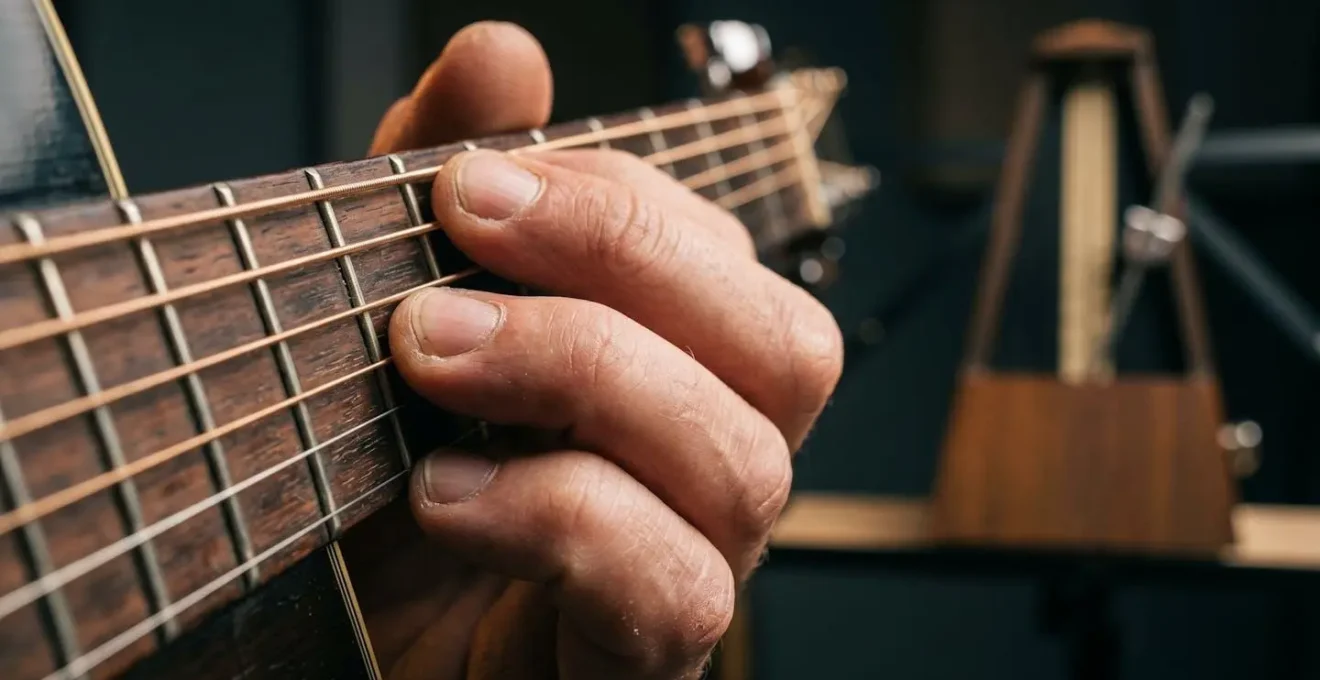
As this image suggests, the relationship with time becomes intimate and tactile, a matter of muscle memory and focused intent. The external click is present in the background, but the real work is happening in the hands and the mind. The ultimate goal is to internalize the pulse so deeply that you can turn the metronome off for several bars and come back in perfectly on time. This is achieved through exercises like the « disappearing click, » where you program the metronome to go silent for measures at a time, forcing you to maintain the tempo in a void. It’s the rhythmic equivalent of flying by instruments instead of by sight.
Straight or Swing: How to Feel the Difference in Generic Pop Beats?
Time isn’t just about being « on time. » It’s about feel. The two most fundamental feels in Western music are straight and swing. Straight time divides the beat into two equal parts (straight eighth notes), creating a driving, even pulse common in rock and funk. Swing time divides the beat into two unequal parts—a long note followed by a short note—creating the lilting, « bouncy » feel of jazz, blues, and shuffle. The problem is that many musicians treat this as a binary switch. It’s not. Swing exists on a continuum, and the best players live in the nuance between the extremes. In fact, research shows that swing ratios range from 1:1 (straight) to approximately 2:1 (triplet feel) depending on genre and tempo.
To really feel the difference, stop thinking in ratios and start thinking in subdivisions. Straight eighths are built on a sixteenth-note grid (« 1-e-&-a »). The « and » falls exactly halfway between the downbeats. A classic swing feel is built on a triplet grid (« 1-trip-let, 2-trip-let »). The downbeat lands on « 1, » and the upbeat (the « swing ») lands on « let. » The space between them is what creates the feel. To find it in a generic pop beat, listen to the hi-hat. Is it playing a constant, even « t-k-t-k-t-k »? That’s straight. Is it playing a « tss-da, tss-da, tss-da » pattern? That’s a swing or shuffle feel. The hi-hat or shaker almost always reveals the song’s underlying rhythmic DNA.
Case Study: The Swing Continuum in Action
Musical analysis reveals that the « correct » swing ratio is not a fixed number but a fluid concept that changes with context. For instance, at very fast tempos, jazz musicians tend to play eighth notes closer to a straight feel, as the time for a pronounced « long-short » swing is compressed. A classic example is the uptempo bebop of Dizzy Gillespie, where the swing is subtle and driving. In contrast, at slower, more relaxed tempos like a Count Basie blues, the swing becomes much more exaggerated and laid-back, approaching a true triplet feel. This demonstrates that feel is an artistic choice, not a mathematical formula. The ability to navigate this continuum—to apply more or less swing based on the song’s energy—is a hallmark of a mature rhythmic sensibility.
The key is to practice both feels over the same track. Take a simple pop or rock song with a straight beat and try playing your part with a triplet-based swing feel. Then, take a blues shuffle and try to play a perfectly straight line over it. This forces you to consciously override your rhythmic habits and gain control over the feel you’re projecting.
The Adrenaline Error That Makes Live Bands Play Too Fast
Every band knows the feeling. You finish the first song of the set, and it was 15 BPM faster than you rehearsed it. This isn’t a failure of practice; it’s a failure to account for biology. Live performance triggers the body’s fight-or-flight response. The audience, the lights, the pressure—it all signals a high-stakes event. Your body responds by flooding your system with hormones. In fact, research on live performance shows that elevated hormone levels including adrenaline, dopamine, and endorphins dramatically alter your perception of time. Your heart rate increases, your senses sharpen, and everything feels like it’s happening faster. Your internal clock speeds up with it. The result is « tempo rush, » and it’s the number one killer of a good live groove.
You cannot stop this physiological reaction. Adrenaline is part of the energy of a live show. What you can do is learn to manage it. The first step is awareness. Know that it *will* happen. The drummer, who is often the timekeeper, is especially susceptible. The physical exertion of playing combined with performance anxiety is a perfect recipe for rushing. The entire band must develop strategies to counteract this. This starts with the count-off. The person counting in the song must take a deep, grounding breath and consciously start the song *slower* than it feels in their head. It will likely feel sluggish and wrong, but it will probably be the correct tempo.

In the heat of the moment, as shown in the energy of a live show, conscious control is paramount. The anchor is not just the drummer; it’s the collective. The bassist and drummer must lock their eyes and ears, forming a two-person anchor against the tide of adrenaline. If one starts to rush, the other’s job is to pull back, to be the steadying force. Another powerful technique is to connect your timing to your breath. Adrenaline makes your breathing shallow and fast. By consciously taking slow, deep breaths during instrumental sections or rests, you can physically slow your body’s response and, by extension, your internal clock. It’s a battle fought not just with your ears, but with your entire nervous system.
Problem & Solution: Decoding 3-over-2 Polyrhythms for Non-Drummers
Polyrhythm is when two different rhythmic patterns are played simultaneously. While it sounds like a concept for avant-garde jazz or prog rock, the most common polyrhythm—three-over-two—is the secret ingredient in countless genres, from African music to Latin grooves, and even pop and rock. It’s the source of that complex, rolling tension that makes a rhythm feel compelling. For non-drummers, however, it can feel like trying to pat your head and rub your stomach at the same time. The problem is trying to « count » it mathematically. The solution is to feel it physically using mnemonic phrases and body separation.
The 3-over-2 polyrhythm (also known as a hemiola) stacks a pattern of three even notes over a pattern of two even notes in the same amount of time. Trying to count « 1-2-3 » with one hand and « 1-2 » with the other is a recipe for frustration. The key is to find the common denominator, which is six. The « 3 » side lands on beats 1, 3, 5 of the six-beat cycle, while the « 2 » side lands on beats 1 and 4. A far more intuitive method is to use a simple, memorable phrase where the syllables naturally map to the rhythm. The classic example is « Pass the golden butter. » Say this phrase evenly. Now, tap your foot twice, once on « Pass » and once on « gold-« . That’s the « 2 » side. Tap your hands three times, on « Pass, » « the, » and « en. » That’s the « 3 » side. Repeat the phrase until your hands and feet are moving independently but are held together by the vocal guide.
Once you internalize the feel of this phrase, you can abandon it and just feel the rhythmic relationship. You can then apply it to your instrument. A guitarist might tap the « 2 » with their foot while their picking hand arpeggiates a three-note pattern. A pianist might play a two-note bass line in the left hand against a three-note melody in the right. The goal is to embody both sides of the rhythm in different parts of your body. Start by walking the two-beat pulse while clapping the three-beat pattern. This physical separation is often the breakthrough moment where the polyrhythm stops being a math problem and starts being a groove.
Problem & Solution: Locking the Kick Drum with the Bass Guitar
The kick drum and the bass guitar are not two separate instruments; they are two halves of one engine. This is the foundation of the rhythm section. When they are not « locked in, » the entire song feels unstable, weak, and disjointed. The common amateur mistake is thinking that « locking in » simply means hitting the same notes at the same time. That’s the bare minimum. The real art of the low end lies in the micro-timing and the shared sonic envelope. A professional rhythm section understands that the relationship is far more nuanced. Does the bass note land perfectly on the kick’s attack for a punchy, unified sound? Or does it land a few milliseconds behind it to create a laid-back, « greasy » feel? This is where the pocket lives.
The solution is to stop thinking about notes and start thinking about shape and intention. The kick drum provides the transient—the sharp, percussive « thump. » The bass guitar provides the sustain and tonal body—the « oomph » that blooms after the kick has hit. To lock in, both players must listen intently to this combined sound. Record a simple kick pattern. The bassist should then practice playing a single note along with it, but experiment with the placement. First, try to land exactly on the kick, aiming to make the two sounds merge into one. Then, intentionally play just slightly behind it. Feel how the groove suddenly leans back and relaxes. Then, try playing slightly ahead of it, feeling how the energy pushes forward. The right choice depends entirely on the genre and the song’s emotional goal.
Case Study: The Art of the Shared Sonic Envelope
In a professional setting, the relationship between kick and bass is a deep conversation about micro-timing. As detailed in analyses of professional rhythm sections, the bassist’s job is to complement the kick drum’s role. For a powerful rock track, the bass and kick often strike simultaneously to create a massive, unified punch. In a classic funk groove, the bassist might play a fraction of a second after the kick, creating a « flam » effect that gives the groove its characteristic swing and swagger. Furthermore, they consider the sustain. If the kick is short and tight, the bass note might be held longer to fill the space. If the kick has a long boom, the bass might play a shorter, staccato note to keep the low end from becoming muddy. This interplay creates a single, complex low-end texture that feels like one cohesive instrument, which is the true definition of a « locked-in » rhythm section.
This level of communication requires dedicated practice. The drummer and bassist should spend time playing just together, away from the rest of the band. Work on simple, repetitive grooves and focus entirely on the placement and shape of your notes. This is the engine room, and it must be built on solid ground.
How to Play with Backing Tracks Without Looking Like Karaoke?
Backing tracks are a modern necessity for many bands wanting to reproduce a complex studio sound live. But they are also a trap. Played poorly, they can turn a dynamic live performance into a stiff, lifeless karaoke session. The band becomes enslaved to the click track in their ears, focusing on not making a mistake rather than connecting with the audience. The problem is treating the track as a dictator instead of another musician. Authenticity comes from interacting with the pre-recorded elements, not just playing along to them. As with any part of a live show, the key is making it feel human and intentional.
First, humanize the click itself. A sterile, robotic metronome beep is musically uninspiring and fatiguing to listen to for an entire set. A simple but powerful technique is to replace the click with a custom track containing a simple percussion loop, like a shaker or a tambourine, that grooves and feels musical. You can also add verbal cues (« Verse, 2, 3, 4… ») recorded in a human voice to signal upcoming sections. This makes the in-ear experience feel more like a bandmate giving you a cue and less like a machine giving an order. The synchronization with pre-recorded tracks is essential, as research on live band synchronization shows that backing tracks pre-recorded at specific tempos require click tracks to maintain coherent timing, but that click can and should feel good.
Second, you must rehearse *interplay* with the track. Know it inside and out. When a string pad enters, does the guitarist’s energy change? When a synth bass line takes over, does the live bassist simplify their part to create space? The band should perform as if the sounds coming from the track are being played by an invisible band member. React to them. Add small fills when the track’s arrangement thins out. Build your intensity when the track builds. Give the track a physical presence on stage. Instead of having it run anonymously from a laptop off-stage, have the keyboardist or a dedicated member « play » the sampler or laptop, physically triggering cues. This visual cue tells the audience that the tracks are an integral and intentional part of the performance, not a crutch.
Key takeaways
- Rushing or dragging is a symptom of a weak internal subdivision grid. Master the sixteenth-note feel.
- The metronome is a diagnostic tool, not a bandmate. Practice with displaced and disappearing clicks to build independence.
- Groove is not binary; it’s a continuum. The difference between « straight » and « swing » is in the triplet subdivision, and great players move fluidly between them.
How to Co-Write Songs in a Band Without Destroying Your Friendships?
Songwriting in a band can be a minefield of ego, creative differences, and unspoken resentments. It’s often where friendships go to die. The root of most conflict is a breakdown in communication and a lack of a shared creative process. Arguments over a « bad » riff or a « cheesy » lyric are symptoms of a deeper problem: the band hasn’t established a framework for collaboration. To co-write effectively, you must replace subjective arguments with objective processes. This starts by grounding the creative process in the one thing you can all agree on: the groove. A song that doesn’t feel good is built on a foundation of sand, no matter how clever the chords or lyrics are.
Before any chords are finalized or lyrics are written, the band should jam on the feel. What is the song’s rhythmic DNA? Is it an uptempo, straight-eighth rock feel? A laid-back, triplet-based shuffle? The drummer and bassist should establish this first. Once a collective internal clock is established for the new piece of music, everyone else has a solid grid to build upon. This non-verbal communication is vital. Use the « Silent Start » rule: begin playing a new idea without any discussion. Let the music emerge organically. This prevents one person’s intellectual idea from dominating before a collective feel has a chance to form. The groove becomes the impartial judge; if an idea doesn’t serve the feel, it’s the wrong idea, and it’s not a personal attack to say so.
From there, implement rules of engagement borrowed from improvisational theater. The « Yes, and… » policy is a powerful tool. Instead of shutting an idea down (« No, that riff is boring »), you build on it (« Yes, and what if we tried that riff with a swing feel? »). This validates the contribution while pushing the idea forward. When an idea truly doesn’t work, use a constructive alternative like « No, but… » to offer a different path (« No, that chord progression doesn’t fit the verse, but what if we used it for the bridge instead? »). By rotating roles and focusing on the collective feel, you transform the songwriting process from a battle of wills into a collaborative construction project.
Stop talking about the groove and start building it. Take these principles to your next rehearsal, ground your creativity in a collective pulse, and forge the rhythmic foundation your songs deserve. Your music will thank you for it.