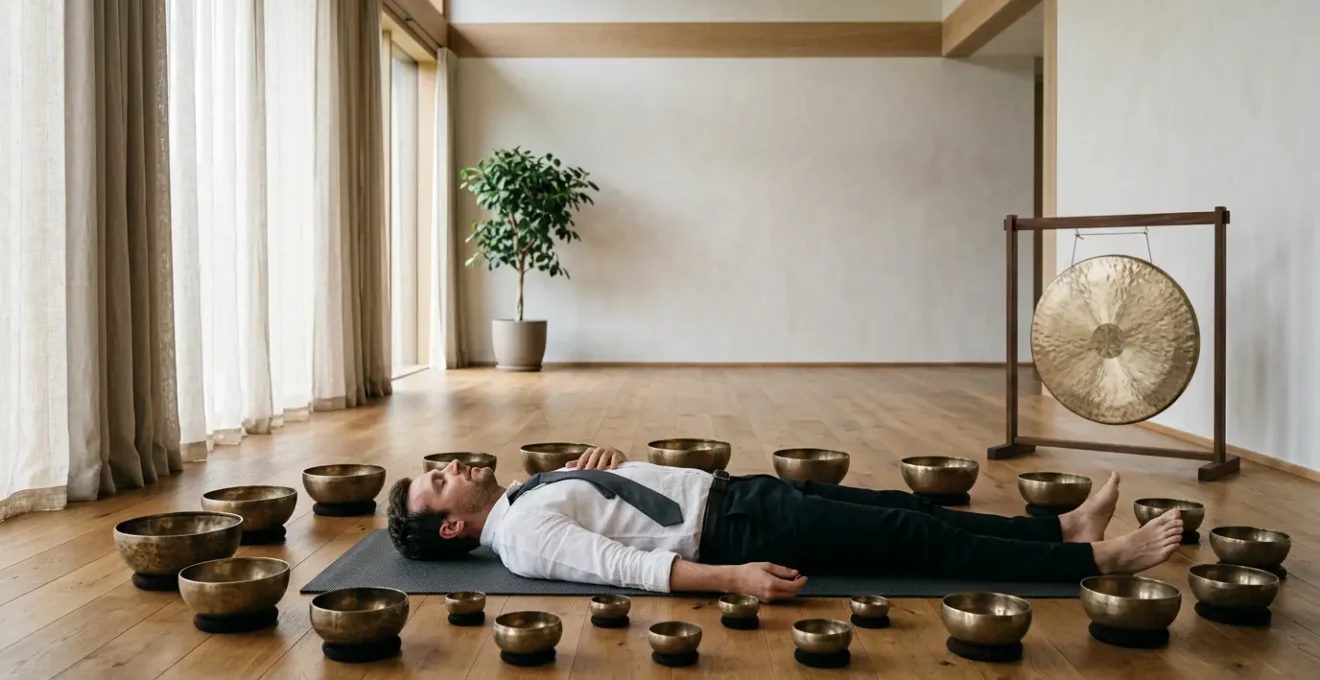
Sound baths lower cortisol not through relaxation alone, but by triggering a direct physiological shutdown of the body’s stress response via the vagus nerve.
- Vibrations from bowls and gongs physically stimulate the vagus nerve, activating the parasympathetic « rest and digest » system.
- Consistent frequencies guide the brain into a theta wave state (4-8 Hz), a neurological state that halts the production of stress hormones like cortisol.
Recommendation: Treat sound therapy as a form of neuro-acoustic training, focusing on the physical sensations and breath to maximize its hormonal benefits.
For the high-stress professional, the battle against chronic stress often feels like an unwinnable war fought with productivity hacks and fleeting moments of mindfulness. You’re told to meditate, exercise, and disconnect, yet the underlying current of tension remains, fueled by a constant drip of the stress hormone, cortisol. This adrenal fatigue leaves you wired but tired, struggling to find a solution that offers genuine physiological reset, not just temporary distraction. Many conventional wellness practices only skim the surface of the problem.
But what if the key to de-escalating your body’s stress response wasn’t another app or mental exercise, but a targeted physical intervention? What if you could use sound not just as ambient background noise, but as a precise tool to engage your nervous system directly? This is where the practice of sound baths moves beyond the realm of simple relaxation and enters the domain of neuro-acoustic therapy. The central premise is that specific sonic frequencies can induce a measurable biological cascade, starting with the vagus nerve and culminating in a significant reduction in cortisol levels.
This article will not ask you to simply « relax and listen. » Instead, it will guide you through the concrete, science-backed mechanisms that explain how a sound bath systematically dismantles your stress response. We will explore how you feel vibrations, what to expect in a session, the crucial safety considerations, and how your brain is intelligently guided into a state of deep restoration, ultimately giving you a new framework for managing stress on a physiological level.
To fully understand this process, we will break down the key elements of the sound bath experience, from the initial physical sensations to the profound emotional and neurological shifts that follow. The following sections provide a structured journey into this therapeutic practice.
Summary: The Professional’s Guide to Physiological Stress Reduction via Sound
- Why You Feel Sound Vibrations Physically in Your Chest?
- What to Expect During Your First 60-Minute Gong Bath?
- Epilepsy and Sound: Who Should Avoid Intense Sound Therapy?
- The « Spacey » Feeling Mistake: Driving Immediately After Therapy
- Problem & Solution: Creating a Mini Sound Bath with One Bowl
- Problem & Solution: Fixing Shallow Breathing to Reduce Stage Tension
- Shepard Tone or Haas Effect: How Our Brains Are Tricked by Sound?
- Why Certain Frequencies Trigger Emotional Release During Therapy?
Why You Feel Sound Vibrations Physically in Your Chest?
That distinct, rumbling sensation you feel in your chest and abdomen during a sound bath is not merely a psychological effect; it is a tangible physiological process called somatic resonance. Unlike sound heard only through the ears, low-frequency tones produced by gongs and large Tibetan bowls create sound waves with enough physical force to travel through the body. This is where the therapy begins its direct work on your nervous system. The chest cavity, being largely hollow and containing the lungs, acts as a natural resonance chamber, amplifying these vibrations in a way that is easily perceived.
This physical vibration is the primary mechanism for stimulating the vagus nerve, the longest cranial nerve in the body and the main component of the parasympathetic nervous system—your body’s « rest and digest » command center. The vagus nerve wanders from the brainstem down through the neck and into the chest and abdomen, with branches connecting to the heart, lungs, and digestive tract. As the Neuvana Life Research Team notes, « When we listen to music, the vibrations of the sound resonate in the eardrums before traveling through the vagus nerve. » When the vibrations are strong enough to be felt somatically, this stimulation is even more direct.
By stimulating this nerve, the low-frequency sounds effectively send a signal to your brain to switch off the sympathetic « fight or flight » response that keeps cortisol levels high. This activation, or improvement in « vagal tone, » slows the heart rate, deepens the breath, and signals the adrenal glands to halt the stress hormone cascade. Indeed, a pilot study demonstrated that vibrotactile stimulation can have a measurable neurological impact, finding that 33% of electrode pairs responded with increased coherence during 20 Hz vibration, indicating a harmonizing effect within the brain’s limbic system.
What to Expect During Your First 60-Minute Gong Bath?
Your first 60-minute gong bath is a journey of surrender, moving from active thought to a state of profound physiological rest. It’s crucial to understand this progression to avoid becoming frustrated by the initial « monkey mind. » The experience is not about forcing relaxation but about allowing the sound to guide your brain into it. The session can be broken down into three distinct phases, each with its own observable internal biomarkers.
Minutes 0-15: The Acclimatization Phase. As the session begins, your analytical mind will still be active. You might notice the complexity of the layered sounds, try to identify patterns, or find your thoughts drifting to your to-do list. This is normal. The role of the complex, often non-melodic sounds of the gong is to gently overwhelm the analytical brain, which seeks but cannot find a predictable structure to latch onto. During this time, your primary task is to focus on your breath and simply observe the sounds without judgment.
Minutes 15-40: The Parasympathetic Shift. This is where the physiological down-regulation becomes palpable. You will notice your breathing pattern deepen and slow naturally. A common and positive sign of this shift is the sound of stomach gurgles (borborygmi), which indicate the vagus nerve has activated your digestive system—a clear sign you’ve exited « fight or flight » mode. Your limbs may feel heavy as muscle tension releases, and you might perceive subtle changes in body temperature. This is the body entering a state of deep physical rest.
Minutes 40-60: The Theta State. In the final phase, your brainwaves shift from the alert beta state to the deeply meditative and restorative theta state (4-8 Hz). This is the same state experienced during REM sleep and deep meditation. As research from the Norwegian University of Science and Technology found, theta waves were most abundant in frontal brain regions during deep nondirective meditation. In this state, you may experience dreamlike imagery, a sense of timelessness, and a feeling of being disconnected from your physical body. It is in this neurological space that cortisol production ceases and cellular repair processes are optimized.
Epilepsy and Sound: Who Should Avoid Intense Sound Therapy?
While sound baths are a safe and effective modality for most individuals, their powerful effect on brainwave activity necessitates a responsible approach to contraindications. The very mechanism that makes sound therapy effective—brainwave entrainment—can pose a risk for individuals with certain neurological conditions, most notably epilepsy. For this small subset of the population, intense and rhythmic auditory stimulation can potentially trigger a seizure. This is a crucial consideration for both practitioners and clients to ensure a safe therapeutic environment.
The condition, known as audiogenic seizure or musicogenic epilepsy, is a rare neurological disorder. As the National Organization for Rare Disorders explains, it is « characterized by seizures that are triggered by acoustic stimulation, which can be simple (as in startle epilepsy) or complex (e.g. musicogenic seizures, seizures triggered by the voice). » The immersive, and at times intense, frequencies of a gong or the close proximity of a singing bowl can act as such a trigger. While extremely uncommon— research indicates that musicogenic epilepsy affects an estimated 1 in 10,000,000 people—the risk is not zero, and safety must always be the first priority.
This is why a thorough intake process is essential. Individuals with a history of seizures, epilepsy, or other neurological conditions should consult their physician before attending a sound bath. It’s also important to inform the sound therapist of any such conditions. Other groups who should exercise caution include pregnant women (especially in the first trimester), individuals with pacemakers or other implanted medical devices, and those with severe mental health conditions, as the deep state of release can sometimes be destabilizing without proper support.

The goal of sound therapy is to promote healing and well-being, and this commitment begins with acknowledging and respecting individual sensitivities. A professional and ethical practitioner will always prioritize a client’s safety over their participation, creating a space of trust and care. Transparency about these contraindications is a hallmark of a credible and responsible practice.
The « Spacey » Feeling Mistake: Driving Immediately After Therapy
One of the most common yet overlooked mistakes after a sound bath is getting up too quickly and attempting to operate a vehicle. The deeply relaxed, slightly disoriented, or « spacey » feeling you experience is a direct and positive indicator that the therapy worked. It signifies that your brain has successfully shifted into a theta wave state, the restorative neurological zone between wakefulness and sleep. Attempting to drive in this state is not only unwise but can be as dangerous as driving while drowsy.
As Dr. Ilene S. Ruhoy, a neurologist, explains in Psychology Today, « Theta waves (4-7Hz) [are] associated with drowsiness and meditative states. This state is sometimes referred to as a transitional period between an awake state and a true drowsy state where sleep is then entered. » Your reaction time, spatial awareness, and decision-making faculties are temporarily slowed. Just as you wouldn’t get behind the wheel immediately after waking from a deep sleep, you must allow your brain time to transition back from the low-frequency theta state (4-8 Hz) to the alert, focused beta wave state (13-30 Hz) required for safe driving.
A professional sound therapist will always incorporate a period of silence and gentle guidance at the end of a session to facilitate this transition. However, as a participant, you have a responsibility to your own safety. Plan to have at least 10-15 minutes after the session concludes to sit, drink some water, and fully return to your body before heading to your car. If you feel particularly disoriented, a simple grounding protocol can rapidly accelerate the shift back to an alert state of consciousness.
Your 5-Minute Grounding Protocol to Shift from Theta to Beta State
- Proprioceptive Activation: Press the palms of your hands together firmly for 30 seconds, then stomp your feet on the ground 10 times. This sends strong physical alertness signals to your nervous system.
- Sensory Stimulation: Drink a glass of cold water in small sips and splash some cold water on your face and wrists. If available, smelling a strong, bright scent like peppermint essential oil can also be highly effective.
- Visual Reorientation: Open your eyes wide and intentionally shift your focus. Look at a distant object for a few seconds, then a near object. Repeat this for one minute to fully reactivate your visual processing cortex.
- Movement Activation: Perform 10 simple standing-to-squat movements or some gentle jumping jacks. This increases your heart rate and blood flow, which is a key trigger for shifting brainwave frequencies towards the beta range.
Problem & Solution: Creating a Mini Sound Bath with One Bowl
The problem for many busy professionals is that scheduling a full 60-minute sound bath can be a logistical challenge. The solution is not to forgo the benefits but to integrate a « micro-dose » of sound therapy into your workday. A mini sound bath, lasting just five minutes with a single Tibetan singing bowl, can serve as a powerful pattern-interrupt to a stressful day, effectively lowering cortisol levels and resetting your nervous system right at your desk.
You don’t need an elaborate setup or a large gong to achieve a physiological effect. The key is combining the resonant sound of the bowl with intentional vagal nerve stimulation. A powerful and accessible technique for this is humming. As research from Neuvana Life highlights, « Humming has been shown to be an effective vagus nerve stimulator in a number of studies. » The vibrations created in your throat and chest during a low-pitched hum directly activate the vagus nerve. When you pair this with the external frequency of a singing bowl, the effect is compounded.
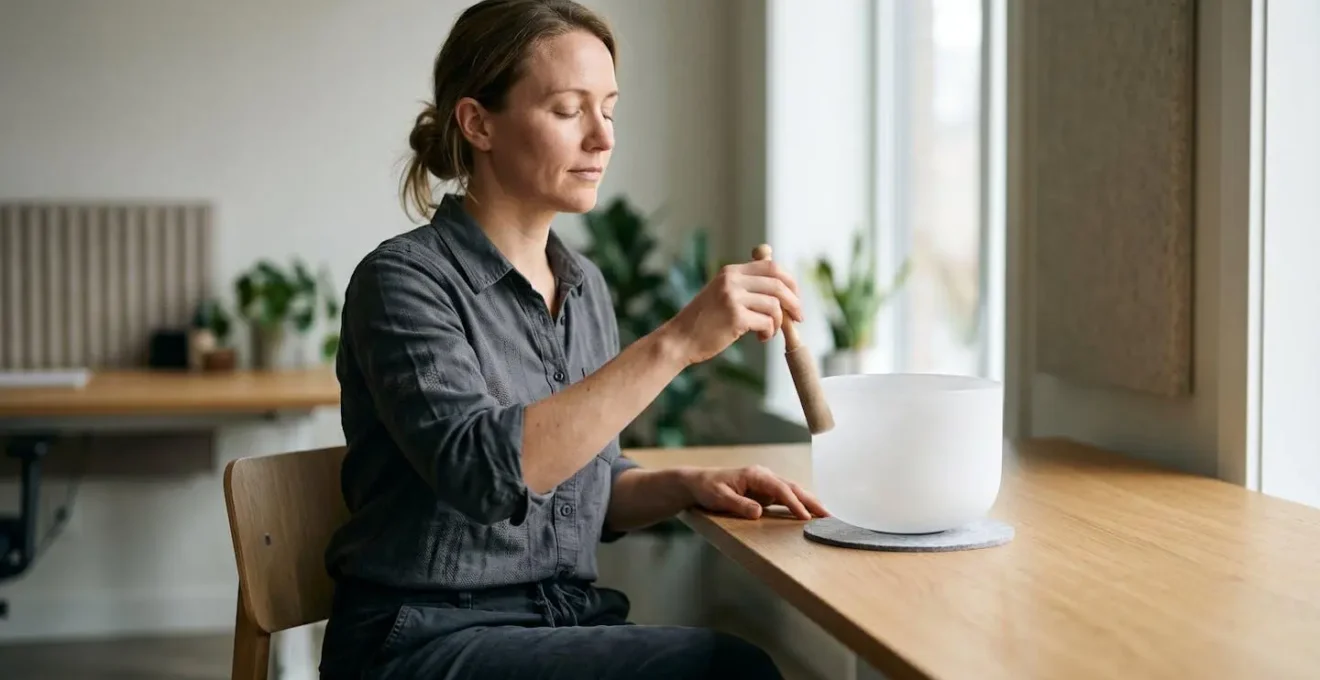
The protocol is simple: find a quiet space, strike your singing bowl gently, and as the sound sustains, close your eyes and begin a low, continuous hum for the duration of the sound. Focus on feeling both the vibration of your own voice in your chest and the sound waves from the bowl around you. Repeat this for 3-5 cycles. This brief intervention is enough to initiate a parasympathetic shift. In fact, a 2025 study measuring salivary cortisol demonstrated that cortisol levels in males could decrease significantly within 20 to 30 minutes of listening to specific music, and a targeted micro-session can produce a similar, albeit shorter-lived, effect.
This mini-ritual serves as a potent tool to use between high-stakes meetings or when you feel the physical symptoms of stress accumulating. It’s an accessible way to apply the principles of neuro-acoustic therapy on demand, empowering you to manage your physiological state proactively throughout the day.
Problem & Solution: Fixing Shallow Breathing to Reduce Stage Tension
A common manifestation of stress, especially for professionals facing presentations or high-pressure negotiations, is a tightening in the chest and a shift to shallow, rapid breathing. This is a classic symptom of the sympathetic « fight or flight » response, which constricts the diaphragm and reduces oxygen flow, creating a feedback loop of anxiety. A singing bowl can be used as a powerful biofeedback tool to break this cycle and retrain your body for deep, diaphragmatic breathing, which is essential for maintaining composure.
The solution lies in using the bowl not just for its sound, but for its physical vibration and duration. Instead of counting breaths, which can sometimes increase anxiety, you can use the bowl as an auditory and tactile pacer. The first technique is to lie down, place a flat-bottomed bowl directly on your solar plexus (the area just below your ribcage), and strike it gently. Your goal is to feel the physical vibration as a direct cue. Focus on breathing « into » the bowl, making it rise and fall. This provides unmistakable tactile feedback, confirming you are engaging your diaphragm rather than your chest.
The second technique uses the sound’s decay as a timer. Strike the bowl and inhale deeply as the sound begins to ring. Then, exhale slowly and completely for the entire duration of the sound’s natural decay, which can be 30-45 seconds or more. This forces you to extend your exhalation, which is a powerful signal to the vagus nerve to activate the parasympathetic nervous system and induce calm. Performing this simple exercise for just five minutes before a presentation can dramatically reduce physical tension and mental anxiety.
This process can be enhanced by listening to specific audio tracks. For instance, research on brainwave entrainment shows that binaural beats can be used to guide the brain out of a high-anxiety state. Using this principle, listening to audio with frequencies in the low-alpha range (8-10 Hz) for a few minutes pre-performance can scientifically shift your brainwaves from an anxious beta state to one of calm, focused alertness, priming you for optimal performance.
Shepard Tone or Haas Effect: How Our Brains Are Tricked by Sound?
Part of the profound and immersive nature of a sound bath comes from the use of psychoacoustic principles that « trick » the brain, guiding it into a state of deep meditation. While a gong bath doesn’t typically use a perfect Shepard Tone (an auditory illusion of a continually rising or falling pitch), it employs similar concepts of layered, complex frequencies that defy the brain’s predictive patterns. This is a key reason why it’s so effective at quieting the analytical « monkey mind. »
Our brains are constantly trying to make sense of auditory input, predicting melodies, rhythms, and sources. A well-played gong produces a massive spectrum of harmonics and overtones that are not linear or easily predictable. The sound seems to swell, recede, and come from multiple directions at once. This acoustic complexity gently overwhelms the brain’s predictive processing centers, particularly in the left hemisphere, which is associated with logic and language. Unable to analyze or categorize the sound, the brain has little choice but to surrender its analytical efforts and simply experience it. This is a form of induced mindfulness.
Another related principle is the use of tones that create a sense of vastness and immersion. As described by Soul Sanctuaries Sound Healing Research, « The deep, low tones of a gong can encourage the brain to slow down into a meditative state, promoting a sense of calm and mental clarity. » These low frequencies are less directional, making them feel all-encompassing, as if the sound is originating from within and around you simultaneously. This blurs the boundary between your sense of self and your environment, a state often described in deep meditation. It is this intentional, science-based use of complex acoustics that facilitates the shift from active thinking to passive, restorative awareness.
Key takeaways
- The physical vibration of sound is a primary tool for stimulating the vagus nerve and activating the body’s relaxation response.
- A 60-minute sound bath is a structured journey that guides the brain from an active state into a restorative theta wave state where cortisol production halts.
- Safety is paramount; individuals with epilepsy or certain medical implants should consult a doctor before attending intense sound therapy sessions.
Why Certain Frequencies Trigger Emotional Release During Therapy?
It is not uncommon for participants in a sound bath to experience a sudden and unexpected release of emotions, from tears to laughter. This is often the most surprising, and ultimately most therapeutic, aspect of the experience for many high-stress professionals who are accustomed to suppressing their feelings. This emotional catharsis is not a random occurrence; it is a predictable outcome of guiding the brain into the specific neurological state where the barrier between the conscious and subconscious mind becomes permeable.
As we’ve explored, the sound frequencies entrain the brain into a theta wave state. This is the domain of the subconscious. In our normal, waking beta-wave state, the prefrontal cortex—our « CEO brain »—is firmly in control, managing logic, reason, and emotional suppression. When theta waves become dominant, the influence of the prefrontal cortex diminishes, allowing suppressed emotions, unprocessed memories, and deep-seated tensions to surface. As RoundGlass Living’s research beautifully puts it, « States associated with the theta rhythm cradle the intriguing border between the conscious and subconscious worlds. »
The sound bath creates a safe, non-judgmental container for this process to unfold. The continuous, immersive sound provides a stable anchor, allowing these emotions to arise and be released without the conscious mind needing to analyze or resist them. You are not « thinking » your way through the emotion; you are allowing the body and the subconscious to release it through a purely somatic and energetic process. This is why the release can feel so pure and cleansing—it bypasses the intellectual filters that so often complicate our emotional lives. The theta state, as the research suggests, may indeed be a natural « repair mode » for the psyche.
For the professional who spends their days in a state of high-alert, analytical control, this therapeutic release is the final step in truly reducing the body’s cortisol load. It clears the emotional backlog that contributes to chronic stress, creating a sense of lightness, clarity, and profound peace that extends far beyond the session itself.
By approaching sound baths with this understanding of their physiological and neurological impact, you can transform them from a passive relaxation activity into an active tool for managing your health. Start by exploring a session with a certified therapist to experience these effects firsthand and learn to apply these principles in your daily life for lasting stress reduction.