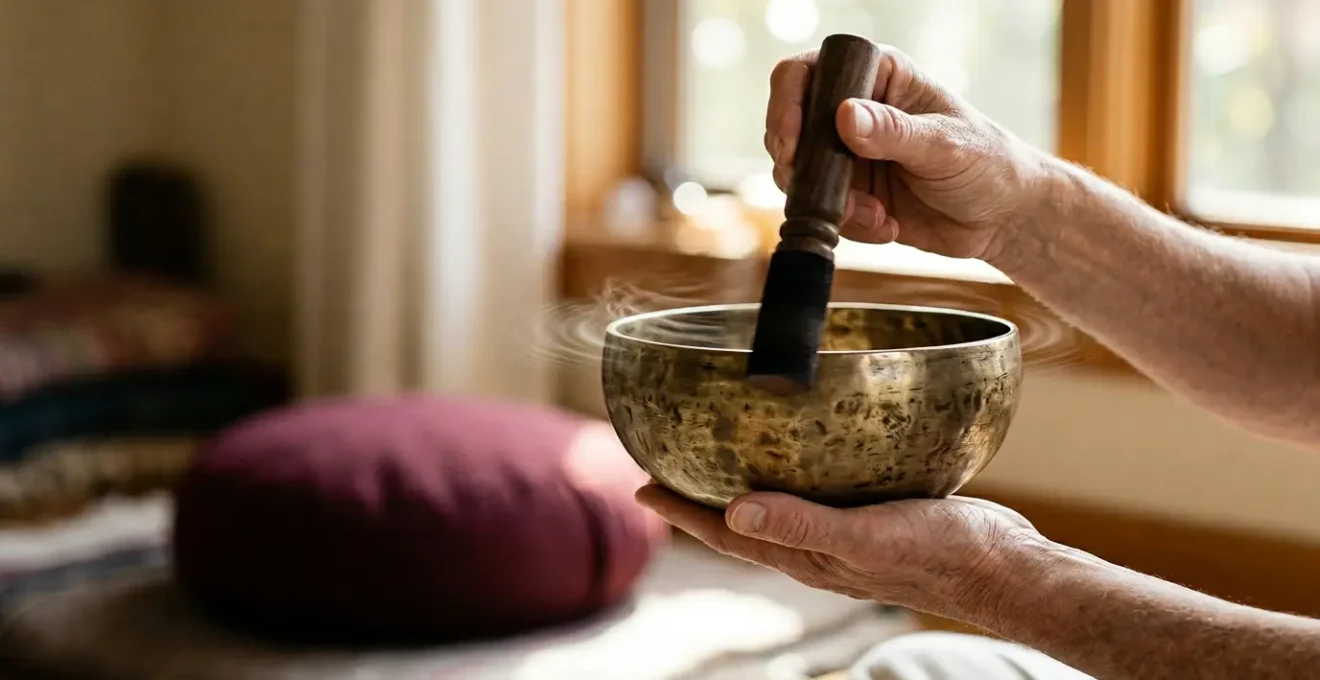
If you struggle with a wandering mind in silence, the solution isn’t fighting it—it’s intentionally giving it a productive focus through sound.
- Every sound, from a singing bowl to a mantra, has a unique « vibrational signature » that produces a specific physiological effect.
- By choosing the right sound for your goal—calming, energizing, or releasing emotion—you can actively « tune » your mental state.
Recommendation: Start by experimenting with one type of sound anchor, like a specific vowel tone, and observe its effect on your body and mind without judgment.
You sit down to meditate, close your eyes, and take a deep breath. You seek stillness, a moment of peace. But instead of silence, you’re met with a chorus of thoughts—the « monkey mind » leaping from to-do lists to past conversations and future worries. It’s a common frustration that leads many to believe meditation isn’t for them. The usual advice is to just observe the thoughts, or perhaps use a generic « relaxing » soundtrack as a distraction. But what if this approach misses the point entirely?
What if sound wasn’t a crutch for those who can’t handle silence, but a sophisticated tool for actively guiding the mind? The true power of sonic anchors lies not in masking your thoughts, but in giving your consciousness a precise, intentional object of focus. Each sound carries a unique vibrational signature, a key designed to unlock a specific psycho-physiological state. It’s the difference between aimlessly floating in the ocean and using a rudder to navigate toward a specific shore.
This guide moves beyond the platitudes. We will explore how to consciously select the right sound—the right key—for the right internal lock. You will learn to differentiate the effects of metal and crystal bowls, understand why ancient mantras have such a profound impact on the brain, and discover how to use your own voice to release stored emotions. The goal is to transform your relationship with sound from a passive listening experience into an active partnership in your journey toward deeper awareness and inner peace.
To guide you on this journey of sonic exploration, this article is structured to help you understand the unique properties of each sound anchor and how to apply them to your practice effectively. Discover the path from mental chatter to profound stillness.
Summary: Beyond Silence: A Practical Guide to Sonic Meditation Anchors
- Metal or Crystal: Which Bowl Resonates with Your Personal Pitch?
- Sanskrit or English: Does the Meaning Matter More Than the Sound?
- Silence or Background Drone: Which Supports Focus Better?
- The Rhythm Mistake That Causes Hyperventilation During Pranayama
- Problem & Solution: Choosing Energizing vs Calming Sounds
- Vowel Sounds or Om: Which Toning Technique Releases Anger?
- Why Your Fear of Wrong Notes Is Blocking Your Emotional Expression?
- How Sound Baths Reduce Cortisol Levels in High-Stress Professionals?
Metal or Crystal: Which Bowl Resonates with Your Personal Pitch?
When choosing a singing bowl, the material is not merely an aesthetic choice; it defines the very nature of the sound and its therapeutic effect. Your selection should be guided by the kind of « vibrational signature » you wish to invite into your practice. Metal and crystal bowls are not interchangeable—they are distinct instruments for sonic tuning, each with a unique purpose.
Metal bowls, traditionally made from a bronze alloy, are masters of complexity. They produce a rich, layered sound filled with multiple, overlapping frequencies. In fact, bronze bowls produce 4-18 simultaneous frequency partials, creating a complex soundscape with internal beat frequencies. This intricate web of sound is deeply immersive, making it an excellent tool for quieting a busy mind. The multiple harmonics give your awareness a vast, textured landscape to explore, effectively drowning out intrusive thoughts by offering a more compelling focus. Think of it as a rich tapestry of sound that envelops your consciousness.
Crystal bowls, in contrast, are paragons of purity and clarity. Typically producing only one to three partials, their sound is a clean, stable, and unwavering tone. This singular focus makes them exceptionally powerful for targeted resonance work. If you are working on a specific chakra or intention, the crystal bowl’s pure frequency acts like a tuning fork for your energy field, bringing it into alignment without the complexity of multiple harmonics. It doesn’t distract the mind with complexity; it commands it with clarity. The choice, therefore, depends on your need: a complex, enveloping sound to get lost in (metal), or a pure, focused tone to align with (crystal).
Ultimately, the best bowl is the one that resonates with your personal state on any given day. Some days you may need the complex embrace of metal, and on others, the clarifying call of crystal. Approach the choice with curiosity and let your inner state be your guide.
Sanskrit or English: Does the Meaning Matter More Than the Sound?
The debate between using traditional Sanskrit mantras and their English translations touches on a fundamental question: is the power of a mantra in its literal meaning or in its vibrational essence? As a meditation teacher, I guide students to understand that while intention is vital, the sonic properties of certain ancient languages appear to have a unique and measurable effect on the brain. The sound itself is a powerful technology.
Neuroscientific research has begun to illuminate this. Studies comparing the recitation of Sanskrit mantras to their translations have shown remarkable differences in brain activity. For instance, research from MIT and Stanford demonstrates that Sanskrit mantras activate seven to nine different regions of the brain, while their English counterparts typically activate only two or three. This suggests the specific phonetics and rhythmic structure of Sanskrit—the precise way the tongue hits the palate, the length of the vowels—are not arbitrary. They are a form of neuro-linguistic programming that has been refined over millennia to induce specific states of consciousness.

This doesn’t mean English affirmations are useless; they are excellent for setting conscious intentions. However, the true power of a traditional mantra lies in its ability to bypass the analytical mind. You don’t need to intellectually grasp the meaning of « Om Mani Padme Hum » for it to work. As a research review by Ashim Dutta notes, mantra repetition engages attention networks and quiets inner chatter by its very nature. The sound itself becomes the anchor, its vibration resonating through your body and mind.
Mantra repetition influences brain activity, autonomic physiology, and psychological health by engaging attention networks, quieting inner discursiveness, and triggering the body’s mechanisms of calm and restoration.
– Ashim Dutta, Mantras and the Mind: The Neuroscience of Sacred Sound
So, does meaning matter more than sound? The wisest approach is to use both. Use English affirmations to set your intention and program your conscious mind. Then, use a Sanskrit mantra to let the sound itself do the deeper work of tuning your entire nervous system.
Silence or Background Drone: Which Supports Focus Better?
For the meditator plagued by a « monkey mind, » absolute silence can feel less like a sanctuary and more like an echo chamber for anxious thoughts. In this context, a constant, unobtrusive background sound—a drone—is not a crutch but a strategic tool. It doesn’t eliminate thoughts, but it creates a stable sonic container that prevents external noises from hijacking your attention and gives the wandering mind a smooth, featureless surface to rest upon.
The primary function of a drone, like white noise or the hum of a fan, is to mask auditory variability. Our brains are wired to notice change. A sudden dog bark, a distant siren, or a creak in the floorboards can instantly pull you out of a meditative state. A steady drone creates a consistent auditory floor, making these intermittent sounds less jarring and less likely to break your focus. As the guides at Studio Anya explain, « Their steady frequency blocks out intermittent sounds like traffic, voices, or household noises, » cultivating a more peaceful internal space.
However, the goal is not simply to block out the world. The drone serves a deeper purpose: it provides a simple, non-engaging anchor for your attention. Unlike music with a melody or a podcast with words, a drone has no narrative and no emotional arc. It is present without being demanding. This allows your mind to settle without being bored. You can let the sound be the primary object of your meditation or simply let it hold the space while you focus on your breath. In either case, it provides a gentle but persistent reminder to return to the present moment whenever the mind begins to stray. The result, as studies show, can be a marked improvement in focus. In fact, research demonstrates that a brief pre-work meditation can improve attention span by 16% and reduce mental task-switching, an effect that is often easier to achieve with the support of a stable sound anchor.
Experiment with different types—the gentle hiss of pink noise, the deeper rumble of brown noise, or the simple hum of an air purifier. The right drone should feel like a soft blanket, present and comforting but easy to ignore once you settle in.
The Rhythm Mistake That Causes Hyperventilation During Pranayama
Pranayama, or yogic breathwork, is a powerful tool for regulating the nervous system. However, when approached with force or anxiety, it can backfire. One of the most common and unsettling mistakes beginners make is inadvertently creating a breathing rhythm that leads to hyperventilation. This often stems from a misunderstanding: the goal isn’t to take the biggest, fastest breaths possible, but to create a smooth, balanced, and intentional rhythm.
The mistake lies in over-emphasizing the inhalation and rushing the exhalation, often with a subtle tension in the chest and shoulders. A practitioner might think they are « doing more » by pulling in vast amounts of air, but this rapid, shallow breathing pattern is precisely what the body does during a stress response. It sends a panic signal to the nervous system. As experts at The Kaplan Center explain, « if breathing is shallow and fast, as is common in the stress response, hyperventilation occurs, which lowers carbon dioxide too much, leading to dizziness, unease, and anxiety. » Instead of calm, you create the very state you were trying to avoid.
The solution is to shift your focus from the *volume* of air to the *rhythm and quality* of the breath. The single most effective technique to prevent this mistake is to make your exhalation longer than your inhalation. This is a foundational principle of calming pranayama. A simple and safe rhythm to start with is the 4-6 count: inhale gently through your nose for a count of four, and then exhale slowly and completely, also through your nose, for a count of six. There should be no strain, no holding, and no « pushing » the air out. The longer exhale activates the parasympathetic nervous system (the body’s « rest and digest » system), which is the physiological antidote to the fight-or-flight response that causes hyperventilation.
Approach your breath with gentleness and curiosity, not force. The magic of pranayama isn’t in how much you can breathe, but in how gracefully you can guide the natural rhythm of your own life force.
Problem & Solution: Choosing Energizing vs Calming Sounds
Not all sound anchors are created equal. Just as you wouldn’t drink a cup of coffee to help you fall asleep, you shouldn’t use the same sound for every meditative goal. The problem many practitioners face is using sound indiscriminately, hoping a « relaxing » track will somehow both energize them for the day and calm them for sleep. The solution lies in understanding that different frequencies and sound patterns have different effects on our brainwaves and nervous system, allowing us to choose our sonic tool with intention.
The underlying mechanism is a process called brainwave entrainment. Your brain produces electrical patterns, or brainwaves, that correspond to different mental states (e.g., Delta for deep sleep, Alpha for relaxed focus, Beta for active thinking). Sound, particularly rhythms and pulses, can encourage your brain to synchronize with an external frequency. This is not pseudoscience; research published in National Geographic confirms that certain sound frequencies, like binaural beats, can entrain brainwave patterns, effectively guiding your mind toward states of calm or focus.
Generally, for calming and relaxation, you want sounds that are slow, have a low frequency, and are sustained. Think of the deep rumble of brown noise, the slow rhythm of ocean waves, or a low-pitched singing bowl. These sounds encourage your brain to shift toward Alpha and Theta states, associated with relaxation and deep meditation. For energy and focus, you want sounds that are slightly more complex and in the mid-to-high frequency range, without being jarring. The steady, even patterns of Baroque music (around 60 beats per minute) or the complex but gentle sound of a forest with birdsong can help entrain a state of alert-yet-calm Beta waves, ideal for focused work or starting your day with clarity.
Your Guide to Selecting the Right Sound
- White Noise: Best for blocking out sharp, unpredictable sounds like office chatter or construction. Use at a moderate volume to avoid it becoming a distraction itself.
- Pink Noise: Softer and more natural-sounding than white noise. Excellent for extended work sessions and can enhance deep sleep and memory consolidation.
- Brown Noise: Features even deeper frequencies, like a rumbling waterfall. Ideal for people sensitive to higher frequencies and highly effective for focus, particularly for those with ADHD.
- Nature Sounds: Rain, ocean waves, and forest ambiances are proven to reduce stress and improve cognitive performance through the biophilia effect (our innate connection to nature).
- Baroque Music: Classical pieces at approximately 60 beats per minute can enhance learning and memory by providing structured patterns that support sustained attention.
Instead of just putting on « meditation music, » ask yourself: What is my intention right now? Do I need to ground and calm, or do I need to focus and energize? Then, choose your sound accordingly. This simple shift in perspective can dramatically deepen the effectiveness of your practice.
Vowel Sounds or Om: Which Toning Technique Releases Anger?
When dealing with potent, fiery emotions like anger, the generic advice to « just breathe » can feel dismissive. Sometimes, the energy is too intense; it needs a physical pathway for release. This is where vocal toning becomes a uniquely powerful tool. While the mantra « Om » is a beautiful tool for creating a sense of universal connection and harmony, it is not always the most effective tool for processing visceral anger. For that, the raw, open power of simple vowel sounds is often more direct and liberating.
The science behind this lies in the stimulation of the vagus nerve, a primary component of the parasympathetic nervous system. As noted in research from Simple Sanskrit, « Vocal chanting stimulates the vagus nerve through controlled breathing and sound vibration, which supports emotional regulation and calmness. » The vibration of your own voice, resonating in your chest and throat, is a direct, physical massage for this crucial nerve, helping to shift you out of a fight-or-flight state. Vowel sounds offer a more versatile and less inhibited way to access this mechanism when dealing with difficult emotions.
Think of « Om » as a closed-loop system; the « M » sound at the end brings the energy back inward, creating a feeling of wholeness. This is wonderful for peace but can feel restrictive when you need to let something go. Vowel sounds—like « Ahhh, » « Ohhh, » or « Ehhh »—are open-ended emotional release valves. There is no closing ‘M’ sound to contain the energy. You can release the sound and the emotion with it. The « Ah » sound, for example, is naturally associated with opening the heart and chest, a physical release for the constriction that often accompanies anger. Toning a long, sustained « Ahhh » sound allows you to physically move the stuck energy of anger out of your body on the wave of your breath and voice. It’s a safe, contained way to express and release the emotion without directing it at anyone.
So, while « Om » is a profound tool for generating peace, don’t be afraid to turn to the raw power of a simple vowel when you need to clear the air. Let the « Ahhh » sound be your permission slip to open up, release the pressure, and allow the anger to dissipate into the space around you, transformed by the power of your own voice.
Why Your Fear of Wrong Notes Is Blocking Your Emotional Expression?
In vocal toning or mantra practice, there’s a common hesitation I see in students: a fear of « sounding bad » or « getting it wrong. » This self-consciousness, this perfectionism, is the single greatest obstacle to the practice’s true purpose. The goal of using your voice as a meditation anchor is not to give a concert-hall performance. It is to create a physical vibration that can move and release stored emotional energy. Your fear of hitting a wrong note is the very thing blocking that release.
Emotional expression is inherently messy, and your voice is one of its most direct channels. When you hold back your voice for fear of it cracking, being off-key, or sounding « ugly, » you are, in effect, reinforcing the same pattern of emotional suppression you are trying to heal. The authentic sound of releasing sadness may not be a perfect pitch; it might be a wavering, fragile tone. The sound of releasing anger might be a raw, dissonant growl, not a harmonious chord. By judging these sounds as « wrong, » you are judging the authentic expression of your emotion as wrong, and so the energy remains stuck.

The transformative power of sound practice comes from repetition and intention, not from perfection. Consider the remarkable findings of neuroscientist James Hartzell, who studied the brains of professional Vedic Sanskrit pandits. These individuals train for years to orally recite ancient texts. MRI scans revealed they had substantial increases in gray matter density and cortical thickness in brain regions tied to memory and language. This neuroplasticity wasn’t a result of their perfect pitch, but of their disciplined, consistent practice. The brain changed in response to the sustained activity of producing sound.
The « right » note is the one that is authentic in the moment. Give yourself permission to be messy, to be imperfect, to be human. Your voice is not an instrument to be judged; it is a tool to be used. Use it, and in the act of using it, you will find the very release you seek.
Key Takeaways
- Each sound anchor (bowl, mantra, drone) has a unique « vibrational signature » that produces a specific, measurable physiological effect.
- The goal of vocal toning is not perfection but authentic expression; the fear of « wrong notes » is the primary barrier to emotional release.
- You can intentionally « tune » your nervous system by choosing specific sounds: low-frequency, sustained sounds for calming, and more complex patterns for energizing.
How Sound Baths Reduce Cortisol Levels in High-Stress Professionals?
For high-stress professionals, the mind often operates in a state of chronic hyper-vigilance. The nervous system is perpetually in a low-grade « fight or flight » mode, leading to elevated levels of the stress hormone, cortisol. While traditional silent meditation can be effective, it can also feel like another task to « get right, » which can be counterproductive. Sound baths offer a profound alternative by providing an immersive experience that requires no effort from the participant, allowing the nervous system to down-regulate and cortisol levels to fall naturally.
A sound bath is a form of passive meditation. You simply lie down and allow the waves of sound from various instruments like gongs, singing bowls, and chimes to wash over you. This is not just a poetic description; the sound waves create physical vibrations that permeate the body. This process bypasses the analytical mind, which is often the source of stress for professionals who are paid to think, analyze, and solve problems all day. You don’t have to « do » anything. You don’t have to quiet your mind. You simply have to be present as the sound does the work for you.
The results are measurable and significant. A 2020 clinical study measuring mood and stress showed noticeable improvements in participants’ stress index and heart rate variability after sound therapy. They reported reduced tension, anger, fatigue, and confusion. Crucially, research published in National Geographic found that when comparing silent meditation to sound meditation, « sound meditators reported significantly less stress, tiredness, and negativity. » For a professional running on empty, this is a powerful testament to the restorative power of sound. It provides a direct pathway to the parasympathetic « rest and digest » state, allowing cortisol production to decrease and giving the body and mind a chance to genuinely recover.
By stepping into a sound bath, you are giving your over-active mind a much-needed vacation. It is one of the most effective and accessible ways for busy professionals to combat the physiological effects of chronic stress and recalibrate their entire system, emerging calmer, clearer, and more resilient.