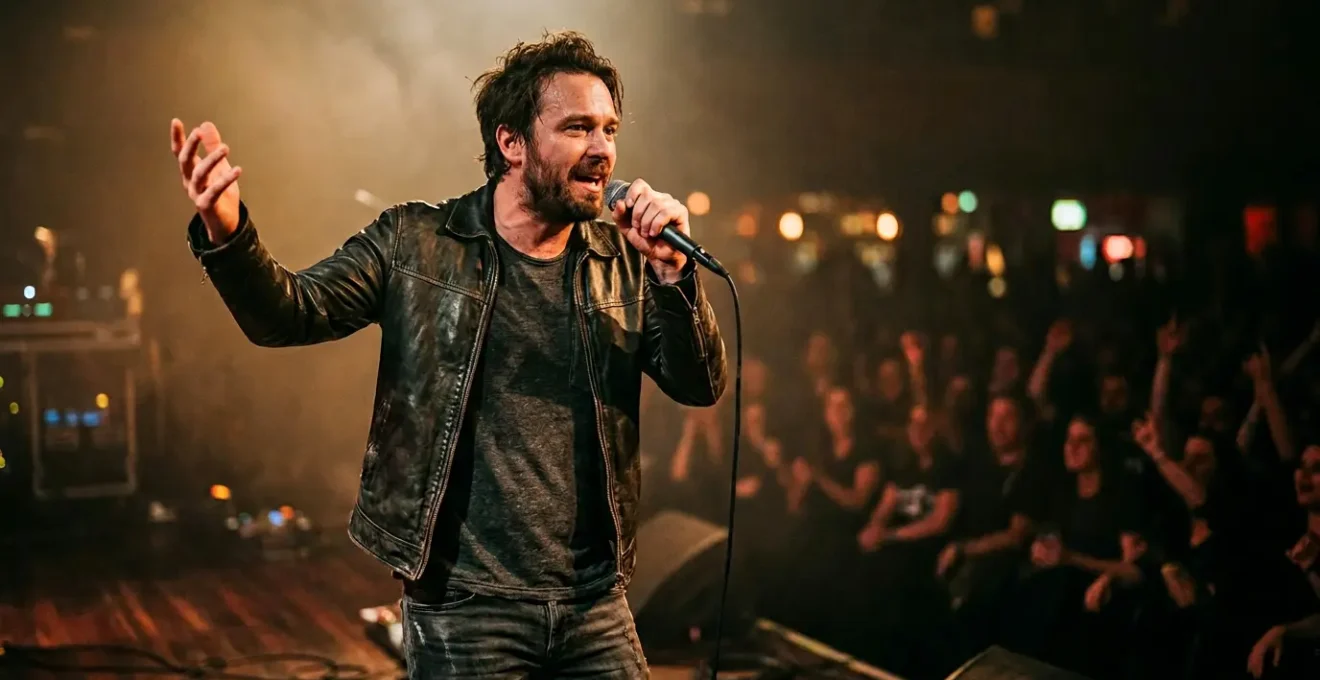
The secret to killing stage fright isn’t ‘being more confident’—it’s learning a physical vocabulary to channel nervous energy into a commanding performance.
- Stop trying to be « cool » and distant; genuine vulnerability creates a powerful connection with the audience.
- Treat the stage as a territory to be owned, using strategic movement to create visual scale and intimacy.
- Reframe technical mistakes not as failures, but as opportunities for human connection and emotional expression.
Recommendation: Start by choosing one physical action from this guide—like breaking out of your ‘safe spot’ behind the mic—and make it a non-negotiable part of your next rehearsal.
You’re on stage. The lights are hot, the amp is buzzing, and you know your parts inside and out. You sound fantastic. But when you watch the video back, you see someone who looks stiff, awkward, and trapped in their own head. The music is there, but the connection isn’t. It’s a frustratingly common problem for talented performers. You’ve probably been told to « just be confident » or to « make more eye contact, » but this vague advice rarely helps when your heart is pounding and your legs feel like lead.
The truth is, those platitudes miss the entire point. They treat stage presence as a mysterious, innate quality you either have or you don’t. They focus on an internal feeling—confidence—which is the hardest thing to control under pressure. But what if the solution wasn’t in your head, but in your body? What if stage fright wasn’t something to eliminate, but a source of powerful energy to be redirected? This guide is built on that very principle. We are going to stop trying to *feel* confident and start *acting* with command.
This isn’t about faking it. It’s about learning a physical language. We’ll dismantle the idea that being a « cool, » detached performer is effective. We’ll explore how to use your body and the space around you to build a dynamic, authentic connection with every single person in the room. Forget imagining the audience in their underwear; we’re going to teach you how to look them in the eye and make them feel like they’re part of the show. Prepare to transform from a musician who performs *at* an audience to a frontman who commands the room.
This article will guide you through the practical, physical strategies to unlock your inner frontman. We will cover everything from your mindset to your movement, giving you actionable techniques to build a commanding and authentic stage presence.
Summary: A Frontman’s Guide to Commanding the Stage
- Why Your « Cool » Persona Is Actually Creating a Barrier with the Audience?
- How to Use the Entire Stage to Make Your Band Look Larger?
- Hand-Held or Stand: Which Mic Technique Suits Your Genre Best?
- The « Hello Cleveland » Mistake That Makes You Look Inauthentic
- Problem & Solution: Looking Good in Bad Club Lighting
- Why Your Fear of Wrong Notes Is Blocking Your Emotional Expression?
- How to Match Your Instagram Aesthetic to Your Sound?
- How to Convert Casual Listeners into Superfans Who Buy Merch?
Why Your « Cool » Persona Is Actually Creating a Barrier with the Audience?
Many performers, especially when nervous, adopt a « cool » persona. They stand still, stare at their shoes or the back wall, and act aloof. They think it projects an air of mystery or rock-and-roll indifference. The reality? It’s a defensive wall. This detached coolness tells the audience one thing: « I’m not here with you. » It creates an invisible barrier that prevents any real energy exchange. Your audience didn’t pay to watch a rehearsal; they paid for a connection, an experience. They want to see the human behind the music.
The most magnetic performers in history did the exact opposite. They tore down the wall with raw, unapologetic vulnerability. As highlighted in performance studies, true stage presence is a mix of confidence and authenticity. This is confirmed by experts who note that stage presence involves vulnerability that allows performers to connect more deeply with their audience. It’s the crack in the facade that lets the light in, and lets the audience’s energy in, too. Being « cool » is safe. Being vulnerable is brave, and audiences respond to bravery.
Case Study: Freddie Mercury’s Emotional Stage Presence Strategy
Think about Freddie Mercury. He wasn’t « cool » in a detached sense; he was a blazing sun of emotion. He didn’t just sing songs; he shared his entire being with the crowd. He exemplified an extraordinary stage presence built on a foundation of charisma, explosive movements, and, most importantly, active audience interaction. Instead of maintaining a distant persona, he engaged the crowd with call-and-response chants, shared personal moments and jokes, and moved with an exuberance that was impossible to ignore. This created a profound emotional connection, making every person in a massive stadium feel like they were part of an intimate moment, not just spectators.
So, the first step is a mental shift. Your goal isn’t to look untouchable. Your goal is to be radically present and emotionally available. The energy you’ve been using to maintain your « cool » wall can be repurposed to build a bridge directly to your audience. This shift from protection to connection is the foundation of true stage command.
How to Use the Entire Stage to Make Your Band Look Larger?
If you’re a performer who feels glued to a small patch of stage in front of your mic stand or pedalboard, you’re communicating insecurity. You’ve created a « safe spot, » and the audience can feel it. This makes you, and by extension your entire band, look smaller and less confident. The stage is your canvas, your territory. To command it, you must own every square inch of it. Learning to use the entire stage is a physical declaration of confidence that makes your presence—and your band’s—feel monumental.
This isn’t about running around aimlessly. It’s about purposeful movement that defines the space. Great performers use a concept called spatial dynamics. They move between different zones of the stage to change the emotional tone of the performance. Moving to the front edge (downstage) creates intimacy and connection. Holding the center projects power and authority. Retreating towards the back (upstage) can build mystery or give a bandmate the spotlight. By varying your position, you create a dynamic visual story that complements the music.
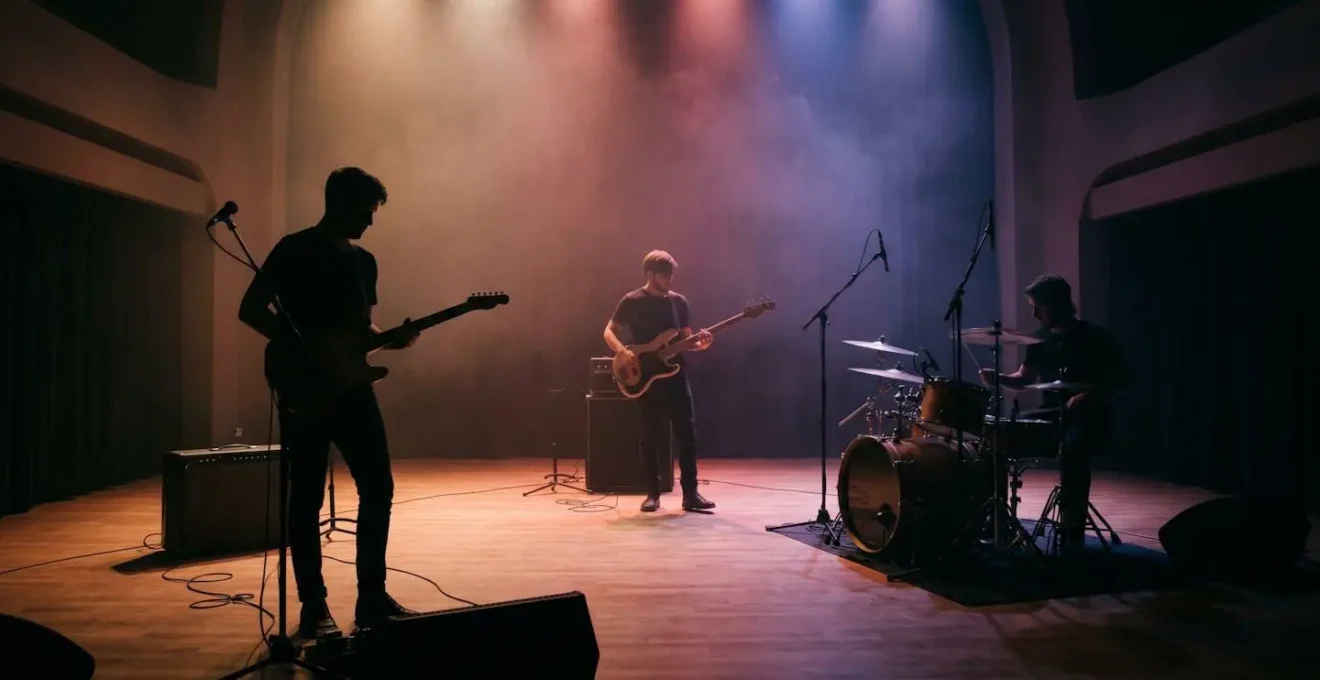
As the image shows, breaking out of a flat, horizontal line and using the depth of the stage creates a much more engaging and professional look. A triangular or layered formation makes a three-piece band look as visually commanding as a five-piece. You’re not just playing music; you’re choreographing the audience’s eye, creating visual interest, and literally making your band look larger than life.
Your Action Plan: Commanding Your Space
- Establish Points of Contact: In rehearsal, consciously visit every corner of the stage. Touch the back wall, walk to the front edge, go to the far left and right. Make the entire space your familiar territory.
- Inventory Your Movement: Film yourself. Identify your « safe spot » and any repetitive, nervous movements (like pacing). These are the habits to break.
- Confront with Purpose: For each part of a song, ask « Where should I be to support this emotion? » A quiet verse might be near the mic; a huge chorus is your cue to step forward and claim center stage.
- Gauge Mémorability: Is your movement telling a story or is it just random shuffling? A powerful move is one that feels motivated by the music. A pause at the edge of the stage before a big drop can be more impactful than 10 minutes of pacing.
- Integrate and Prioritize: Start small. Choose one song in your set to consciously « break the box. » Plan to step away from the mic during an instrumental, or walk to a bandmate and interact. Make it a deliberate, rehearsed action.
Start treating your stage plot like a football coach treats a playbook. Know your zones, plan your movements, and execute with intention. The moment you step out of your comfort zone, you start truly owning the stage.
Hand-Held or Stand: Which Mic Technique Suits Your Genre Best?
The microphone is not just a tool to make you louder; it’s a critical prop that shapes your entire performance. Your choice between a handheld mic and a stand-mounted one—and how you use it—sends a powerful message to the audience. It dictates your freedom of movement, your vocal tone, and even the aesthetic of your genre. Making a conscious choice here, rather than just defaulting to what’s available, is a key element of your physical vocabulary on stage.
A stand-mounted mic can act as an anchor, a home base. It’s ideal for performers who play an instrument or for genres like folk and jazz where subtle, controlled movements are part of the aesthetic. You can lean into it for intimacy, pull back for power, or grip the stand for dramatic effect. However, for many, it can also become a crutch—a barrier to hide behind. On the other hand, a handheld mic is an object of power. It frees you to roam the stage, to engage directly with the front row, and to use your entire body. It becomes an extension of your hand, perfect for the high-energy physicality of rock, pop, and hip-hop. The tradeoff is that you lose the ability to play an instrument, and poor technique can lead to inconsistent sound.
The key is to match the tool to the job. Don’t just grab what the sound guy gives you. Think about what your music and your performance style demand. It’s worth noting that certain microphones have become industry-standard choices for their durability and sound quality in live settings, making them reliable starting points for any performer. These industry workhorses are a testament to how crucial the right gear is for a live show.
| Genre/Style | Recommended Mic Type | Technique Approach | Key Advantage |
|---|---|---|---|
| Rock/Metal (Aggressive) | Dynamic handheld (SM58, Audix OM7) | Close proximity, high energy movement | Handles high SPL, durable for energetic performance |
| Pop/Contemporary | Condenser handheld (Beta 87A, Sennheiser e865) | Moderate distance, controlled movement | Captures vocal nuances and detail |
| Folk/Acoustic | Stand-mounted condenser | Fixed position, subtle movement | Captures delicate tonal qualities, allows instrumental playing |
| Jazz/Crooner Style | Vintage-style dynamic on stand | Proximity play for warmth, minimal movement | Warm tone, classic aesthetic |
| Hip-Hop/Rap | Dynamic handheld with tight pattern | Ultra-close technique, high mobility | Maximum isolation, physical connection to crowd |
Ultimately, the best technique is one that feels both natural and intentional. Experiment in rehearsal. If you use a stand, practice moving away from it and returning. If you use a handheld, practice holding the cable, gesturing with the mic, and maintaining consistent distance. Your microphone is your direct line to the audience—learn to use it with authority.
The « Hello Cleveland » Mistake That Makes You Look Inauthentic
You’ve seen it a thousand times. A band walks on stage, the singer shuffles to the mic and mumbles, « Hello [City Name]! Are you ready to rock?! » It’s the « Hello Cleveland » moment—a generic, paint-by-numbers attempt at stage banter that feels completely hollow. It’s a classic sign of a performer on autopilot. This kind of inauthentic interaction is worse than silence. It signals to the audience that you see them as a generic crowd, not as specific people sharing a room with you tonight.
Authentic stage banter isn’t about having a perfect, witty monologue prepared. In fact, that can be just as bad. It’s about creating real, unscripted moments of connection. It’s about breaking the fourth wall and acknowledging the reality of the room you’re in. This could mean commenting on something that just happened (« Wow, that feedback was intense! »), sharing a tiny, 10-second story about the song you’re about to play, or simply making genuine eye contact with someone in the front row and smiling. It’s about being human.
The goal is to shift from « performing » your banter to simply talking. As the performance educators at Soundfly put it, this is a skill that requires seeing it as an opportunity. They advise that stage banter is a lesson in multitasking where your words carry weight and should be made as natural as possible. Don’t try to be a comedian if you’re not one. Don’t try to be a philosopher. Just be yourself. A simple, honest « Thank you so much for being here with us tonight. This next song means a lot to us, » is a million times more powerful than a forced, clichéd call to action.
Prepare for these moments not by writing a script, but by finding « islands » in your set. Identify 2-3 spots where you can pause, breathe, and connect. Maybe it’s while the guitarist is tuning, or after a particularly high-energy song. These are your opportunities to turn a performance into a shared experience. Drop the act, look at the people in front of you, and just talk to them. That’s the antidote to « Hello Cleveland. »
Problem & Solution: Looking Good in Bad Club Lighting
You arrive at the venue, and the stage lighting consists of two dim red cans and a flickering blue par. It’s a performer’s nightmare. Bad lighting can wash you out, hide you in shadows, and completely kill the visual energy of your show. But as a charisma coach, I tell my clients: you cannot be a victim of your environment. You must learn to create your own light. This isn’t about bringing your own rig; it’s about using your body and your awareness to look dynamic even in the worst conditions.
First, think in terms of silhouette and contrast. If the lighting is muddy and dark, wearing all black will make you disappear. Opt for lighter colors or outfits with a mix of light and dark tones. Even a small element, like a white t-shirt under a dark jacket, can create a point of contrast that draws the eye. Textures and reflective materials are also your allies. A leather jacket, a satin shirt, or even a piece of metallic jewelry can catch the sparse light in a way that flat cotton won’t, creating moments of visual interest as you move.
Second, motion is your friend. A static object in bad lighting is just a lump. A moving object is a dynamic shape that the human eye is drawn to. You don’t need to do acrobatics. Use broader, more deliberate gestures. When you move your arm, make the movement full and intentional. When you step forward, make it a confident stride. This motion will interact with whatever light is available, creating shifting patterns of light and shadow that make you look alive and engaged. Find the « hot spots » on stage, even if they’re small, and move into them at key moments in a song—for a solo, a big chorus, or an important lyric.
Finally, use your energy to project past the footlights. Your most powerful tool isn’t a spotlight; it’s your focus. If you project energy, passion, and intensity through your facial expressions and body language, the audience’s brains will fill in the gaps. They will perceive you as dynamic and captivating because your performance *feels* that way. Don’t surrender to the gloom. Use contrast, motion, and focused energy to command attention, proving that a great performer is more powerful than a bad lighting rig.
Why Your Fear of Wrong Notes Is Blocking Your Emotional Expression?
Let’s talk about the enemy: perfectionism. As a musician, you’ve spent thousands of hours honing your craft, trying to eliminate mistakes. That discipline is valuable in the practice room, but on stage, it can become a cage. When your primary focus is « don’t mess up, » your mental and physical energy is tied up in prevention, not expression. You’re playing from a place of fear, not a place of passion. The audience doesn’t feel your technical precision; they feel your tension. Your fear of hitting a wrong note is blocking you from delivering the one thing they truly came for: an emotional experience.
As performance psychologist Noa Kageyama notes, there’s a better way. It’s not about practicing more, but about developing specific skills for performing under pressure. He states, « Performing well under pressure isn’t a matter of chance… There are some very concrete skills that maximize our chances of playing as well as we can. » The most important of these skills is shifting your focus from technical accuracy to emotional intent. Ask yourself, « What is the feeling of this song? » and dedicate your performance to conveying that feeling. When your goal is to express joy, anger, or longing, your body language, facial expression, and even your vocal tone will naturally align. A clam is just a clam. A moment of pure, unadulterated emotion is transcendent.
The solution is to adopt a different mindset, one borrowed from a genre built on improvisation and happy accidents.
The Jazz Mindset Applied to Performance Anxiety
In a world of rigid sheet music, the jazz philosophy offers a liberating alternative. Professional musicians, when discussing performance anxiety, often emphasize focusing less on perfection and more on connection with the music itself. As one performer insightfully noted in a discussion on pro tips for managing performance anxiety, « I remind myself that I will probably make errors in the performance, but that’s part of being human. The important thing is to perform with passion and bring the music to life. » This approach reframes mistakes not as failures, but as spontaneous, human moments. A wrong note isn’t a catastrophe; it’s an unexpected grace note in the story of the performance.
The audience will forgive a dozen flubbed notes if you give them one moment of genuine, breathtaking emotion. Let go of the fear. Embrace the humanity of live music. The moment you prioritize expression over perfection is the moment you become a true performer.
How to Match Your Instagram Aesthetic to Your Sound?
Your stage presence doesn’t end when the house lights come up. In today’s music world, your digital presence is a direct extension of your physical one. Your Instagram feed, in particular, is your 24/7 opening act. If your live show is energetic, raw, and dynamic, but your Instagram is full of static, poorly lit selfies, you’re creating a brand disconnect. You’re telling two different stories. Matching your digital aesthetic to your sound and stage persona is crucial for building a cohesive identity that turns casual listeners into a dedicated following.
This isn’t about having a « perfect » or overly curated feed. It’s about capturing the energy and texture of your live performance. Stop thinking about Instagram as just a photo album; think of it as a virtual stage. If your live show uses a lot of deep blues and warm amber lighting, let that color palette bleed into your posts. Use photos and videos that show the textures of your world: the wood grain of your guitar, the grit of a backstage wall, the condensation on a post-show beer. These details tell a richer story than a simple posed band photo.
Most importantly, prioritize capturing motion and emotion. A short video clip of the drummer going wild, a blurry photo of the singer mid-scream, a candid shot of the band laughing backstage—these are the images that convey the *feeling* of your music. They are the digital equivalent of a commanding stage presence. They show, rather than tell, what your band is about. Ditch the perfectly sterile, posed shots and embrace the beautiful chaos of being a real, performing musician. Look for the sweat, the passion, and the in-between moments.
Your Instagram should feel like a backstage pass to your world. It should reward fans with a deeper look into the energy they felt at your show. When a new fan discovers you, your feed should immediately give them a sense of your sound and what it would feel like to see you live. By aligning your physical and digital presence, you create a powerful, consistent brand that feels authentic and compelling, drawing people deeper into your music.
Key Takeaways
- Stage presence is a physical skill, not an innate talent. It’s about channeling nervous energy into deliberate, commanding action.
- Authenticity trumps « coolness. » Vulnerability and genuine human connection are your most powerful tools for engaging an audience.
- Own your space. Using the entire stage with purpose makes you and your band appear more dynamic and professional.
How to Convert Casual Listeners into Superfans Who Buy Merch?
The ultimate goal of a powerful stage presence isn’t just applause; it’s conversion. You want to convert the person who walked in off the street into a casual listener. You want to convert that casual listener into a dedicated fan. And you want to convert that fan into a superfan—the kind of person who not only streams your music but also buys the t-shirt, comes to the next show, and tells all their friends. This entire process is fueled by the connection you forge on stage. A great performance creates an emotional high, and your merch table is the place where fans can take a piece of that feeling home.
Your stage presence creates the demand. As research on the topic points out, « The power of stage presence leaves the live audience waiting in anticipation for the next song. The music industry creates star power when band members have great stage presence, which translates to more ticket sales. » That same principle applies directly to the merch table. But you have to complete the circuit. You can’t just hope they find their way over. You need a strategy that bridges the gap from the last chord to the cash box. Here are the essential steps:
- Mention your merch from the stage. It sounds simple, but it’s the most-missed opportunity. Before your last song, when the energy is at its peak, make a quick, authentic plug. A simple « We’ve got some new shirts over at the merch table, come say hi after the show! » is all it takes.
- Use the « Golden Hour. » The 30 minutes immediately following your set are critical. Get to your merch table as quickly as possible. This is your chance to meet people, thank them for coming, and create a personal connection. A handshake and a « Thanks for rocking with us » will sell more shirts than any fancy display.
- Make it authentic. Your merch plug should match your on-stage persona. If you’re a serious band, be direct. If you’re a fun, high-energy band, make a joke. « All this money goes directly to our gas tank and beer fund, so your support is deeply appreciated! » is honest, funny, and effective.
- Create trophies, not just products. Design merch that references a specific song lyric, an inside joke from your stage banter, or a memorable moment. This transforms a simple t-shirt from a piece of clothing into a memento of a shared experience.
Your performance makes them a fan for a night. Your connection at the merch table can make them a fan for life. It’s the final, crucial step in converting the energy you create on stage into tangible support that allows you to keep doing what you love.
Now you have the playbook. Stop waiting to feel confident and start practicing the physical actions of command. Get out of your head and into your body. The next time you step on stage, don’t just play your music—ignite the room. Start today.