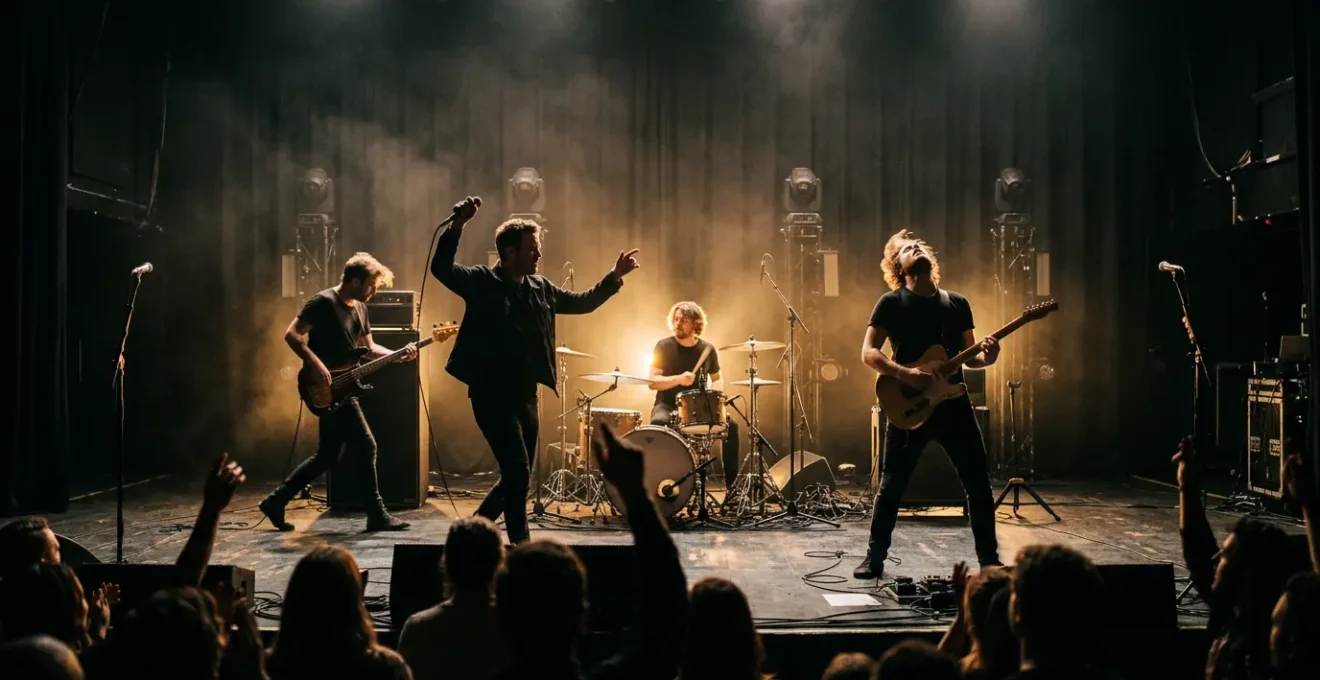
A tight live show is defined not by the songs, but by the seamless, engineered transitions that connect them.
- Non-verbal communication is your primary tool for on-stage direction and audience connection, far outweighing technical gear.
- Strategic setlist design and dynamic volume control are essential for managing audience energy and preventing listening fatigue.
Recommendation: Treat the silence between songs as part of the performance and choreograph it with the same intention as the music itself.
Your band just finished a blistering song. The energy is electric. But then… silence. The guitarist fumbles for their tuner, the bassist takes a long drink of water, and the drummer adjusts their throne. In those 30 seconds of dead air, the momentum you built evaporates. The audience checks their phones. This is the moment where amateur bands are separated from professional acts. For bands whose live sets feel disjointed, the common advice is to « practice more » or « write a better setlist, » but this misses the point entirely.
The problem isn’t the music. The problem is the negative space—the moments between the notes. The solution isn’t just about what you play; it’s about how you connect those pieces into a single, cohesive experience. True professionals understand that a live show is a form of theatre. It has a narrative arc, tension, and release. They don’t just perform songs; they perform a *show*. And that requires deliberate, non-verbal communication and stagecraft.
But what if the key to a killer live set wasn’t in adding more, but in mastering the transitions? This guide moves beyond the basics and into the realm of professional show production. We will dissect the common errors that kill momentum and provide you with a producer’s mindset to engineer a seamless performance. You will learn to treat the space between songs not as a liability, but as your greatest tool for keeping an audience completely hooked.
This article will break down the essential strategies for transforming your live set from a series of disconnected songs into an unforgettable, continuous performance. Explore the topics below to master the art of the transition and control your show’s narrative from start to finish.
Summary: A Producer’s Playbook for Seamless Live Show Transitions
- Why Eye Contact Is More Important Than Your Pedalboard During Jams?
- How to Play with Backing Tracks Without Looking Like Karaoke?
- Opener vs Closer: Which Song Placement Defines Your Show’s Success?
- The « Dead Air » Error That Kills Momentum When a String Breaks
- Problem & Solution: Switching to IEMs Without Feeling Isolated from the Crowd
- Why Your Best Ideas Are Getting Rejected by Your Bandmates?
- The « Full Volume » Error That Exhausts Your Audience’s Ears
- LP or EP: Which Format Is Best for Building a Fanbase Today?
Why Eye Contact Is More Important Than Your Pedalboard During Jams?
In the heat of a live performance, it’s tempting for musicians to retreat into their own world, focusing intently on their instruments or staring down at a complex array of pedals. This is a critical mistake. The truth is, your internal focus is irrelevant to the audience; your external communication is everything. On stage, you are not just a musician; you are a performer and a conductor. According to extensive research, nonverbal communication can account for 65 to 95 percent of all communication, and on a loud stage, that figure is even higher.
Eye contact is the primary tool for this non-verbal direction. It’s how the drummer knows to bring the dynamics down, how the bassist catches the cue for a stop, and how the frontman signals an extended solo. A quick glance and a nod are faster and more effective than any audible cue. When you’re staring at your pedalboard, you sever that connection. You become a passive participant waiting for your part, rather than an active driver of the performance. This lack of connection is what makes jams feel sloppy and transitions fall apart. The band isn’t a single unit, but a collection of individuals playing in the same room.
Mastering this requires shifting your mindset during rehearsal. It’s not just about learning the notes; it’s about learning the show choreography. Practice playing while looking up, making eye contact with your bandmates at key transition points. This builds a silent language that is invisible to the audience but is the very glue holding the show together. This is what allows for improvisation and a fluid performance that can adapt in real-time. Your pedalboard makes you sound good, but eye contact makes the *band* sound great.
Action Plan: Mastering On-Stage Non-Verbal Cues
- Map Your Movements: Identify key transitions in your set. Casually walk to another part of the stage or toward a bandmate to physically signal that a change in topic or energy is coming.
- Designate Cues: Assign clear, visible gestures. A straight-arm point toward a soloist or a specific piece of gear can direct both your band’s and the audience’s attention instantly.
- Practice for Clarity: Make your movements distinct and intentional. The goal is to create a clear visual signal that a transition is happening, focusing the audience on the moment itself.
- Film and Review: Record your rehearsals. Watch yourself to identify natural movements you already make and analyze how to enhance them for clear communication or eliminate distracting, unintentional habits.
- Integrate and Refine: Start by incorporating one or two non-verbal cues into your set. Once they feel natural, add more until your entire show is a seamless flow of musical and physical communication.
How to Play with Backing Tracks Without Looking Like Karaoke?
Backing tracks are a powerful tool for elevating a live show, adding layers and textures that are impossible to replicate with a small band. However, they carry a significant risk: if executed poorly, the performance can feel sterile, pre-recorded, and disengaging—the dreaded « karaoke » effect. The key to avoiding this is to ensure the tracks *support* the live performance, rather than define it. The audience came to see a living, breathing band, not to watch musicians play along to a recording.
The first rule is that the most important elements, especially the lead vocals and primary melodic instruments, must remain 100% live. This maintains the sense of immediacy and raw emotion that defines a great performance. Tracks should be reserved for atmospheric pads, auxiliary percussion, complex harmonies, or subtle synth layers that enrich the soundscape without overpowering the live musicians.
Case Study: BANKS’ Minimalist Backing Track Strategy
The artist BANKS provides a masterclass in this approach. Her live shows often use backing tracks consisting of minimally processed and layered background vocals. This technique brilliantly accentuates the instrumentation and adds atmospheric depth, but the star of the show remains her powerful, authentic lead vocal, performed entirely live. By keeping the primary performance genuine and emotionally present, she completely avoids the karaoke perception while still delivering the sonic richness of her studio recordings.
Furthermore, the band must maintain control over the tracks. Rather than being a slave to a pre-set timeline, a performer should be able to trigger sections, loops, and effects in real-time. This is where tools like foot controllers become essential performance instruments in their own right.
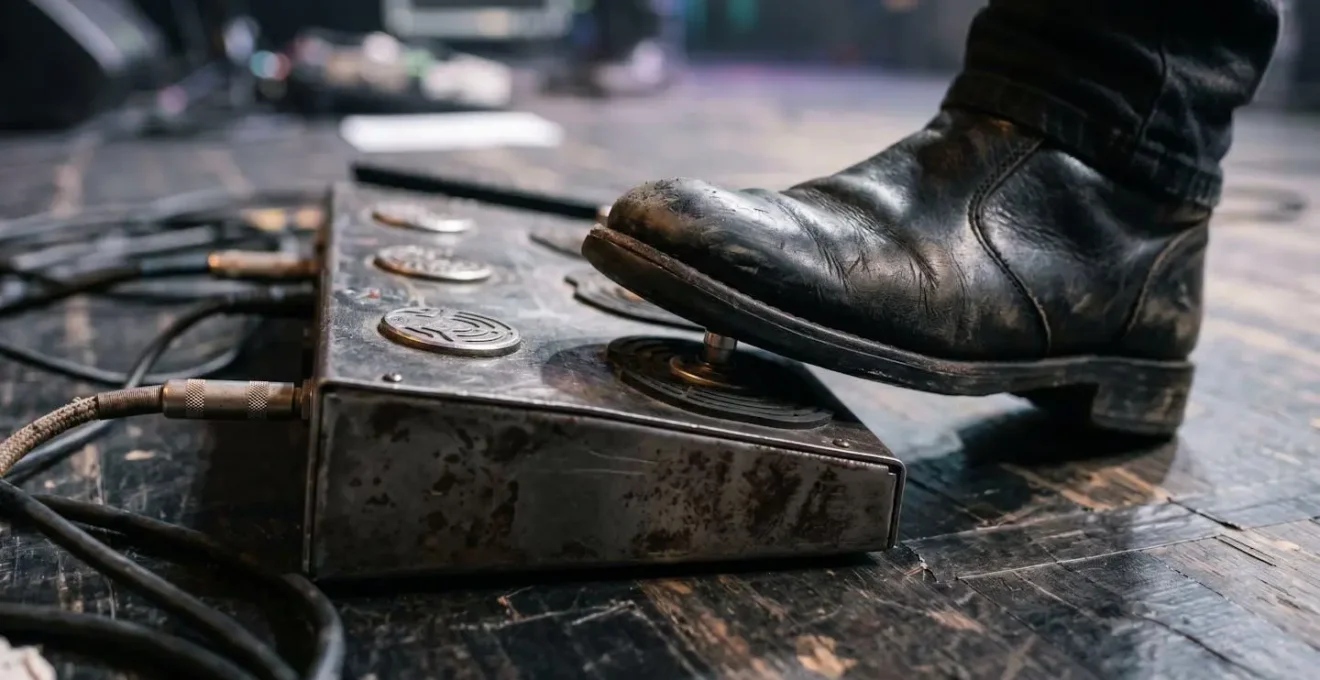
As shown above, a MIDI foot controller allows a musician to interact with the backing tracks dynamically. It transforms a passive act of playing along into an active performance of managing the show’s electronic elements. This engineered momentum, where the band is visibly in command of every sound, is what convinces an audience that they are witnessing a unique, live event, not a recitation.
Opener vs Closer: Which Song Placement Defines Your Show’s Success?
A setlist is not just a list of songs; it is the narrative arc of your show. The order in which you present your music has a profound psychological impact on the audience, and no two songs are more critical than your opener and your closer. These two moments disproportionately define the audience’s entire memory of your performance, a phenomenon well-documented in psychological research.
As Nobel laureate Daniel Kahneman and his colleague Barbara Fredrickson established, human memory is deeply flawed when it comes to judging experiences. We don’t average our feelings over time; instead, our memory is powerfully biased by two key moments.
The peak-end rule suggests that people judge an experience mainly by how they feel at its most intense point (the peak) and its end.
– Daniel Kahneman and Barbara Fredrickson, Peak-End Rule Psychology Research
For a live show, the « peak » is your most explosive, high-energy moment, but the « end » is entirely within your control. Your opener sets the initial impression. It must grab the audience immediately, establishing your sound, your energy, and your professionalism within the first three minutes. A weak, slow, or sloppy opener creates a deficit of engagement that you’ll have to fight to win back all night. Conversely, a powerful, tight opener creates instant momentum.
The closer is the final taste you leave in their mouths. It’s the last thing they will remember. This song should be anthemic, memorable, and leave the audience on a high, wanting more. It solidifies their positive memory of the show. Even if there was a lull in the middle of the set, a killer closer can retroactively elevate the entire experience in their minds. Professional bands understand this intuitively; an analysis of thousands of concerts reveals that legendary acts like Iron Maiden have an incredibly consistent setlist structure, proving they are not leaving this crucial element to chance.
The « Dead Air » Error That Kills Momentum When a String Breaks
It’s the moment every band dreads: the song ends with a crash, and then the guitarist’s face drops. A string has snapped. The show grinds to a halt. What follows is often 90 seconds of awkward silence, punctuated by the frantic sounds of string winding and nervous apologies. This is « dead air, » and it is the single fastest way to destroy the energy you’ve spent the entire show building. From a producer’s perspective, a technical difficulty is not a disaster—it’s a predictable event. The real error is not having a plan for it.
The solution is what we call dead air conversion: turning an unplanned stop into an intentional, engaging moment. This requires pre-planned strategies, or « emergency plays, » that can be deployed instantly to fill the silence and maintain audience connection. The goal is to make the audience feel like this moment, too, is part of the show. Instead of watching a problem being fixed, they are being entertained. This transforms a moment of weakness into a demonstration of professionalism and charisma.
These are not complex solutions; they are simple, rehearsed routines that the entire band knows. The frontman might have a specific story ready to tell, or the rhythm section might be prepared to drop into a funky, improvisational groove. The key is that it must be immediate and confident. Hesitation is what signals to the audience that something has gone wrong. A confident transition, even into something as simple as a drum solo, communicates control.
Here are several proven « emergency plays » to add to your production playbook. Rehearse them until they feel natural:
- The Groove Handoff: The rhythm section immediately launches into the groove of the next song. The frontman then uses body language and gestures to « feature » each remaining member with a short solo or a moment to make some noise, directing the audience’s focus away from the technical issue.
- The Rehearsed Banter: Use a pre-planned, entertaining skit or a funny story that seamlessly leads into the opening lyric or theme of the next song. This scripted banter provides perfect cover for a guitarist to switch instruments or make a quick repair.
- The Audience Sing-Along: The singer can use the time to « teach » the audience a simple vocal part from an upcoming chorus. By engaging them directly and running through it a few times, you transform downtime into a moment of connection and build anticipation for the song.
- The Hometown Story: Every band should have a few short, genuine stories about their experiences in that specific city or venue. Sharing a fond memory while technical adjustments are made creates a personal connection and shows appreciation for the local audience.
Problem & Solution: Switching to IEMs Without Feeling Isolated from the Crowd
In-ear monitors (IEMs) are a game-changer for professional musicians. They provide a crystal-clear monitor mix, protect hearing, and eliminate stage feedback. But they come with a significant downside: isolation. By sealing the ear canal, custom-fit in-ear monitors can provide 25 to 34 decibels of noise reduction. This is great for hearing your bandmates, but it completely cuts you off from the energy and sound of the room. You can’t hear the crowd singing along, you can’t feel the room’s natural reverb, and you lose the crucial sense of connection that fuels a great performance.
This « bubble » effect is a common complaint and can make a performer feel detached and unable to react to the audience’s energy. The solution is not to abandon IEMs, but to strategically bring the sound of the audience *into* your monitor mix. This is achieved by using ambient microphones—mics that are set up not to capture the band, but to capture the room and the crowd.
This setup, as visualized below, bridges the gap between the performer’s isolated sound world and the live energy of the venue, creating a more immersive and responsive experience.

Simply placing one mic on stage isn’t enough; it often leads to a muddy, confusing mono signal. The professional solution involves a more deliberate stereo placement technique to recreate a natural listening experience.
Solution: Stereo Ambient Mic Placement for Stage Connection
The most effective method for maintaining crowd connection with IEMs is to place two condenser microphones on the left and right edges of the stage, pointing out toward the audience. This setup captures a stereo image of the crowd and the room’s ambience. This signal is then fed into the IEM mixes. By panning these ambient mics hard left and right in your ears, you can recreate the natural sense of space you would have without IEMs. You can hear which side of the crowd is cheering, feel the natural reverb of the hall, and react in real-time to the audience’s energy, all without compromising the clarity of your band mix.
Why Your Best Ideas Are Getting Rejected by Your Bandmates?
You’ve designed a brilliant, seamless transition. It’s musically clever and will keep the audience hooked. You present it to the band, and… it’s met with blank stares or immediate resistance. The drummer thinks it’s too complicated, the bassist is worried about missing their cue, and the singer doesn’t want another thing to think about. Why do your best ideas for tightening the show get shot down? It’s rarely because the idea is bad. It’s because you failed to sell it.
As one production guide notes, « Bandmates often reject complex transition ideas because they can’t visualize adding another task during a performance. » The key word here is visualize. In their minds, they are already juggling their instrument, their performance, and their cues. When you propose a « complex » new transition, they don’t hear « seamless audience engagement »; they hear « one more chance to screw up. » Your job as the « producer » of the band is not to dictate, but to make the new idea feel simple, low-risk, and obviously beneficial.
First, never introduce a new transition idea as a complex theoretical concept. Demo, don’t just describe. Play a rough recording of how it will sound. Even better, simplify it to its core components. Show the drummer how their part just needs to shift slightly, or how the bassist’s line naturally leads into the next song. Break it down into individual, manageable tasks instead of presenting it as a monolithic challenge.
Second, frame it in terms of a problem they all recognize. Don’t say, « I have an idea for a new transition. » Say, « You know that awkward pause after ‘Rebel Song’ where we all just stand there? I have a simple way to fix it. » By anchoring the solution to a shared pain point, you generate buy-in before you even explain the mechanics. Make it their idea, their solution. When the band feels ownership over the show choreography, they are far more likely to execute it with enthusiasm and precision.
The « Full Volume » Error That Exhausts Your Audience’s Ears
Many bands operate under the mistaken belief that « louder is better. » They push the volume to the max from the first song to the last, thinking it equates to high energy. This is a critical production error that leads to auditory fatigue. The human ear is not designed to handle sustained high volume. When bombarded with constant loudness, it naturally starts to compress what it hears, losing the ability to perceive detail and nuance. After three songs at full blast, your intricate guitar solo and the singer’s subtle dynamics are lost in a wall of noise. The audience isn’t energized; their ears are exhausted.
The real secret to creating powerful, impactful moments is not volume, but dynamics. It’s the contrast between loud and quiet that creates excitement and emotional depth. A quiet, sparse verse makes a loud, explosive chorus feel monumental. A transition that drops to near-silence makes the start of the next song feel like a cannon blast. Without these valleys, the peaks have no meaning.
As a producer, you must think of your set’s volume as another instrument to be played. You are managing the audience’s listening capacity. By using dynamic arrangements and deliberately quiet moments, you give their ears a chance to reset, making them more receptive to the powerful moments when you choose to unleash them. The following table illustrates how different approaches to volume affect not just the measurable sound pressure level (SPL), but the audience’s actual perceived experience.
| Technique | Actual Volume (SPL) | Perceived Impact | Audience Fatigue |
|---|---|---|---|
| Full volume throughout set | Consistently high (95-105 dB) | Initial excitement, declining engagement | High – ears compress, detail lost |
| Dynamic arrangement (single instrument focus) | Moderate (75-85 dB) | Feels big and exciting through contrast | Low – ears remain receptive |
| Deliberate quiet transitions | Low to moderate (65-80 dB) | Makes following song exponentially more powerful | Very low – creates anticipation |
| Frequency-specific emphasis | Moderate overall, targeted peaks | Perceived as louder without physical volume increase | Low – specific frequency ranges engaged |
As this comparative audio analysis demonstrates, techniques that use lower actual volume often have a higher perceived impact and dramatically lower audience fatigue. By embracing dynamics, you keep the audience engaged and physically able to appreciate your entire performance, not just the first 15 minutes.
Key Takeaways
- Non-Verbal Cues Are Your Stage Language: Eye contact and physical movement are faster and more effective for on-stage direction than any gear or verbal cue.
- The Setlist Is a Narrative: Use the « peak-end rule » to your advantage by crafting a powerful opener and a memorable closer to define the audience’s entire experience.
- Dynamics Are More Powerful Than Volume: Constant loudness leads to auditory fatigue. Use contrast between loud and quiet moments to create real impact and maintain audience engagement throughout the set.
LP or EP: Which Format Is Best for Building a Fanbase Today?
The debate between releasing a full-length album (LP) versus a shorter extended play (EP) is often framed around marketing, streaming algorithms, and fan attention spans. While these are valid points, a savvy producer knows the choice of release format has a direct and profound impact on the design of your live show. The format you release dictates the story you can tell on stage and sets audience expectations before they even walk in the door.
An LP, with its 10-12 tracks, implies a longer, more varied performance. It allows for a traditional narrative arc with ebbs and flows, quieter moments, and deep cuts. However, it also presents a challenge: maintaining high energy and seamless transitions over a 60-90 minute set is incredibly difficult. An EP, by contrast, suggests a shorter, more potent experience. It’s a concentrated blast of your best material, designed for maximum impact with no filler. This format naturally lends itself to a tighter, more meticulously choreographed live show where every moment is engineered for engagement.
In today’s attention economy, the EP-as-live-show model is proving incredibly effective, even at the highest levels of the industry. It allows an artist to present a perfectly polished, high-impact narrative that leaves no room for dead air or flagging momentum.
Case Study: Drake’s EP-Style Arena Tour
Drake’s recent global tours sold out massive arenas using a structure that mimics an EP-style performance, often without a traditional live band. His shows are constructed as seamless, 20-minute continuous sections of his biggest hits, flowing one into the next with no breaks. This approach, heavily reliant on backing tracks, demonstrates how release strategy informs live structure. It manages audience expectations for a high-octane, non-stop experience and creates a tightly controlled narrative that keeps engagement at its peak. It’s not a traditional concert; it’s a 90-minute highlight reel, and it’s incredibly effective.
This doesn’t mean the LP is dead. It simply means you must be intentional. If you release an LP, your live show must justify its length with a compelling, dynamic journey. If you release an EP, your show must deliver on the promise of a short, powerful, and flawless performance. Your release format is the first piece of your show choreography, setting the stage for the story you will tell live.
Start applying this producer’s mindset to your own rehearsals. Stop just playing the songs and start choreographing the show. Film your set, identify the dead air, and engineer creative solutions to fill it. Transform your live performance from a simple recitation of songs into a seamless, unforgettable experience.