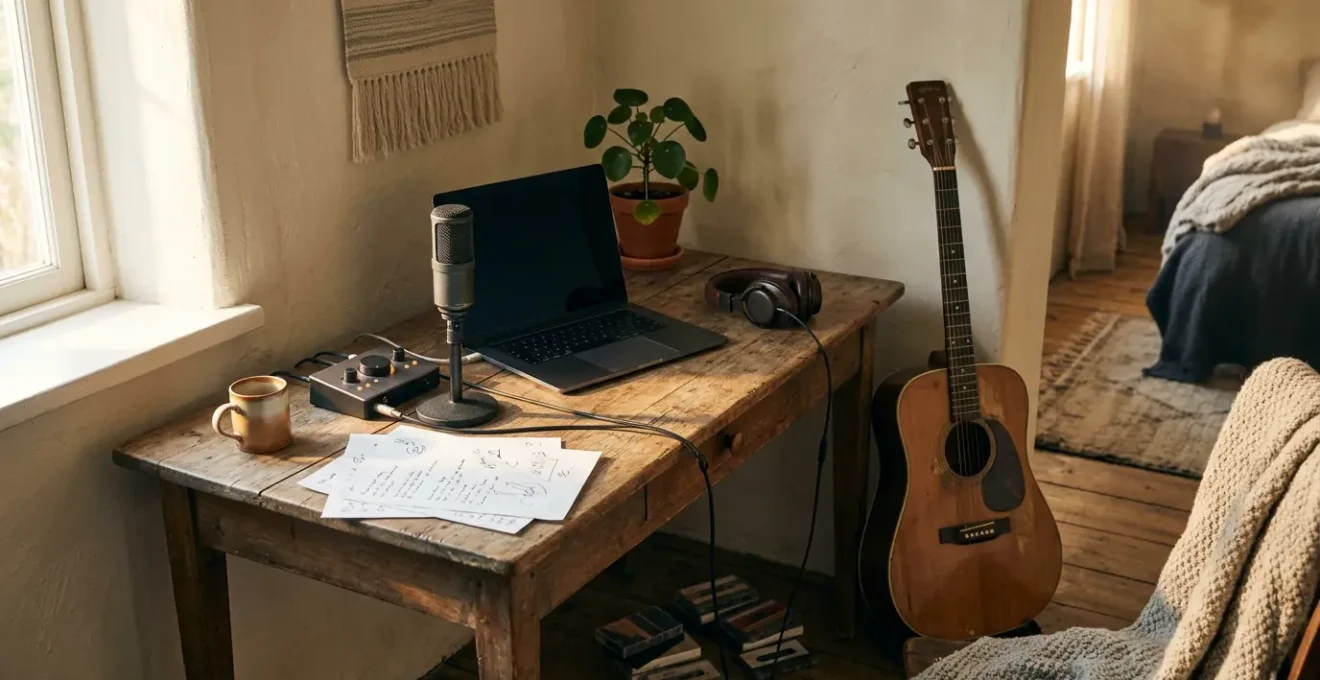
The difference between an amateur lo-fi track and an authentic bedroom pop hit isn’t cheap gear; it’s mastering the art of intentional imperfection.
- Authentic « warmth » comes from curating specific analog artifacts like tape saturation and pitch warble, not random noise.
- Intimacy is created through minimalist arrangements and close-mic vocal techniques that give every sound psychoacoustic space.
Recommendation: Stop trying to « fix » your mix and start curating your « flaws » to build a unique sonic fingerprint that defines your artistic brand.
You’ve spent hours in your DAW, layering dreamy synth pads and a laid-back beat. You’re chasing that elusive vibe—the sun-drenched, nostalgic sound of artists like Clairo, beabadoobee, or early Mac DeMarco. You know the aesthetic. It feels effortless, authentic, and intimate. Yet, when you play back your track, it doesn’t sound « lo-fi cool, » it just sounds… amateur. It’s a common frustration for producers drawn to the bedroom pop genre. The internet is full of simplistic advice: « use a cheap mic, » « slap on a vinyl crackle sample, » or « just add more reverb. » But following these steps often leads to a muddy, indistinct mix that lacks the professional polish disguised as imperfection.
The truth is, the celebrated bedroom pop aesthetic isn’t an accident. It’s a carefully constructed sonic world built on deliberate choices. The key isn’t about having low-quality equipment, but about understanding how to introduce specific, controlled flaws that create a feeling of warmth and nostalgia. This is the principle of intentional imperfection. It’s the difference between a random mic bump and the gentle, rhythmic hiss of a cassette tape bed. It’s about curating a sonic fingerprint that feels personal and real, not just poorly recorded. This guide will move beyond the generic tips and break down the specific production techniques that separate the pros from the pretenders. We will explore how to use analog emulation, shape intimate vocals, arrange with minimalism, and subvert pop structures to finally achieve that authentic bedroom pop sound.
In this guide, we’ll deconstruct the core components of the bedroom pop aesthetic, providing actionable steps to elevate your productions from amateur to authentic. The following sections offer a roadmap to mastering this unique sound.
Summary: A Producer’s Guide to the Bedroom Pop Aesthetic
- Why Cassette Emulation Is Essential for Warm Indie Textures?
- Whisper or Belt: How to Record Intimate Vocals That Sit Up Front?
- Less is More: Why Stripping Back Layers Creates a Bigger Indie Sound?
- The Drum Machine Mistake That Kills the Organic Vibe
- Chorus and Reverb: Finding the Balance for Dreamy Guitar Lines
- Why « Analog Warmth » Is Often Just Nice Distortion and Roll-Off?
- Generalist or Specialist: Why Trying to Please Everyone Kills Your Brand?
- What Structural Secret Do 80% of Top 40 Hits Share?
Why Cassette Emulation Is Essential for Warm Indie Textures?
The core of the bedroom pop sound isn’t just « lo-fi, » it’s a specific flavor of nostalgia, and nothing encapsulates that better than the sound of a cassette tape. Simply adding a generic « vinyl crackle » sample misses the point. The magic of tape lies in its unique combination of artifacts: saturation, pitch instability (wow and flutter), and noise. Modern cassette emulation plugins are not about degrading your audio; they’re about imparting a very specific character. This character comes from the way tape gently compresses transients and adds pleasing musical distortion. In fact, audio engineering research shows that tape saturation introduces musically related 2nd and 3rd order harmonics, which our ears perceive as richness and warmth, not harshness.
This process is about curating a « textural bed » for your track to sit in. The subtle hiss isn’t a flaw to be gated out; it’s the sonic glue that fills the negative space in a minimalist arrangement, enhancing the feeling of intimacy. Likewise, the gentle, unpredictable pitch variations from « wow and flutter » make static synth pads and rigid drum machines feel alive and organic. Choosing the right « tape type » in a plugin can dramatically shape your tone: Type I offers classic, warm saturation, while Type II can bring out a bit more high-frequency detail. Mastering these tools is a crucial first step in achieving an authentically vintage sound, turning a clean digital signal into something with history and personality.
- Select your cassette type: Choose Type I ferric-oxide for standard warmth, Type II chromium dioxide for enhanced high-frequency response, or Type IV metal-formulated for a firmer bass.
- Adjust wow and flutter: Introduce subtle pitch and volume fluctuations to replicate analog tape transport imperfections and add movement.
- Add tape hiss: Use hiss and asperity noise as a textural ‘auditory bed’ that fills gaps and creates an intimate atmosphere.
- Control saturation: Dial in saturation to achieve frequency-dependent soft clipping and natural, gluey compression.
- Fine-tune artifacts: Use dropout and crosstalk parameters sparingly for added analog character without overwhelming the mix.
Whisper or Belt: How to Record Intimate Vocals That Sit Up Front?
In bedroom pop, the vocal isn’t just another layer; it’s the emotional centerpiece. The goal is a vocal that sounds like it’s being whispered directly into the listener’s ear—present, personal, and vulnerable. This isn’t achieved with a cheap microphone, but with a specific technique called close-miking. By singing quietly and closely (a few inches) into a decent condenser microphone, you trigger a phenomenon known as the « proximity effect. » This physics-based principle naturally boosts the low-end frequencies of the signal. Studies on close-mic recording techniques show an up to 6 dB boost below 200 Hz, which gives the voice a warm, rich, and intimate quality without needing excessive EQ.
This technique requires control. Singing too loudly this close will result in harsh clipping and a boomy, muddy sound. The art is in the performance—a restrained, breathy delivery that leverages the proximity effect for warmth, not volume. This creates a powerful dynamic where the quietest element in the mix feels the most prominent. It’s a technique that prioritizes emotional connection over raw power. The subtle sounds of breath and lip movements, often edited out in polished pop, become part of the authentic texture.

As you can see, the relationship between the vocalist and the microphone is paramount. This proximity is what creates that signature confidential tone, turning the recording process into an extension of the intimate songwriting itself. Mastering this balance is a hallmark of the genre.
Case Study: Frank Sinatra’s Microphone Technique for Intimate Vocals
Frank Sinatra demonstrated masterful control of the proximity effect by moving closer to the microphone during quieter, intimate passages to enhance warmth, then pulling back during louder sections to maintain balanced frequency response. This dynamic technique allowed him to create emotionally compelling performances that leveraged the bass boost of close-miking without muddiness, establishing a blueprint for intimate vocal recording that remains influential in bedroom pop production today.
Less is More: Why Stripping Back Layers Creates a Bigger Indie Sound?
A common mistake producers make when trying to create a « big » sound is to add more and more layers. More synth pads, more guitar overdubs, more percussion. In reality, this often leads to a crowded, muddy mix where nothing has space to shine. The secret to the expansive, dreamy sound of many bedroom pop hits is radical minimalism. By stripping the arrangement back to its essential components—typically a core beat, a bassline, a single harmonic instrument, and the vocal—you create what is known as psychoacoustic space. Each sound has room to breathe, and its individual texture and detail become more apparent to the listener. This is why a simple, clean guitar line in a minimalist track can feel more impactful than a wall of guitars in a dense rock mix.
This « less is more » philosophy is supported by cognitive science. As IQSounds Production Research notes in « Mastering the Art of Minimalism in Music Production, » humans have a limited capacity for processing simultaneous information. They state that most people can only comfortably track up to three distinct melodic lines at once. By keeping your arrangement sparse, you allow the listener to focus on the key emotional elements: the vocal melody and the main instrumental hook. This approach forces you to be more creative and intentional with each sound you choose. Instead of adding another synth, you might focus on making the existing one more interesting with modulation or saturation. It’s a discipline that trades density for clarity and impact.
Case Study: Billie Eilish and Minimalist Production Success
Billie Eilish and producer FINNEAS exemplify minimalist bedroom pop production by focusing arrangements around a prominent bassline and intimate vocals, often using fewer than ten tracks to create expansive sonic landscapes. Their approach demonstrates that stripping away unnecessary elements allows each remaining sound to occupy more psychoacoustic space, resulting in mixes that feel both huge and intimate—a signature of successful bedroom pop that proves less is genuinely more.
The Drum Machine Mistake That Kills the Organic Vibe
Nothing screams « amateur » louder than a perfectly quantized, robotic drum machine beat. While drum machines like the Roland TR-808 are staples of the genre, the mistake is leaving them perfectly on the grid with uniform velocity. The organic, laid-back « vibe » of bedroom pop comes from emulating the subtle imperfections of a human drummer. This process is called humanization, and it revolves around two key concepts: micro-timing and velocity variation. A real drummer never hits the snare or hi-hat at the exact same volume or at the precise millisecond every single time. Replicating this is essential for a groove that feels alive.
Start by programming your basic beat. Then, go in and manually nudge individual hits. Shifting a snare a few milliseconds *behind* the beat creates a « laid-back » or « dragged » feel, while shifting it slightly *ahead* creates a « pushed » or urgent feel. Professional producers often apply timing variations of 5 to 20 milliseconds to achieve this. Next, adjust the velocity (how hard the note is hit) of each drum. Hi-hats, in particular, benefit from this; no two hits should have the exact same volume. This creates a dynamic, breathing rhythm instead of a static loop. To take it a step further, layer in organic foley sounds—a soft pillow thump under the kick, a jangle of keys under the hi-hats—at a very low volume. These non-musical textures add a tactile, non-replicable character that tricks the brain into perceiving the whole beat as more organic.
- Program your basic drum pattern with consistent velocities on the grid as your foundation.
- Manually nudge snare hits and hi-hats 5-20 milliseconds ahead of or behind the beat to create a human ‘laid-back’ or ‘pushed’ feel.
- Vary velocity on individual drum hits by 5-15% to simulate natural drummer inconsistency—hi-hats benefit most from this.
- Layer organic foley sounds (pillow thumps under kicks, key rattles under hi-hats) at low volume to add tactile character.
- Apply targeted micro-timing to create groove relationships; if hi-hats are busy, allow snares to be slightly less precise.
Chorus and Reverb: Finding the Balance for Dreamy Guitar Lines
The washy, shimmering guitar is a cornerstone of the bedroom pop sound. This is typically achieved with a combination of chorus and reverb. However, the amateur mistake is to simply drown the guitar in both effects, resulting in a muddy, undefined sound that gets lost in the mix. The professional approach is about creating a sense of space and movement while maintaining clarity. Chorus provides the movement, creating a sense of width and gentle detuning that makes the guitar sound « thicker. » Reverb provides the space, placing the guitar in a virtual room or hall. The key is balance and order.
A powerful technique for achieving a dreamy-yet-clear sound is sidechain ducking the reverb. Instead of putting the reverb directly on the guitar track, you send the guitar signal to a separate auxiliary track with the reverb. Then, you place a compressor on that reverb track and set its sidechain input to listen to the *dry* guitar signal. This way, the reverb’s volume is « ducked » or lowered whenever the guitar is playing, and it swells back up in the silent spaces between notes. The result is a beautiful, ethereal tail of reverb that creates atmosphere without washing out the clarity of the original guitar line. The order of your effects also has a massive impact on the final texture.
This table compares how changing the order of your effects can drastically alter your guitar’s character, a crucial consideration for sonic curation.
| Effect Chain Order | Sonic Result | Best Use Case |
|---|---|---|
| Distortion → Reverb → Chorus | Controlled, classic texture with lush spatial depth | Dreamy bedroom pop guitar, intimate lead lines |
| Reverb → Distortion → Chorus | Chaotic, explosive, heavily textured sound | Experimental shoegaze walls of sound |
| Chorus → Distortion → Reverb | Warm saturation with spatial dimension, modulation subtly present | Indie rock rhythm guitars, fuller arrangements |
| Chorus → Reverb (100% wet, freeze) → EQ | Reverb tail becomes synthesizer-like pad matching guitar harmony | Ethereal textures, ambient interludes |
Why « Analog Warmth » Is Often Just Nice Distortion and Roll-Off?
« Analog warmth » is one of the most chased-after but misunderstood qualities in music production. Many aspiring producers believe it’s a mystical property of vintage hardware that is impossible to achieve « in the box. » In reality, what we perceive as « warmth » is a combination of three distinct, replicable artifacts: harmonic saturation, gentle transient shaping, and specific frequency roll-offs. It’s not magic; it’s physics. When an analog signal (like one going to tape or through a tube amp) is pushed, it doesn’t clip harshly like a digital signal. Instead, it begins to softly distort, adding musical harmonics that enrich the sound. This is saturation.
Simultaneously, this process naturally compresses the signal, softening the sharp attack of transients (like the initial « snap » of a snare drum). This gentle compression acts as a « glue, » helping different elements in a mix cohere. Finally, analog gear has physical limitations; it can’t reproduce the highest and lowest frequencies with perfect fidelity. A classic characteristic of tape, for instance, is a natural roll-off of high frequencies (often above 10-15kHz) and a slight « head bump » or boost in the low-mids. These three elements—saturation, compression, and EQ shaping—are the pillars of analog warmth. As the iZotope Audio Engineering Team puts it, « Tape saturation is not about a perfect sound; it’s about a specific, desirable imperfection. » By understanding this, you can stop chasing a ghost and start using modern saturation, compression, and EQ plugins to deliberately create that coveted warmth in your digital productions.
- Harmonic Saturation: Apply subtle tape or tube saturation to add even-order (2nd) and odd-order (3rd) harmonics that enrich the frequency spectrum.
- Transient Shaping: Use the gentle compression inherent in tape/tube emulation to soften harsh transients and « glue » sounds together.
- Frequency Shaping: Implement characteristic EQ changes—a slight boost in the low-mids (200-400Hz) and a gentle roll-off of highs above 10kHz to replicate analog frequency response.
Generalist or Specialist: Why Trying to Please Everyone Kills Your Brand?
In the early stages, it’s tempting to want your music to appeal to everyone. You might try to smooth out the « weird » parts of your mix, quantize your drums perfectly, and autotune your vocals to sound like a polished Top 40 hit. This is a trap. The very essence of bedroom pop’s appeal is its specificity and authenticity. By trying to be a generalist, you dilute your sound until it becomes generic and forgettable. The most successful artists in this space are specialists. They don’t run from their sonic quirks; they lean into them until those quirks become their signature. That slight tape warble, the boxy-sounding snare, the breathy vocal—these aren’t flaws to be fixed. They are the building blocks of a unique artistic identity, a sonic fingerprint.
Your goal is not to sound like a flawless, radio-ready production. Your goal is to create a sound that is recognizably *yours*. This means embracing your « signature flaw. » Find one element of your production process that feels unique and authentic to you and feature it consistently. This is how you build a brand. Listeners connect with the personality in the music, and that personality is found in the imperfections. Trying to please everyone by sanding down your edges ultimately pleases no one and alienates the core audience that is looking for something genuine and different.
Case Study: Clairo and beabadoobee: Building Specialist Sonic Brands
Artists like Clairo and beabadoobee gained widespread recognition by cultivating highly specific sonic palettes early in their careers—embracing lo-fi imperfections like tape hiss, pitch warble, and quiet vocals as brand identity rather than flaws to fix. Their initial seemingly amateur recordings, distributed virally on YouTube and SoundCloud, became the foundation of specialist brands that resonated deeply with bedroom pop audiences. This sonic consistency allowed them to evolve their production quality over time without losing their authentic identity, proving that embracing a narrow aesthetic niche creates stronger artist branding than attempting polished, generic appeal.
Your Action Plan: Develop Your Signature Flaw
- Identify: Pinpoint one « imperfection » in your process that feels authentic (e.g., a specific cassette plugin, a guitar pedal on vocals, a boxy snare sound).
- Feature: Use this chosen element consistently across multiple tracks as a signature sonic marker.
- Embrace: Treat textural elements like room noise, clipped breaths, and tape warble as markers of authenticity, not defects.
- Resist: Avoid the temptation to « fix » these traits to sound like polished Top 40 tracks; this alienates your core audience.
- Define: Let this signature sound become your calling card, turning a perceived weakness into a memorable strength that defines your artist brand.
Key Takeaways
- The bedroom pop aesthetic is built on intentional imperfection, not low-quality gear.
- Minimalist arrangements create psychoacoustic space, making each element sound bigger and more intimate.
- Your unique sonic fingerprint—built from curated « flaws » like tape hiss, saturation, and micro-timing—is your most valuable asset.
What Structural Secret Do 80% of Top 40 Hits Share?
The vast majority of Top 40 hits follow a predictable and highly effective structure: Verse-Chorus-Verse-Chorus-Bridge-Chorus. This formula is designed for maximum catchiness and radio-friendliness. The secret of bedroom pop isn’t ignoring this structure out of ignorance, but knowing it in order to subvert it intentionally. This subversion is a powerful tool for reinforcing the genre’s intimate, diary-like aesthetic. It signals to the listener that this isn’t a product manufactured for mass consumption; it’s a personal statement. As Music Production Analysis points out, « The difference between ‘amateur’ and ‘artist’ in Bedroom Pop is knowing the structure in order to subvert it intentionally, not out of ignorance. »
For example, in an era of shrinking attention spans, where research analyzing Spotify listening data revealed that 50% of listeners decide if they like a song within the first 30 seconds, many bedroom pop artists start with an instrumental hook or even the chorus. However, they might then defy expectation by only featuring that chorus once in the entire song, or by having it morph and change each time it appears. The bridge, often a simple transition in pop, can become the emotional centerpiece of a bedroom pop track, stretching out into an ambient outro. Endings are often abrupt, cutting to silence or fading into tape noise rather than building to a big final chorus. Each of these choices is a deliberate rejection of the commercial formula, which in turn strengthens the song’s authentic, unpolished vibe.
This table highlights the key differences between standard pop songwriting and how bedroom pop artists intentionally break the rules.
| Structural Element | Top 40 Standard | Bedroom Pop Subversion | Strategic Purpose |
|---|---|---|---|
| Opening | Intro → Verse | Chorus-first or instrumental hook | Capture attention in critical first 30 seconds |
| Chorus | Repeated 3-4 times, hook-heavy | Often absent or disguised; sometimes only once | Reject commercial formula for diary-like intimacy |
| Bridge | Contrasting section before final chorus | Becomes focal point or extends into ambient outro | Subvert expectation, create emotional weight |
| Ending | Energetic final chorus with ad-libs | Abrupt cut or fade into tape noise/silence | Enhance authentic, unpolished aesthetic |
| Production Quality | Polished, radio-ready hi-fi | Intentional lo-fi texture (tape hiss, pitch warble) | Create intimacy and ‘coolness’ through imperfection |
Ultimately, achieving the bedroom pop sound is an exercise in curation. It’s about consciously choosing your sonic palette and applying these techniques not as fixes, but as artistic statements. Start experimenting with these concepts, find the « flaws » that resonate with you, and begin building your own unique sonic brand.